

















Executive Summary
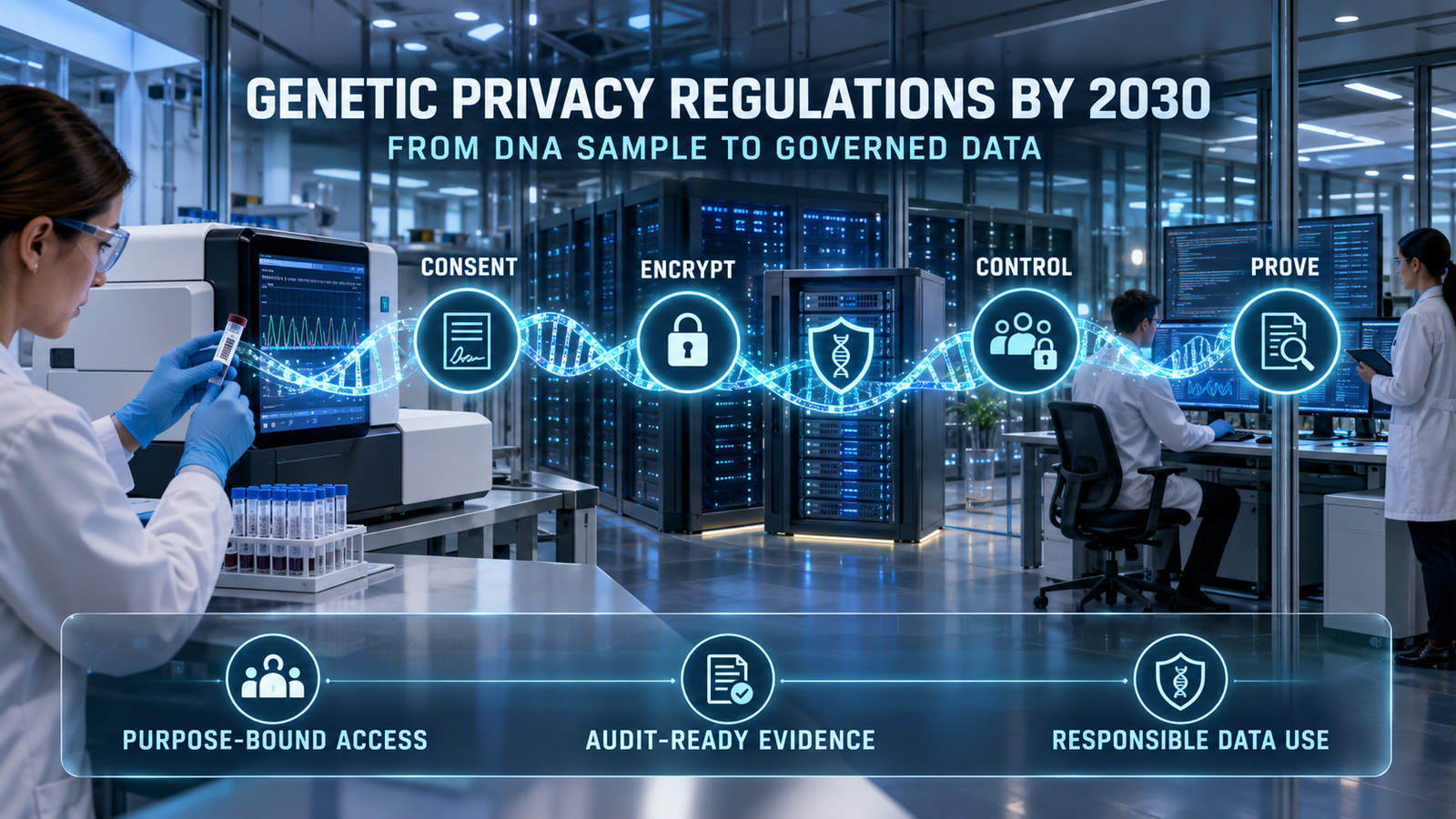
Genetic privacy regulations are becoming an enterprise architecture issue, not a clause that legal teams can solve after deployment. A sequence file can identify one person, reveal information about biological relatives, support new inferences years later, and remain sensitive long after passwords or payment cards would have been replaced.
That durability changes the investment case for genomic data security. Organizations need enforceable purpose limits, granular consent, lineage, retention controls, revocable access, and evidence that follows data through laboratories, cloud platforms, research environments, AI pipelines, and commercial partners.
The current legal baseline is fragmented, and healthcare data privacy laws do not form a universal shield. GINA restricts specified uses of genetic information in employment and health insurance, but does not cover life, disability, or long-term-care insurance; HIPAA protects genetic information only when the data and organization fall within its regulated ecosystem.[1][2]
Consumer testing, wellness applications, research collaborations, and data brokers may instead encounter Federal Trade Commission authority, the FTC Health Breach Notification Rule, state genetic-testing statutes, consumer-health laws, and broad state privacy acts. That overlap makes genetic data privacy compliance a product requirement, while international processing adds GDPR special-category rules and the European Health Data Space framework.[3][4]
No responsible publisher can state precisely what genetic privacy regulations will say in 2030. This Article therefore separates enacted requirements from evidence-based forecasts, and converts both into procurement, security, and governance decisions that can survive regulatory change.
The commercial takeaway is direct. Buy control-plane capability before buying another analytics interface, measure compliance by evidence rather than policy volume, and treat DNA data protection as a lifecycle discipline whose unit of control is an approved use—not merely a file.
Why Genomic Data Is Critical for AI in Healthcare
I. The Current Market Landscape and Challenge
One Genome, Several Legal Perimeters
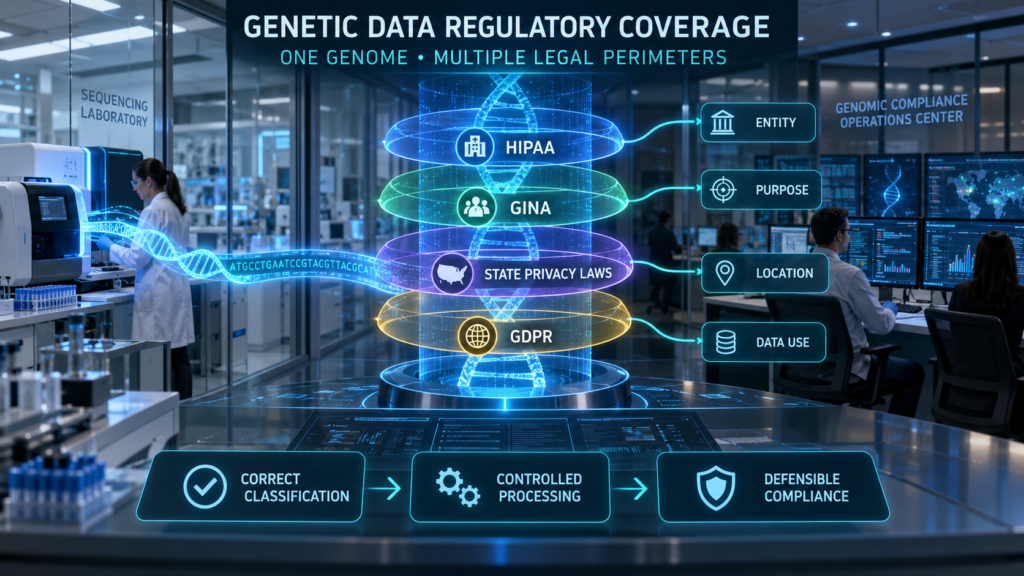
Classification depends on the organization, processing purpose and applicable law. A variant record may qualify as protected health information in a HIPAA-regulated setting, consumer health data under applicable state law, or genetic information subject to employment restrictions. Where GDPR applies, genetic personal data falls within its special-category protections. GDPR coverage must be assessed under its territorial-scope rules, rather than assumed solely from someone’s EU residence.[2][4][5]
Legal coverage follows actors, purposes, locations, contracts, and data flows. A single “HIPAA compliant” badge cannot answer whether a direct-to-consumer provider sold an insight, whether a research partner reused a cohort, or whether a cloud administrator exported a derived phenotype.
GINA is also narrower than many buyers assume. It prohibits covered employers from using genetic information in employment decisions and limits acquisition and disclosure, while its insurance title addresses health insurance rather than life, disability, or long-term-care products.[1][5]
HIPAA can protect genetic information as health information, but it does not regulate every laboratory, mobile application, genealogy platform, or analytics vendor that touches DNA. Genetic privacy regulations therefore require a coverage matrix rather than a single-regulation checklist.
State Rules Are Moving the Control Point
State laws increasingly focus on consent, disclosure, retention, deletion, sample destruction, and data sale. California’s Genetic Information Privacy Act, for example, imposes duties on direct-to-consumer genetic testing companies, including express consent mechanisms and security obligations.[6]
Washington’s My Health My Data Act illustrates a wider trend: consumer health data can receive protections outside the conventional HIPAA perimeter. The practical effect is that product telemetry, inferred health status, and third-party software development kits may matter as much as the laboratory report.[7]
This patchwork raises deployment cost because product teams must translate overlapping definitions into executable policies. A consent screen that is adequate for account creation may be inadequate for research, model training, relative matching, law-enforcement disclosure, or a later corporate transaction.
The Cost of Inaction
The cost is not limited to a statutory fine. Weak genetic data privacy compliance and genomic data security create breach response expense, contract disputes, delayed partnerships, research suspension, customer deletion work, engineering rework, and a trust deficit that can reduce sample participation.
The FTC’s action involving 1Health.io alleged failures involving DNA-data security and changes to privacy commitments, showing that published promises and actual controls must match.[8] The lesson is operational: an aspirational privacy notice can become evidence against the company if the system cannot enforce it.
Genomes also resist ordinary breach logic. Credentials can be rotated, but inherited sequence characteristics cannot; disclosure can affect relatives who never used the breached service, and future scientific advances can extract information that was not understood when the data was collected.
What to Expect by 2030—and What Not to Claim
The following items are planning forecasts, not statements of enacted 2030 law. They are based on current state statutes, FTC enforcement, GDPR doctrine, health-data initiatives, and the technical limits of de-identification.
One enacted timeline already extends beyond this planning horizon. The European Health Data Space Regulation entered into force on March 26, 2025, with phased application. Most secondary-use data categories enter application in March 2029, while the remaining categories, including genomic data, follow in March 2031. Organizations should distinguish these enacted milestones from forecasts about additional privacy legislation.[13]
By 2030, genetic privacy regulations are likely to demand more granular proof of purpose, stronger deletion and biological-sample destruction workflows, clearer secondary-use controls, and faster evidence production. Regulators are also likely to scrutinize derived data, AI-generated risk scores, and DNA data protection rather than focusing only on raw sequence files.
Rules may increasingly recognize the familial nature of genomic information. A consent model built around one account holder cannot fully represent the privacy interests created when matching, genealogy, or inherited-risk analysis reveals information about relatives.
Cross-border programs will probably move toward “compute to data” designs, federated analysis, controlled research environments, and policy-bound outputs. This will not eliminate transfer law, but it can reduce unnecessary replication and improve DNA data protection.
Congress may enact a comprehensive U.S. genetic or privacy statute before 2030, but that outcome is uncertain. Enterprises should avoid building a roadmap that depends on federal preemption, a single regulator, or a guaranteed expansion of GINA.
II. Deep-Dive Technical Analysis and Evidence
Architecture Overview for Genetic Privacy Regulations
A defensible architecture separates identity, consent, genomic objects, derived features, and analytical outputs. It then binds access decisions to subject, purpose, jurisdiction, protocol, environment, and time.

The minimum control plane contains:
- Identity and entitlement: workforce identity, researcher identity, service principals, just-in-time access, and privileged-session controls.
- Consent and purpose registry: approved uses, prohibited uses, withdrawal state, sample status, protocol version, and jurisdictional basis.
- Data catalog and lineage: raw reads, aligned files, variants, phenotypes, reports, embeddings, model features, exports, and downstream copies.
- Policy decision and enforcement: contextual authorization evaluated at query, job, export, and administrative boundaries.
- Key and secret management: separation of encrypted genomic objects, identifiers, keys, and re-identification tables.
- Evidence service: immutable events for consent, access, transformations, releases, deletion, exception approval, and vendor transfer.
- Retention orchestrator: deletion across primary storage, replicas, search indexes, caches, backups, model-development datasets, and biological samples.
Genomic data security fails when these systems disagree. A privacy portal may say consent was withdrawn while a data lake, feature store, notebook snapshot, or external research workspace continues to process the record.
Reference Integration Flowchart
Participant or patient → identity proofing → consent and purpose registry → sample accession → sequencing pipeline → encrypted genomic repository → policy decision point → approved clinical or research workspace → output review → audit evidence and retention action
Every arrow is a control boundary. Genetic data privacy compliance should record the governing purpose, data categories, recipient, jurisdiction, policy version, and result at each boundary rather than relying on a nightly access report.
Why “De-Identified Genome” Is a Dangerous Shortcut
A genome is rich in stable, distinguishing signals, which is why genomic data security cannot rely on name removal. Research has demonstrated surname inference from genomic data and identity inference through long-range familial searches, establishing that removal of names does not automatically make genomic records anonymous.[9][10]
Under GDPR, pseudonymized data remains personal data when it can be attributed to a person using additional information. The regulation requires identifiability to be assessed against means reasonably likely to be used, including available technology and cost.[4]
For genetic privacy regulations, pseudonymization is still valuable, but it is a risk-reduction control rather than a legal escape hatch. The re-identification key should sit in a separately administered domain with independent authorization, monitoring, and incident procedures.
Threat Model That Procurement Teams Should Demand
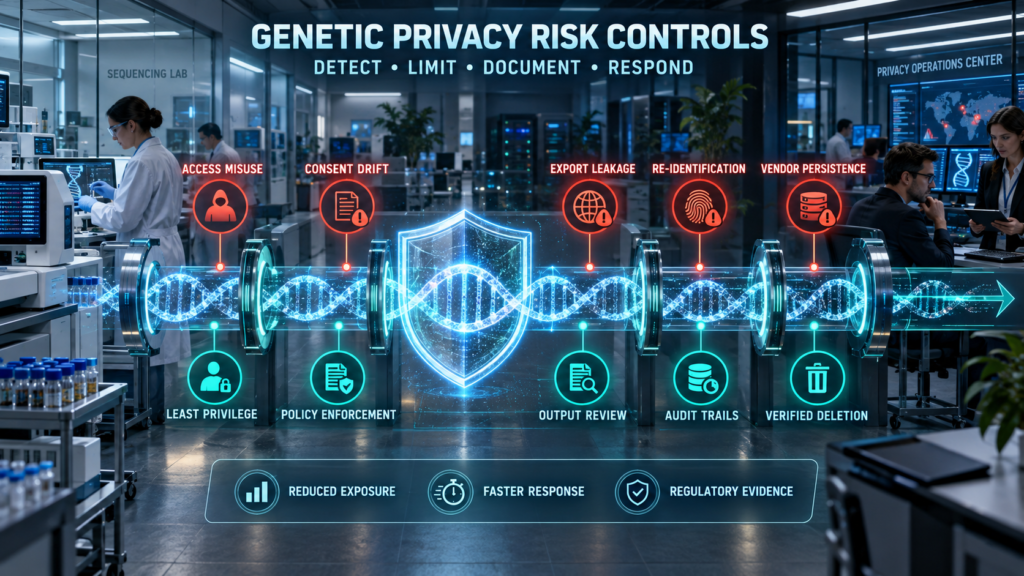
- Credential compromise: a researcher or service account is taken over and used for bulk queries.
- Privileged misuse: an administrator accesses sequence or phenotype data outside an approved purpose.
- Membership inference: an attacker determines whether a person contributed to a cohort or model.
- Familial inference: a relative is identified through matching or genealogy even without direct enrollment.
- Pipeline poisoning: a compromised image, package, notebook, or workflow alters results or exfiltrates data.
- Consent drift: a dataset is reused after withdrawal or beyond the protocol and notice under which it was collected.
- Export leakage: approved analysis produces row-level or small-cell output that permits re-identification.
- Vendor persistence: a processor retains copies in logs, backups, support systems, or model-training stores after termination.
This threat model should drive genomic data security acceptance tests. Generic penetration testing does not prove that purpose restrictions, cohort output rules, or consent withdrawal actually work.
Encryption, Tokenization, and Privacy-Enhancing Technologies
Encryption at rest and in transit is necessary but insufficient. It protects storage media and network paths, yet authorized applications normally decrypt data during computation, leaving policy, workload, output, and administrator risks.
Field-level encryption can isolate identifiers from genomic objects, while tokenization can reduce routine exposure. Envelope encryption with per-dataset or per-cohort keys improves revocation options, although key rotation over petabyte-scale archives can create significant compute and operational cost.
Trusted execution environments can reduce exposure during processing, but attestation, side-channel risk, memory constraints, and confidential-computing vendor dependencies require evaluation. Homomorphic encryption and secure multiparty computation can support selected analyses, yet latency, algorithm compatibility, and engineering overhead prevent universal deployment.
Differential privacy can reduce disclosure from aggregate releases, but genomic rarity makes utility-sensitive parameter selection difficult. A privacy budget is not meaningful unless the enterprise governs repeated queries and combines releases across systems.
Federated analysis reduces data movement, not all risk. Malicious updates, metadata, small cohorts, model inversion, and local security weaknesses remain, so DNA data protection must cover orchestration and outputs as well as source data.
Consent, Lineage, and Policy-as-Code
Static PDFs cannot operate modern genetic privacy regulations or satisfy scalable genetic data privacy compliance. Consent must be represented as machine-readable entitlements and prohibitions that can be evaluated against every job, export, and downstream use.
A workable record includes the consent text and version, signer identity, authority, timestamp, permitted purposes, recipient classes, geographic restrictions, expiration, withdrawal process, sample disposition, and rules for derived data. The organization also needs to preserve proof of what the participant actually saw.
Policy-as-code translates these attributes into repeatable decisions. It also introduces software risk: a mistaken rule can deny valid clinical work or authorize thousands of improper queries, so policy changes require version control, test fixtures, peer review, staged deployment, and rollback.
Lineage must extend beyond tables. Genetic data privacy compliance depends on connecting samples to sequences, sequences to variants, variants to phenotypes, phenotypes to features, features to models, and models to decisions or publications.
Withdrawal Is a Distributed Systems Problem
Withdrawal is rarely one delete command. Data may exist in object storage, warehouses, notebooks, queues, caches, disaster-recovery copies, SaaS platforms, signed reports, published studies, trained models, and physical specimens.
Assess each copy against the applicable withdrawal, erasure and retention requirements. Distinguish data that must be deleted from records that may lawfully be retained, and document any restrictions on further use. For backups, immutable records and previously disclosed outputs, define the permitted handling, access restrictions and deletion or expiry process. Technical immutability alone does not establish a legal exemption.[4]
Deployment Challenges That Budgets Often Miss
The first hidden cost is data discovery. Genomic objects use multiple formats and naming schemes, while derived features may appear as ordinary numeric columns that generic scanners cannot recognize.
The second is identity resolution. Patient, participant, sample, family, study, account, and billing identifiers may be inconsistent, so overconfident matching can delete the wrong record or leave the right record behind.
The third is scientific reproducibility. Strict minimization can conflict with validation, regulated recordkeeping, and research integrity, requiring documented retention exceptions rather than a blanket “delete everything” policy.
The fourth is latency. Fine-grained authorization on every query can slow large cohort studies, and output review can create queues; architects should measure policy-decision latency, cache behavior, failure mode, and emergency access rather than accepting a vendor’s average response time.
The fifth is organizational separation. Security, privacy, legal, research, laboratory, clinical, and product teams use different risk language, yet genetic privacy regulations require one shared control inventory and one accountable decision owner.
Performance Evaluation Matrix
| Control objective | Test method | Decision metric | Minimum evidence | Common failure |
| Purpose-bound access | Replay approved and prohibited requests | 100% expected decisions in test corpus | Policy version, attributes, result | Role-only access ignores purpose |
| Consent withdrawal | Trace one subject across all stores | Completion by documented service level | Per-system deletion or exception receipt | SaaS, cache, or backup omitted |
| Least privilege | Review dormant and excessive grants | Zero unowned privileged grants | Owner, expiry, approval | Permanent research access |
| Export control | Run small-cell and row-level attacks | Block or review defined high-risk outputs | Query, output, reviewer decision | Notebook bypasses gateway |
| Incident readiness | Tabletop sequence-data exfiltration | Notification clock and owner identified | Timeline, legal matrix, decisions | Team assumes HIPAA always applies |
| Vendor exit | Terminate a test dataset | Verified deletion and key revocation | Processor attestation plus telemetry | Contract says delete; logs persist |
| Policy reliability | Load and failure-mode testing | Latency and availability meet workload SLO | Test results and rollback record | Authorization fails open |
| Re-identification resistance | Conduct motivated-attacker review | Residual risk accepted by named owner | Attack model and controls | “De-identified” used as proof |
These measures do not create a universal pass mark. They make genomic data security observable, allowing risk owners to compare capability with clinical urgency, research value, regulatory exposure, and cost.
III. Commercial Solutions and Best Practices
Feature and Cost Comparison Table
The products below illustrate different control-plane categories; inclusion is not an endorsement. Pricing and capabilities change, so buyers should validate current terms, regulated-data support, regional hosting, subprocessors, and deletion behavior during a proof of value.
| Solution | Primary role | Strongest buying case | Genetic-data gap to test | Cost model to verify |
| OneTrust | Privacy governance, assessments, consent, data mapping | Centralizing obligations and rights workflows across business units | Enforcement depth inside genomic pipelines and research workspaces | Usually custom quote; verify modules, records, integrations, and services |
| BigID | Data discovery, classification, inventory, privacy operations | Locating sensitive and derived data across heterogeneous repositories | Recognition of genomic formats, embeddings, variant data, and lineage quality | Usually custom quote; verify data volume, connectors, scanners, and compute |
| Immuta | Fine-grained data access and policy enforcement | Dynamic controls for analytics platforms with contextual authorization | Coverage outside supported engines, emergency access, and export review | Usually custom quote; verify users, platforms, environments, and support |
| Privacera | Cloud data governance and access control | Multi-platform policy administration and audit for data estates | Consent semantics, research protocol modeling, and biological-sample workflow | Usually custom quote; verify platform scope, deployment, and professional services |
No single product supplies complete genetic data privacy compliance or resolves every conflict among healthcare data privacy laws. A mature stack normally combines inventory, consent, identity, access enforcement, key management, secure workspaces, detection, case management, and evidence preservation.
Procurement Gate 1: Prove the Data Model
Give vendors representative FASTQ, BAM/CRAM, VCF, phenotype, pedigree, report, and derived-feature samples. Require them to show classification, lineage, jurisdiction tags, purpose labels, subject association, and handling of data that belongs to more than one family or study.
Procurement Gate 2: Prove Enforcement
Use adversarial test cases: withdrawn consent, expired protocol, cross-border researcher, service-account access, emergency clinical access, small-cohort export, and model-training reuse. Screenshots are not proof; collect decision logs and data-plane telemetry.
Procurement Gate 3: Price the Operating Model
License price is only one component. Model connector development, cloud scanning, policy administration, professional services, key operations, secure enclave compute, audit evidence, data-owner time, incident exercises, and vendor-exit work.
The correct enterprise software comparison uses three-year total cost and control coverage. A cheaper tool that cannot enforce purpose at the analytical boundary may increase manual review and leave the core genetic privacy regulations unmet.
A Practical Implementation Framework
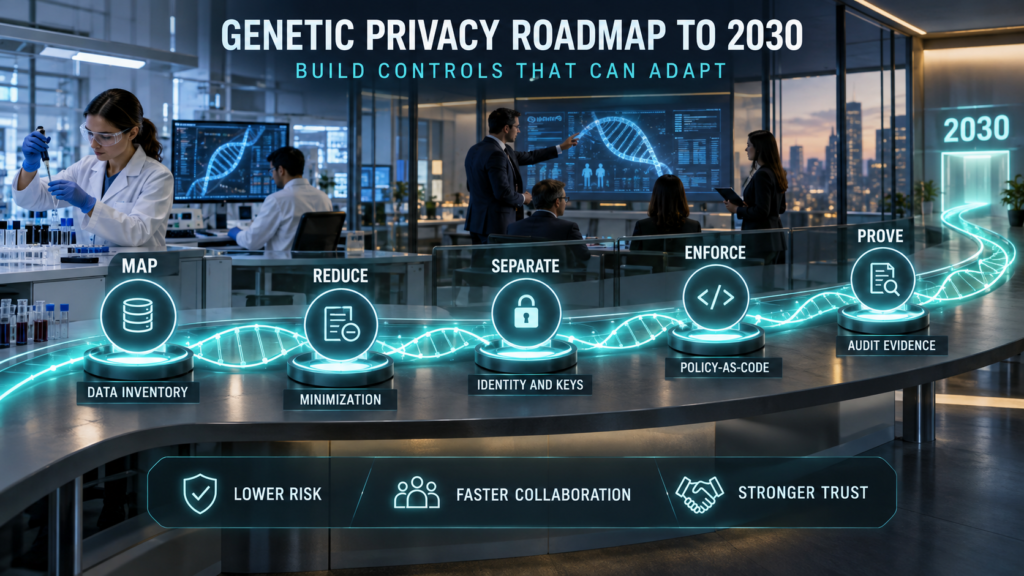
Phase 1—Map: inventory entities, jurisdictions, purposes, contracts, datasets, samples, models, recipients, and disclosures. Build the legal coverage matrix before selecting software.
Phase 2—Reduce: stop unjustified collection, delete abandoned datasets, shorten retention, remove public endpoints, and disable unused integrations. Data that does not exist cannot create continuing DNA data protection cost.
Phase 3—Separate: isolate identifiers, sequence, phenotype, consent, and keys across administrative domains. Use controlled research workspaces instead of distributing raw copies.
Phase 4—Enforce: connect identity, purpose, consent, jurisdiction, and protocol attributes to query and export decisions. Deny by default where the operational model permits it, with governed emergency access for clinical needs.
Phase 5—Prove: automate evidence for access, consent, transfers, deletion, sample destruction, policy changes, incidents, and exceptions. Test genetic data privacy compliance as a production capability, not an annual documentation event.
IV. Business Outcomes and Strategic ROI Takeaways
Model Value as Avoided Friction, Not Imaginary Fine Savings
Executives should reject ROI models built only on maximum statutory penalties. The more defensible value case measures reduced manual reviews, faster research onboarding, fewer uncontrolled copies, shorter rights-request cycles, faster vendor assessments, improved incident triage, and reusable evidence for customers and regulators.
Let annual control value equal avoided operating cost plus avoided expected loss plus enabled contribution margin, minus annualized platform and operating cost. Expected loss should use scenario probability and realistic impact ranges rather than asserting that every breach produces the largest possible fine.
For example, a controlled research workspace may cost more per compute hour but reduce dataset replication, approval time, egress, deletion work, and vendor-transfer exposure. The net result can be favorable even when raw infrastructure cost rises.
Metrics the Board Can Actually Use
- Percentage of genetic assets with an owner, purpose, jurisdiction, retention rule, and lineage.
- Percentage of high-risk access decisions evaluated by contextual policy rather than static role.
- Median time to propagate consent withdrawal and percentage completed within service level.
- Number of raw-data exports, uncontrolled copies, and standing privileged accounts.
- Percentage of processors with tested deletion, incident, subprocessor, and exit evidence.
- Time to determine affected subjects, relatives, jurisdictions, and duties during an incident.
- Percentage of AI training datasets with provenance, approved purpose, evaluation, and removal plan.
These metrics connect genomic data security to cost optimization. They reveal where automation can replace recurring manual evidence collection and where expensive technology is failing to reduce residual risk.
Strategic Takeaways for 2030 Planning
For 2030 planning, prioritize architectures that can update access and purpose policies without relocating every dataset. Central policy administration with distributed enforcement can improve adaptability, provided policy changes are tested, approved and traceable. This is an architectural recommendation, not a prediction of a specific future legal requirement.
Second, deletion capability is an enterprise asset. It lowers storage and discovery cost, supports consumer rights, makes vendor exit credible, and limits the blast radius of a future breach.
Third, AI governance and DNA data protection are converging. Training data provenance, feature lineage, inference controls, evaluation, human review, and output monitoring must connect to the original consent and lawful-use record.
Fourth, compliance should improve scientific collaboration rather than block it. Secure workspaces, reviewed outputs, federated queries, and reusable protocol templates can enable approved research while reducing uncontrolled distribution.
V. Risk Mitigation and Regulatory Framework
Current-Law Compliance Checklist
- Identify whether each actor is a HIPAA covered entity, business associate, consumer product provider, employer, insurer, laboratory, researcher, controller, or processor.
- Map GINA employment and health-insurance restrictions without claiming protection for life, disability, or long-term-care insurance.[1][5]
- Determine whether the FTC Act and Health Breach Notification Rule apply to non-HIPAA health products and connected services.[3]
- Map state genetic-testing, consumer-health, biometric, breach, and comprehensive privacy laws by resident and processing activity.
- Treat EU genetic data as special-category personal data and document both an Article 6 basis and an Article 9 condition where GDPR applies.[4]
- Record consent text, purpose, recipient, retention, sample disposition, withdrawal, and any sale or research authorization.
- Contractually restrict subprocessors, secondary use, AI training, cross-border transfer, incident notice, retention, and deletion.
- Test access, exports, withdrawal, deletion, sample destruction, incident routing, and vendor exit with production-like evidence.
2030 Readiness Checklist
- Maintain a living regulatory map with named counsel and quarterly change review.
- Extend inventory to derived phenotypes, embeddings, polygenic scores, model features, and decision outputs.
- Implement policy-as-code with tests, approval, versioning, observability, and fail-safe behavior.
- Build compute-to-data and controlled-workspace options for high-risk collaboration.
- Create a familial-risk assessment for matching, genealogy, reproductive, and rare-disease use cases.
- Establish cryptographic agility so algorithms and key arrangements can change without rebuilding the platform.
- Measure privacy-enhancing technology overhead against defined workloads before promising broad deployment.
- Link AI model cards and dataset records to consent, provenance, removal, and incident procedures.
- Prepare plain-language communications that distinguish deletion, legal retention, backup aging, published findings, and model effects.
- Require executive acceptance for residual re-identification and secondary-use risk.
NIST’s Privacy Framework can organize privacy risk management, while the NIST AI Risk Management Framework can structure governance for AI-based inferences.[11][12] Neither framework automatically proves genetic data privacy compliance; organizations must profile the controls to their systems, laws, and risk appetite.
Testing Privacy Controls Across a Genomic Workflow
Select one genomic workflow and trace its actors, purposes, data copies, recipients, access decisions and retention requirements. Identify where contractual promises or applicable legal duties are not supported by operating controls.
Test consent withdrawal, prohibited access, cross-border research access, high-risk exports, vendor deletion and incident escalation using synthetic or appropriately authorized test data. Set milestones according to the workflow’s complexity and legal deadlines. Record failures, assign owners and verify remediation before expanding the program.
VI. Appendix and Research Integrity
Appendix A: Legal Sources and Research References
- National Human Genome Research Institute, “Genetic Discrimination.” Explains GINA’s health-insurance and employment protections, exclusions for life, disability, and long-term-care insurance, and the state-law patchwork. https://www.genome.gov/about-genomics/policy-issues/Genetic-Discrimination
- U.S. Department of Health and Human Services, “Genetic Information.” HIPAA Privacy Rule resource addressing genetic information within protected health information. https://www.hhs.gov/hipaa/for-professionals/privacy/special-topics/genetic-information/index.html
- Federal Trade Commission, “Health Breach Notification Rule,” 16 CFR Part 318. Describes notice duties for covered vendors of personal health records and related entities following breaches of unsecured information. https://www.ftc.gov/legal-library/browse/rules/health-breach-notification-rule
- European Union, General Data Protection Regulation, Regulation (EU) 2016/679. Primary legal text covering genetic data, special-category processing, pseudonymization, security, rights, and international reach. https://eur-lex.europa.eu/eli/reg/2016/679/oj
- U.S. Equal Employment Opportunity Commission, “Genetic Information Discrimination.” Describes Title II restrictions on employment decisions, acquisition, disclosure, confidentiality, and employer coverage. https://www.eeoc.gov/genetic-information-discrimination
- California Legislature, SB-41, Genetic Information Privacy Act. Primary state bill text governing direct-to-consumer genetic testing companies and specified consent, security, disclosure, and deletion duties. https://leginfo.legislature.ca.gov/faces/billTextClient.xhtml?bill_id=202120220SB41
- Washington State Attorney General, “Protecting Washingtonians’ Personal Health Data and Privacy.” Official overview and resources for the My Health My Data Act. https://www.atg.wa.gov/protecting-washingtonians-personal-health-data-and-privacy
- Federal Trade Commission, “FTC Charges Genetic Testing Firm 1Health.io.” Enforcement announcement concerning alleged DNA-data security failures and changes to privacy commitments. https://www.ftc.gov/news-events/news/press-releases/2023/06/ftc-charges-genetic-testing-firm-1health-failing-protect-dna-data-unfair-changes-privacy-policy
- Gymrek, M. et al., “Identifying Personal Genomes by Surname Inference,” Science 339, 2013. Demonstrates a re-identification pathway using genomic and genealogical information. https://www.science.org/doi/10.1126/science.1229566
- Erlich, Y. et al., “Identity Inference of Genomic Data Using Long-Range Familial Searches,” Science 362, 2018. Examines identification through distant familial matching in consumer genealogy databases. https://www.science.org/doi/10.1126/science.aau4832
- National Institute of Standards and Technology, “Privacy Framework.” Voluntary framework for identifying and managing privacy risk. https://www.nist.gov/privacy-framework
- National Institute of Standards and Technology, “AI Risk Management Framework.” Voluntary framework for governing and managing AI risk. https://www.nist.gov/itl/ai-risk-management-framework
- European Commission, “European Health Data Space Regulation.” Official information on the EU framework for primary and secondary use of electronic health data. https://health.ec.europa.eu/ehealth-digital-health-and-care/european-health-data-space-regulation-ehds_en
- Global Alliance for Genomics and Health, “Data Security Toolkit.” Genomics-focused security policy and implementation resources. https://www.ga4gh.org/product/data-security-toolkit/
Sources and Claims Index
| Claim area | Footnotes | Evidence type |
| GINA scope, limits, and employment confidentiality | [1], [5] | U.S. government guidance |
| HIPAA treatment of genetic information | [1], [2] | U.S. government guidance |
| Consumer-health breach notification | [3] | Federal regulation summary |
| FTC genetic-testing enforcement | [8] | Federal enforcement announcement |
| California and Washington state requirements | [6], [7] | Primary state sources |
| GDPR and EU health-data governance | [4], [13] | Primary EU legal and institutional sources |
| Genomic re-identification risk | [9], [10] | Peer-reviewed Science research |
| Privacy, AI, and genomics security frameworks | [11], [12], [14] | NIST and GA4GH resources |
Forecast Method and Limitations
The 2030 projections are scenario-based judgments derived from enacted laws, enforcement patterns, technical research, and institutional frameworks available at publication. They are not legal predictions, guarantees, or a substitute for jurisdiction-specific counsel.
Vendor capabilities and prices were described by category and typical commercial structure, not ranked by sponsorship or affiliate compensation. Buyers should verify current product documentation, contracts, independent assurance reports, performance, and total cost.
Editorial and Commercial Disclosure
AI-assisted tools were used to support research organization, drafting and language refinement. NezzHub retains editorial responsibility for the published article. Vendor inclusion does not constitute endorsement.
Author and Editorial Review
Author: Garikapati Bullivenkaiah
Technology research writer with LL.B., LL.M., M.A., and MBA qualifications. He writes about emerging technologies and their business, governance and legal implications. His multidisciplinary academic background informs his analysis of technology adoption, intellectual property, and organizational risk. His articles explain technical concepts and practical considerations for business owners, IT managers and technology decision-makers. LinkedIn Profile
Reviewed by: Chitikineni Ramadevi — Editor
Chitikineni Ramadevi holds an M.Sc. in Computers from Andhra University and has over 10 years of research experience in technology-related subjects. She reviews NezzHub articles for clarity, factual accuracy, source support and practical relevance.
Published by: NezzHub
Research approach: This article draws on primary sources, technical documentation and relevant industry research. References are provided within the article or its sources section.
Last reviewed: 09-20-2026
Corrections: To report a factual error or outdated information, please contact NezzHub.

Garikapati Bullivenkaiah is a seasoned entrepreneur with a rich multidisciplinary academic foundation—including LL.B., LL.M., M.A., and M.B.A. degrees—that uniquely blend legal insight, managerial acumen, and sociocultural understanding. Driven by vision and integrity, he leads his own enterprise with a strategic mindset informed by rigorous legal training and advanced business education. His strong analytical skills, honed through legal and management disciplines, empower him to navigate complex challenges, mitigate risks, and foster growth in diverse sectors. Committed to delivering value, Garikapati’s entrepreneurial journey is characterized by innovative approaches, ethical leadership, and the ability to convert cross-domain knowledge into practical, client-focused solutions.