
















Executive Summary
GPT models generate language one token at a time, but an enterprise-grade system is far more than next-token prediction. A useful deployment combines a model with trusted data, identity controls, tool permissions, evaluation suites, monitoring, incident response, and a cost model tied to business outcomes.
For technology buyers, the central question is not whether GPT models can draft fluent text. It is whether enterprise generative AI can complete a defined workflow at an acceptable error rate, latency, security posture, and cost per successful outcome.
The transformer architecture made language-model training more parallelizable by replacing recurrent sequence processing with attention-based computation.[1] Subsequent work showed that scale can produce broad few-shot capabilities, while instruction tuning and human feedback can make outputs more useful without turning probabilistic generation into guaranteed truth.[2][3]
This Article explains the architecture without pretending the model “thinks” like a person. It also covers GPT API integration, retrieval-augmented generation, tool calling, context limits, compute economics, evaluation, prompt injection, data leakage, and regulatory obligations.
The commercial conclusion is disciplined. Start with one measurable workflow, route only the required data, constrain actions, evaluate with real cases, and expand only when the cost per accepted result beats the current process.
I. The Current Market Landscape and Challenge
The Buying Problem Is Reliability, Not Fluency
Fluent output is now easy to demonstrate. Reliable large language model deployment remains difficult because the model can produce plausible statements that are unsupported, omit decisive context, follow malicious instructions embedded in retrieved content, or call an authorized tool with the wrong arguments.
This gap creates “demo-to-production” failure. A polished assistant may succeed during curated demonstrations but underperform when users submit incomplete requests, documents conflict, permissions differ, latency spikes, or an upstream service fails.
GPT models also change faster than a normal enterprise application dependency. Model identifiers, prices, rate limits, supported tools, safety behavior, and default versions can change, so procurement based on a single benchmark screenshot ages badly.
A sound enterprise generative AI program therefore separates the business workflow from the model supplier. Prompts, policies, evaluation cases, tool schemas, retrieval indexes, and audit events should remain portable enough to test another model or deployment route.
Top AI SEO Tools for Entrepreneurs and Better Search Accuracy
Root Causes of Poor Production Results
The first cause is an undefined task boundary. “Help employees” cannot be evaluated, while “answer HR-policy questions using approved documents and abstain when evidence is missing” can be measured.
The second is weak grounding. GPT models may reproduce patterns learned during training, but they do not provide a transactionally current database or a guaranteed source of company truth.
The third is uncontrolled context. Teams often push entire documents, email threads, or customer records into a prompt without classifying the data, measuring relevance, or verifying whether the chosen service may process it under the required terms.
The fourth is missing evaluation. Human reviewers notice obvious errors, but anecdotal testing cannot quantify groundedness, tool accuracy, refusal behavior, demographic performance, or regression after a model update.
The fifth is automation without authority design. When GPT API integration can send email, issue refunds, change records, or execute code, the system’s risk is determined by permissions and transaction controls—not prose quality.
Cost of Inaction
Doing nothing has a cost when staff manually search documents, summarize tickets, normalize forms, or rewrite recurring communications. The avoidable expense should be measured as handling time, queue delay, rework, missed service levels, and error correction.
Uncontrolled adoption is usually worse. Employees may paste sensitive information into unapproved tools, departments may buy overlapping subscriptions, and teams may publish AI-generated claims without evidence or review.
The cost of inaction is therefore not a reason to deploy GPT models everywhere. It is a reason to create an approved service layer, a use-case intake process, and an AI governance framework before shadow usage becomes the de facto architecture.
Market Structure for GPT Models
The market has four practical layers. Foundation-model providers expose model endpoints; cloud platforms add regional infrastructure and enterprise controls; application vendors package models into workflows; internal teams connect those services to company data and systems.
Commercial differentiation increasingly sits outside the base model. Retrieval quality, workflow integration, evaluation data, permission design, domain review, user experience, and operational telemetry determine whether two companies using similar GPT models achieve different results.
Model selection is still important. Reasoning quality, context capacity, structured-output reliability, multimodal inputs, latency, throughput, tool support, regional availability, and price can materially change system design.
No single model is optimal for every request. Production systems increasingly route simple classification to lower-cost endpoints, complex analysis to stronger models, and regulated decisions to constrained workflows with human approval.
II. Deep-Dive Technical Analysis and Evidence
Architecture Overview: What GPT Models Actually Do
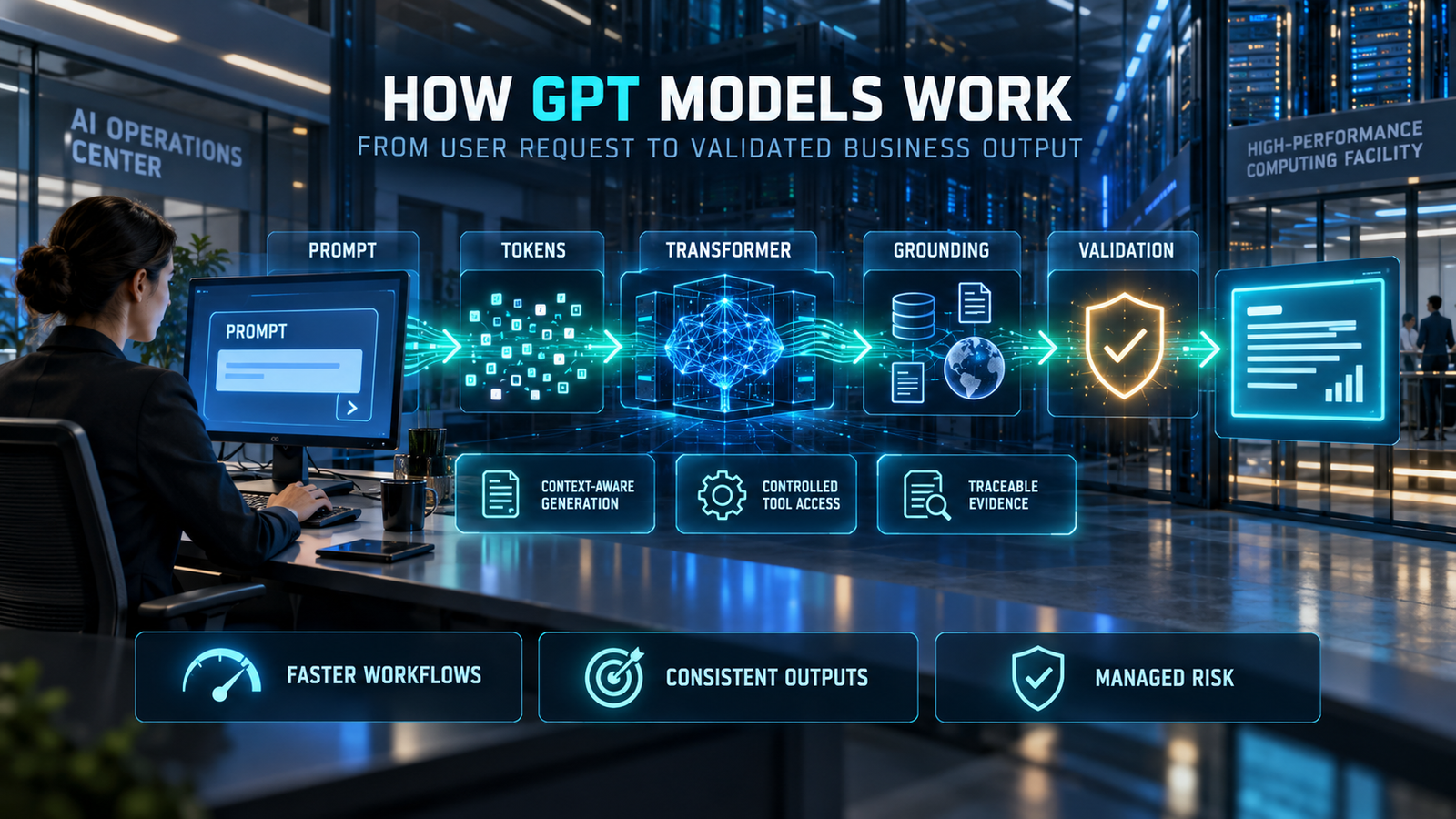
GPT stands for Generative Pre-trained Transformer. “Generative” describes output production, “pre-trained” means broad statistical patterns are learned before a customer task, and “transformer” identifies the neural-network architecture built around attention.[1]
At runtime, text is converted into tokens rather than processed as intact words. The model maps those tokens to vectors, applies many transformer layers, and produces a probability distribution for the next token.
One token is selected according to the decoding configuration. The new token is appended, the sequence is processed again using cached intermediate states where supported, and generation continues until a stop condition or output limit is reached.

The essential components are:
- Tokenizer: converts text or structured input into model-readable units.
- Embeddings: represent tokens as numeric vectors.
- Self-attention: calculates context-dependent relationships among positions.
- Feed-forward layers: transform representations within each layer.
- Residual paths and normalization: stabilize deep-network computation.
- Output head: scores candidate next tokens.
- Decoder controls: influence selection, stopping, and output length.
This mechanism does not retrieve a verified fact for every sentence. GPT models generate a continuation conditioned on input and learned parameters, which explains both their flexibility and their capacity for confident error.
Attention Without the Marketing Myth
Attention allows each token representation to weigh information from relevant positions in the available context. It does not mean consciousness, intention, or a human understanding of truth.
For each attention head, the network constructs query, key, and value representations. Similarity between queries and keys produces weights that mix value information, while multiple heads can learn different relationships.
The original transformer paper reported stronger translation quality with greater parallelization than the recurrent architectures it compared.[1] Modern GPT models extend the decoder-style transformer at much larger scale, but the basic inference loop remains sequential at output time.
Attention also has a cost. Standard full attention grows roughly with the square of sequence length for its attention matrix, although modern systems use architectural and systems optimizations to manage long contexts.
A larger context window does not guarantee that every inserted fact will be used correctly. Relevance can degrade when prompts contain redundant instructions, conflicting documents, distant evidence, or poorly structured data.
Pre-Training, Post-Training, and Runtime Grounding
Pre-training exposes the network to large datasets and optimizes next-token prediction. GPT-3 research demonstrated that scaling an autoregressive language model could produce task performance from instructions and examples without traditional task-specific retraining.[2]
Post-training changes how the base capability is expressed. Supervised examples, preference data, reinforcement learning, safety training, and other techniques can improve instruction following, refusal behavior, format adherence, and conversational usefulness.[3]
Post-training does not install a perfect fact checker. A helpfulness objective can even make a system sound decisive when uncertainty should be surfaced, which is why application-level grounding and verification remain necessary.
Runtime grounding supplies current or proprietary evidence. Retrieval-augmented generation combines model parameters with external documents, allowing the application to select relevant passages before generation.[4]
Fine-tuning and retrieval solve different problems. Fine-tuning is useful for behavior, style, classification boundaries, or repeated formats; retrieval is usually better for frequently changing facts, citations, and access-controlled knowledge.
Integration Flowchart for Enterprise Generative AI
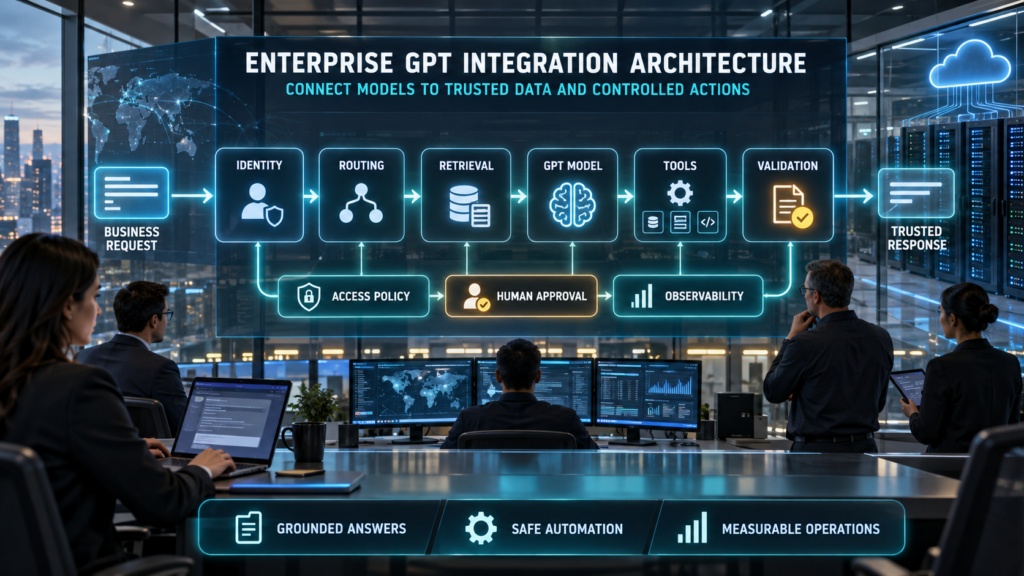
User or system event → identity and policy check → request classification → model routing → retrieval or tool planning → prompt assembly → GPT model inference → schema and safety validation → answer release, or approved tool execution followed by result review → logging, feedback, and evaluation
When the model requests a tool, the application checks the arguments and permissions, obtains approval where required, executes the tool, and returns its result to the model. The final response is validated before release.
Each arrow is an engineering boundary. A secure GPT API integration records who requested the action, which policy applied, what sources were retrieved, which model version ran, which tools were proposed, what validation occurred, and what outcome reached the user.
The orchestrator should keep business rules outside the prompt where possible. Deterministic eligibility tests, monetary limits, entitlements, and compliance blocks belong in code or policy engines, not in natural-language instructions that GPT models may reinterpret.
Retrieval Pipeline
A production retrieval pipeline for GPT models ingests approved content, removes duplicates, preserves source metadata, divides documents into coherent chunks, creates embeddings, and stores them in a searchable index. At query time, it retrieves candidates, reranks them, and passes a limited evidence set to the generator.
Poor chunking can separate a rule from its exception. Poor metadata can mix obsolete and current policies, while weak access filtering can expose documents the requesting user was never authorized to see.
Citations should connect claims to retrieved source spans, not simply list plausible URLs. The system also needs an abstention route when retrieved evidence is missing, conflicting, or below a relevance threshold.
Tool-Execution Pipeline
Tool calling turns text generation into action planning. GPT models propose a tool name and structured arguments, while the enterprise generative AI application validates the schema, checks authority, requests approval where needed, executes the tool, and returns the result for final response generation.
GPT models should never hold unrestricted database, shell, payment, or communication privileges. Use narrowly scoped service accounts, allowlisted operations, parameter validation, idempotency keys, transaction limits, confirmation screens, and compensating actions.
Tokens, Context Windows, and Cost Mechanics
Tokens are billing and computation units, not exact words. Character-to-token ratios vary by language, code, formatting, and tokenizer, so capacity planning should use measured production traffic rather than a universal conversion estimate.
The context window includes system instructions, developer rules, user input, retrieved passages, tool messages, conversation history, and generated output. A long conversation does not create permanent memory unless the application deliberately stores and retrieves state.
GPT API integration cost can be modeled as:
Monthly model cost = (uncached input tokens ÷ billing unit) × input rate + (cached input tokens ÷ billing unit) × cached-input rate + (output tokens ÷ billing unit) × output rate + applicable tool and platform charges.
Match the billing unit to the provider’s published rates. For example, when prices are quoted per million tokens, divide each token count by 1,000,000. Cached and uncached input tokens must be counted separately, without counting the same tokens twice.
The operational cost adds retrieval infrastructure, observability, evaluation, human review, security, integration engineering, support, and incident response. A lower token price can be offset by more retries, longer prompts, or poorer first-pass acceptance.
Cost optimization should begin with measurement. Track tokens per request, output length, retrieval volume, cache hit rate, tool calls, retries, accepted results, latency percentiles, and human-review minutes.
Deployment Challenges That Surface After the Pilot
Non-Determinism and Regression
The same request can produce different outputs because decoding is probabilistic and hosted systems evolve. Even low-temperature settings do not make every provider path permanently deterministic.
Store evaluation inputs, required facts, expected tool calls, prohibited behavior, and scoring rules. Run the suite before changing GPT models, prompts, retrieval pipelines, tool schemas, or safety policies.
Hallucination and Unsupported Inference
NIST uses “confabulation” for confidently presented false or erroneous content in its Generative AI Profile.[5] Retrieval can reduce unsupported claims, but it cannot guarantee faithful use of evidence.
High-risk outputs need claim-level support checks, deterministic calculations, authoritative system lookups, or qualified human approval. Asking a model to “be accurate” is not a control.
Prompt Injection
External text can contain instructions designed to override the application’s task, disclose hidden data, or misuse tools. Prompt injection is especially serious when enterprise generative AI reads email, web pages, uploaded files, or third-party knowledge bases.
Treat retrieved content as untrusted data, separate it from system instructions, restrict tool authority, filter high-risk outputs, and test known attack patterns. OWASP’s LLM application guidance highlights prompt injection, sensitive-information disclosure, excessive agency, and other application-layer risks.[6]
Latency and Availability
End-to-end latency includes gateway checks, retrieval, reranking, model queue time, inference, tool execution, and validation. Streaming improves perceived speed but does not shorten every workflow.
Set separate service objectives for interactive answers and background jobs. Design timeouts, retries with backoff, circuit breakers, model fallbacks, request deduplication, and degraded modes that do not silently bypass safety controls.
Data Residency and Vendor Dependency
Large language model deployment may process personal data, confidential code, contracts, health information, or regulated records. Buyers must verify data location, retention, training-use terms, subprocessors, encryption, logging, deletion, and incident commitments for the exact service tier.
Architectural portability reduces switching cost but is not free. Providers differ in message formats, tool schemas, multimodal inputs, safety behavior, quotas, context handling, and structured-output reliability.
Performance Evaluation Matrix

| Evaluation dimension | Test method | Primary metric | Release threshold | Failure response |
| Factual groundedness | Score claims against approved sources | Supported-claim rate | Set by use-case risk | Abstain, retrieve again, or review |
| Retrieval quality | Label relevant passages for real queries | Recall@k and precision@k | Baseline plus no critical misses | Fix index, chunks, filters, or reranker |
| Structured output | Validate every response against schema | Valid-output rate | Near-total for automated paths | Retry once, then deterministic fallback |
| Tool selection | Compare expected and proposed actions | Correct tool and arguments | Risk-tier threshold | Block execution and review |
| Safety behavior | Red-team misuse and sensitive-data cases | Attack success rate | Zero for critical scenarios | Disable path and remediate |
| Fairness | Compare task error across relevant groups | Error-rate disparity | Documented tolerance | Rebalance data or redesign workflow |
| Latency | Measure complete production path | p50, p95, and p99 | Workflow-specific SLO | Route, cache, trim, or run async |
| Cost efficiency | Divide total cost by accepted result | Cost per accepted outcome | Better than approved baseline | Optimize or stop deployment |
| Human acceptance | Blind review with explicit rubric | First-pass acceptance rate | Business-case target | Improve evidence, instructions, or task scope |
| Regression | Replay fixed and recent failure cases | Pass rate by version | No critical regressions | Roll back model, prompt, or index |
No universal accuracy percentage can validate all GPT models. A marketing draft, benefits explanation, code change, and payment action require different evidence, thresholds, and approval rules.
III. Commercial Solutions and Best Practices
Feature and Cost Comparison Table
The table compares deployment routes rather than declaring a permanent winner. Features, region availability, quotas, and prices change, so procurement teams should validate current contractual documentation before committing.[7][8]
| Deployment route | Best fit | Principal strengths | Engineering trade-off | Cost structure to verify |
| OpenAI API | Teams building custom applications with direct access to GPT models | Broad model and tool capabilities, structured outputs, managed inference | Provider-specific behavior, internet service dependency, governance must be added by customer | Input, cached input, output, tool, storage, batch, and service-tier charges |
| Azure OpenAI | Microsoft-oriented enterprises needing cloud governance and regional options | Azure identity, networking, monitoring, procurement, and deployment controls | Feature and model availability can vary by region or deployment type | Token usage, provisioned throughput, hosting region, networking, and support |
| ChatGPT Enterprise or Business | Knowledge workers who need an administered productivity interface | Rapid adoption, workspace administration, connectors and collaboration features where licensed | Less workflow-specific control than a purpose-built application | Per-user licensing, feature tier, connector governance, and adoption overhead |
| Self-hosted open-weight model | Organizations with specialized sovereignty, latency, or customization requirements | Infrastructure control, tunable serving, potential workload-specific economics | GPU capacity, model operations, security, evaluations, licensing, and specialist staffing | Hardware or cloud GPU, power, serving software, labor, redundancy, and utilization |
These alternatives are not interchangeable. A user-facing subscription may be the fastest route for drafting, while GPT API integration is better for embedded workflows and self-hosting may suit a narrow sovereignty requirement.
The Five-Gate Deployment Framework
Gate 1: Define the Decision Boundary
Write the workflow in operational terms: input, authorized sources, permitted actions, prohibited actions, output recipient, error cost, and human owner. Reject use cases whose success cannot be measured.
Gate 2: Establish the Baseline
Measure the current process before adding enterprise generative AI. Capture handling time, queue delay, completion rate, error rate, rework, escalation, customer satisfaction, and fully loaded labor cost.
Gate 3: Build the Smallest Safe System
Use the minimum model capability, minimum data, and minimum authority required. Separate retrieval from generation and generation from execution, then place validation between every stage.
Gate 4: Evaluate With Production Cases
Create a representative test set from real work, including routine cases, ambiguous cases, adversarial inputs, sensitive data, outdated documents, tool failures, and “should abstain” examples. Keep a holdout set to reduce evaluation overfitting.
Gate 5: Release Gradually
Start in shadow mode, then move to internal assistance, human-approved action, and limited automation only after evidence supports each step. Maintain rollback, incident ownership, and a kill switch.
Best Practices for GPT API Integration
Version prompts, tool definitions, retrieval configurations, policies, and evaluation suites for GPT models as deployable assets. A prompt edited in a web console without change control can create the same production risk as an unreviewed code change.
Require structured output when downstream software consumes the answer. Validate types, ranges, enumerations, identifiers, and business invariants after schema validation because syntactically valid JSON can still be operationally wrong.
Use conversation state deliberately. Summarize or retrieve earlier information when needed, but never assume the model remembers facts outside the supplied context.
Separate user-visible citations from internal traceability. The user needs clear evidence links, while auditors need request IDs, model and policy versions, retrieved source identifiers, tool events, approvals, and final disposition.
Model Routing and Cost Optimization
Route requests by complexity, sensitivity, modality, latency target, and required tools. A compact model may handle extraction or intent classification, while complex exception analysis may justify a more capable endpoint.
Cache stable instructions and repeated context when the provider and data policy permit it. Reduce token waste by retrieving only relevant passages, removing duplicate boilerplate, limiting verbose outputs, and using deterministic code for arithmetic and known business rules.
Batch non-interactive work when pricing and service design support it. Cost optimization must never remove evidence, access checks, or review steps whose absence increases expected loss.
IV. Business Outcomes and Strategic ROI Takeaways
Calculate ROI Per Accepted Outcome
The wrong KPI is “documents generated.” Volume rewards low-quality automation and hides review burden.
Use accepted outcomes instead: a support answer approved without correction, a contract field extracted correctly, a case routed to the right queue, or a draft that meets the editorial rubric on first review.
An operational ROI formula is:
An annual net-benefit calculation is:
Annual net benefit = realized labor savings + avoided error and delay costs + incremental contribution − total implementation and operating costs.
Express every term in the same currency and annual period, and avoid overlapping benefits. Track released staff capacity separately unless its financial value can be demonstrated.
Do not count all saved minutes as cash savings. Released capacity becomes value only when the organization reduces spend, handles more demand, improves service, or reallocates labor to measurable work.
Example: Support Knowledge Assistant
Assume a support team handles 100,000 knowledge questions per year, with a baseline average of six minutes each. A proposed assistant reduces handling time only for accepted answers and adds review time for uncertain cases.
Estimate annual hours saved by multiplying accepted cases by verified net minutes saved per case, then dividing by 60. Net time saved should already include any additional review and rework. Report these hours as released capacity; count them as financial savings only where spending actually falls. Compare measurable financial benefits with annual retrieval, model, platform, implementation and operating costs, including the expected cost of incorrect answers. Avoid counting review costs twice.
This method prevents an attractive pilot from becoming an expensive production service. It also makes model routing rational: a stronger endpoint is justified only when its additional acceptance value exceeds its additional cost.
Metrics for Executives and IT Managers
- Cost per accepted outcome, not cost per raw response.
- First-pass acceptance and material-correction rates.
- Unsupported-claim and abstention rates.
- Correct tool-call and transaction-completion rates.
- p50, p95, and p99 latency by workflow.
- Input, cached, and output tokens per accepted result.
- Human-review minutes and escalation rate.
- Sensitive-data policy violations and blocked attacks.
- Regression failures after model or prompt changes.
- Adoption by eligible users and task completion, not logins alone.
Enterprise generative AI earns strategic value when it improves throughput without hiding additional risk. If monitoring cannot show that balance, management cannot defend expansion.
Strategic Takeaways
First, GPT models are components, not complete employees or databases. Their value appears when application architecture supplies evidence, tools, constraints, and accountable owners.
Second, model quality and system quality are different. Better retrieval, permissions, validation, and workflow design can outperform a model upgrade that leaves the surrounding application weak.
Third, large language model deployment is an operating capability. Teams need continuous evaluation, incident response, cost control, vendor review, user training, and change management after launch.
Fourth, portability is commercial leverage. A documented abstraction layer and vendor-neutral evaluation suite allow buyers to test alternatives when price, performance, policy, or geographic requirements change.
V. Risk Mitigation and Regulatory Framework
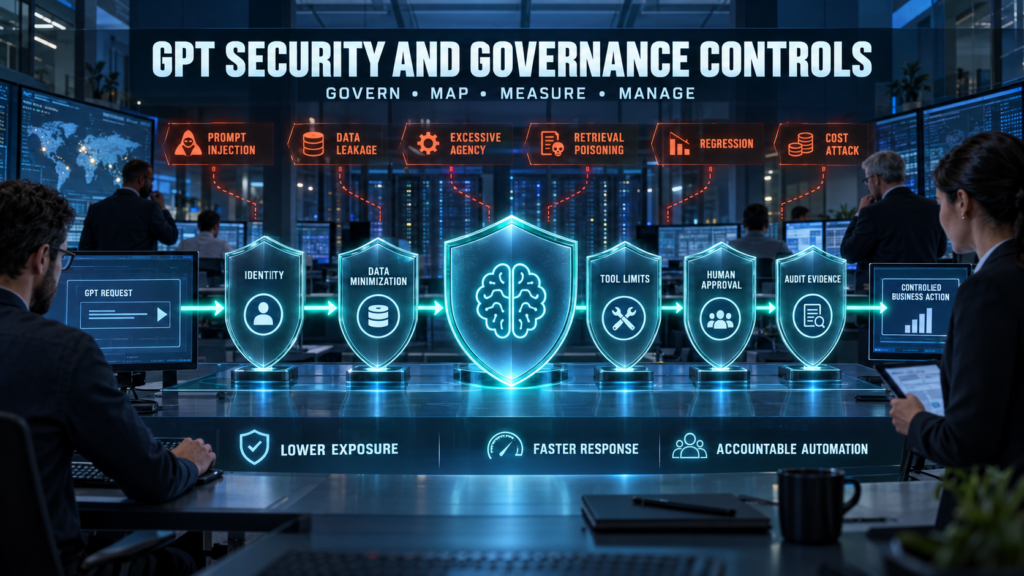
AI Governance Framework for GPT Models
NIST’s AI RMF organizes risk work around Govern, Map, Measure, and Manage, while its Generative AI Profile adds considerations specific to generative systems.[5][9] These are voluntary frameworks, not certificates or substitutes for applicable law.
The EU AI Act applies obligations according to system role and risk, not merely because a product uses a transformer.[10] Organizations must determine whether they are providers, deployers, importers, distributors, or downstream users and obtain jurisdiction-specific advice.
An operational AI governance framework should connect policy to technical evidence. Every approved use case needs an owner, risk tier, data classification, model route, evaluation set, release threshold, monitoring plan, incident path, and retirement trigger.
Pre-Deployment Compliance Checklist
- Define the task, affected users, decisions, prohibited uses, and accountable business owner.
- Classify input, retrieved, generated, logged, and training or evaluation data.
- Confirm provider terms for retention, training use, subprocessors, region, security, deletion, and incident notice.
- Complete privacy, security, legal, records, accessibility, and intellectual-property review appropriate to the use case.
- Document the model, prompt, retrieval, tools, permissions, validation, fallback, and human-review architecture.
- Test factual support, safety, privacy, bias, prompt injection, tool misuse, denial of service, and failure recovery.
- Set measurable release thresholds and obtain risk-owner approval for residual risk.
- Prepare user notices, escalation routes, correction processes, and operational training.
Production Control Checklist
- Authenticate users and enforce authorization before retrieval and tool execution.
- Minimize data and redact secrets or sensitive fields where the task permits.
- Treat uploaded and retrieved content as untrusted input.
- Validate structured outputs and all tool arguments with deterministic rules.
- Require confirmation for irreversible, financial, legal, safety, or externally visible actions.
- Log model, policy, prompt, source, tool, approval, and outcome identifiers with appropriate access controls.
- Monitor quality, attacks, data leakage, latency, cost, drift, and demographic performance.
- Re-run the evaluation suite after every material model, prompt, index, policy, or tool change.
- Maintain rollback, fallbacks, rate limits, circuit breakers, and a tested shutdown process.
Failure Vectors and Mitigations
| Failure vector | Business consequence | Required mitigation |
| Unsupported answer | Bad advice, rework, liability | Grounding, claim checks, abstention, review |
| Prompt injection | Data exposure or tool misuse | Content isolation, least privilege, validation, red testing |
| Sensitive-data leakage | Privacy, contract, or security breach | Classification, minimization, DLP, access control, retention limits |
| Excessive agency | Unauthorized external action | Scoped tools, approvals, limits, idempotency, audit |
| Retrieval poisoning | Manipulated answers | Source governance, signing, provenance, anomaly review |
| Model or prompt regression | Silent performance loss | Versioning, replay tests, staged release, rollback |
| Cost attack | Budget exhaustion and service loss | Quotas, rate limits, token caps, anomaly detection |
| Vendor outage | Workflow interruption | Timeouts, fallbacks, queues, manual route |
| Bias or uneven error | Harm and regulatory exposure | Representative tests, group analysis, redesign, oversight |
| Copyright or provenance dispute | Takedown, claims, rework | Source policy, output review, records, legal process |
Evaluating GPT Models in a Controlled Pilot
Start with one workflow that has reliable source material, a measurable baseline and reversible outcomes. Place the GPT application behind identity checks, authorized retrieval, output validation and human approval where the task requires it.
Choose a pilot duration suited to the workflow’s volume and risk. Measure cost per accepted result, factual support, tool accuracy, latency, review effort and failure recovery. Expand only when results show a measurable improvement and the system meets its approved quality and risk thresholds.
VI. Appendix and Research Integrity
Appendix A: Academic and Primary-Source Footnotes
- Vaswani, A. et al., “Attention Is All You Need,” 2017. Introduced the transformer architecture and reported machine-translation results and training characteristics. https://arxiv.org/abs/1706.03762
- Brown, T. et al., “Language Models are Few-Shot Learners,” 2020. GPT-3 paper examining scale and few-shot task performance. https://arxiv.org/abs/2005.14165
- Ouyang, L. et al., “Training Language Models to Follow Instructions with Human Feedback,” 2022. Research on supervised fine-tuning and reinforcement learning from human feedback. https://arxiv.org/abs/2203.02155
- Lewis, P. et al., “Retrieval-Augmented Generation for Knowledge-Intensive NLP Tasks,” 2020. Introduced a retrieval-plus-generation architecture evaluated on knowledge-intensive tasks. https://arxiv.org/abs/2005.11401
- National Institute of Standards and Technology, “Artificial Intelligence Risk Management Framework: Generative Artificial Intelligence Profile,” NIST AI 600-1, 2024. Cross-sector guidance for generative-AI risk management. https://nvlpubs.nist.gov/nistpubs/ai/NIST.AI.600-1.pdf
- OWASP Foundation, “OWASP Top 10 for Large Language Model Applications.” Application-security risks and mitigations for systems using language models. https://genai.owasp.org/llm-top-10/
- OpenAI, “Models.” Current model catalog and capability documentation; verify before procurement because availability changes. https://platform.openai.com/docs/models
- Microsoft Azure, “Azure OpenAI Service.” Official product and deployment documentation for Azure-hosted model access. https://learn.microsoft.com/azure/ai-services/openai/
- National Institute of Standards and Technology, “AI Risk Management Framework.” Voluntary framework organized around Govern, Map, Measure, and Manage. https://www.nist.gov/itl/ai-risk-management-framework
- European Union, Regulation (EU) 2024/1689, Artificial Intelligence Act. Primary legal text establishing harmonized AI rules and role-based obligations. https://eur-lex.europa.eu/eli/reg/2024/1689/oj
- Bommasani, R. et al., “On the Opportunities and Risks of Foundation Models,” 2021. Interdisciplinary analysis of foundation-model capabilities and risks. https://arxiv.org/abs/2108.07258
- Liang, P. et al., “Holistic Evaluation of Language Models,” 2022. Introduced HELM for multi-metric model evaluation across scenarios. https://arxiv.org/abs/2211.09110
- OpenAI, “Evaluation Best Practices.” Official guidance on task-specific eval design and continuous evaluation. https://platform.openai.com/docs/guides/evals
- ISO, ISO/IEC 42001:2023. Management-system standard for organizations developing, providing, or using AI systems. https://www.iso.org/standard/81230.html
Sources and Claims Index
| Claim area | Footnotes | Evidence class |
| Transformer architecture and attention | [1] | Peer-reviewed conference paper/preprint |
| Scaling and few-shot behavior | [2] | Primary model research |
| Instruction tuning and human feedback | [3] | Primary model research |
| Retrieval-augmented generation | [4] | Peer-reviewed conference research |
| Generative-AI risks and governance | [5], [9], [14] | NIST and ISO frameworks |
| LLM application security | [6] | Industry security standard project |
| Current provider capabilities | [7], [8] | Official vendor documentation |
| EU regulatory obligations | [10] | Primary legislation |
| Foundation-model risk and evaluation | [11], [12], [13] | Academic research and provider guidance |
Research Limitations
Model catalogs, prices, context limits, rate limits, regional availability, and contract terms can change after publication. Readers should validate current official documentation and their signed terms before making a purchasing or compliance decision.
Benchmark scores were not used as universal commercial proof because prompt format, test contamination, tool access, model version, and evaluation method can materially change results.
Corporate Editorial Transparency and AI Usage Disclosure
AI-assisted tools were used to support research organization, drafting and language refinement. NezzHub retains editorial responsibility for the published article. Vendor inclusion does not constitute endorsement.
Author and Editorial Review
Author: Garikapati Bullivenkaiah
Technology research writer with LL.B., LL.M., M.A., and MBA qualifications. He writes about emerging technologies and their business, governance and legal implications. His multidisciplinary academic background informs his analysis of technology adoption, intellectual property, and organizational risk. His articles explain technical concepts and practical considerations for business owners, IT managers and technology decision-makers. LinkedIn Profile
Reviewed by: Chitikineni Ramadevi — Editor
Chitikineni Ramadevi holds an M.Sc. in Computers from Andhra University and has over 10 years of research experience in technology-related subjects. She reviews NezzHub articles for clarity, factual accuracy, source support and practical relevance.
Published by: NezzHub
Research approach: This article draws on primary sources, technical documentation and relevant industry research. References are provided within the article or its sources section.
Last reviewed: 09-22-2026
Corrections: To report a factual error or outdated information, please contact NezzHub.

Garikapati Bullivenkaiah is a seasoned entrepreneur with a rich multidisciplinary academic foundation—including LL.B., LL.M., M.A., and M.B.A. degrees—that uniquely blend legal insight, managerial acumen, and sociocultural understanding. Driven by vision and integrity, he leads his own enterprise with a strategic mindset informed by rigorous legal training and advanced business education. His strong analytical skills, honed through legal and management disciplines, empower him to navigate complex challenges, mitigate risks, and foster growth in diverse sectors. Committed to delivering value, Garikapati’s entrepreneurial journey is characterized by innovative approaches, ethical leadership, and the ability to convert cross-domain knowledge into practical, client-focused solutions.