

















Executive Summary
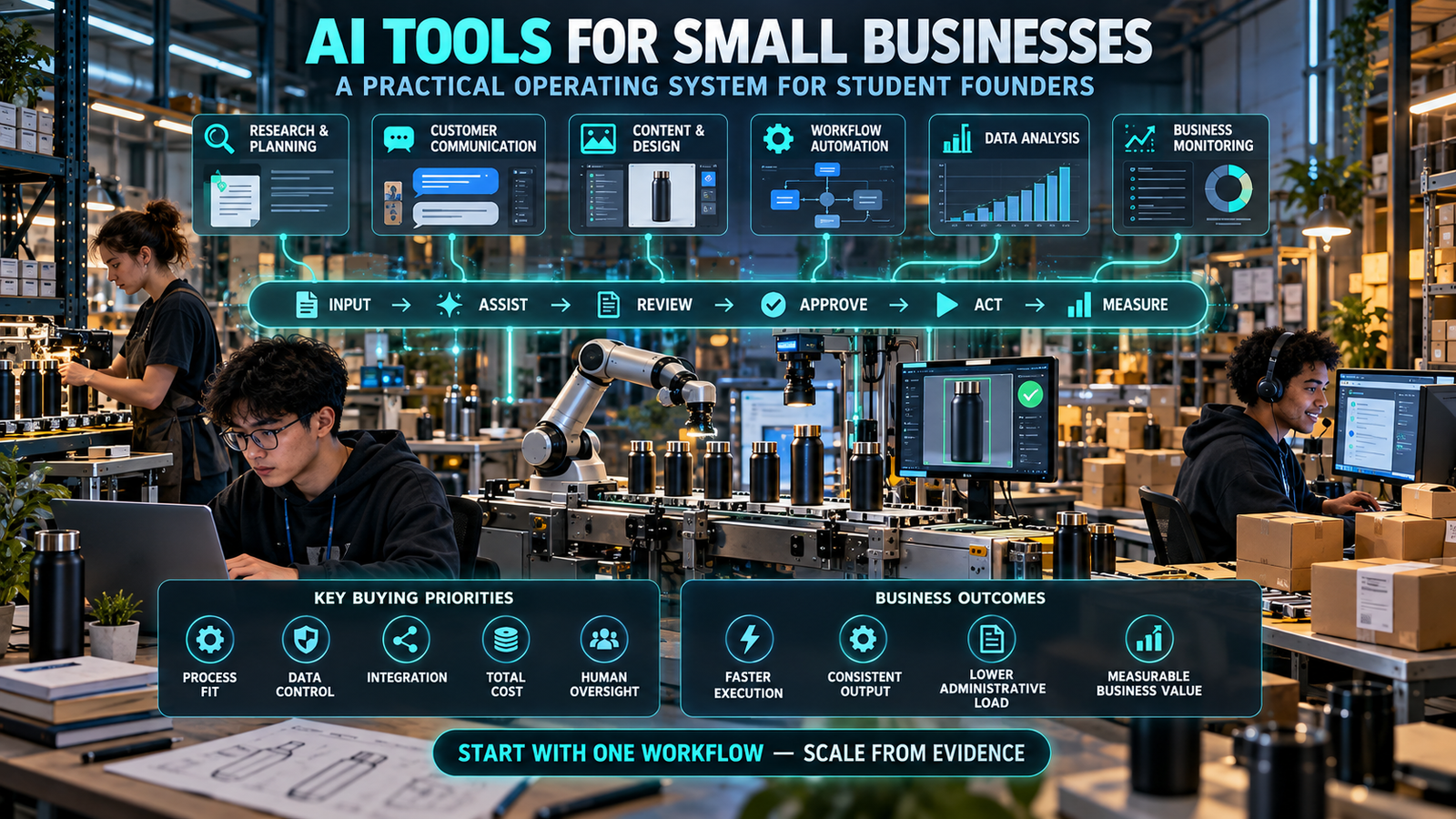
The best AI tools for small businesses do not replace a student founder’s judgment. They compress research, drafting, design, customer service, and workflow administration into a manageable operating system that one person can supervise.
That distinction matters because buying several subscriptions does not create automation. A useful stack connects approved data, a clearly defined task, a human review point, and a measurable business result.
Small-business adoption is no longer marginal. The U.S. Chamber of Commerce reported in August 2025 that 58% of surveyed small businesses used generative AI, up from 40% in 2024, while 77% of AI users said restrictions would harm growth, operations, or their bottom line.[1]
This white paper evaluates four practical platforms: ChatGPT Business, Google Workspace with Gemini, Canva Business, and Zapier. They address different layers, so the comparison is not a contest to select one universal winner.
For a student founder, the strongest starting stack is usually one governed assistant, one productivity suite already used for school or work, and automation only after a manual process is stable. Creative software should be added when content volume or brand consistency creates a real constraint.
The commercial rule is simple. Purchase AI tools for small businesses only when the owner can identify the workflow, baseline its cost, define acceptable output, and stop the automation safely when it fails.
I. Current Market Landscape and the Student-Founder Challenge
Student founders operate under a resource model that conventional software procurement rarely assumes. Cash is limited, schedules change every semester, collaborators may be temporary, and a business account can sit beside personal coursework on the same laptop.
These constraints make AI tools for small businesses attractive, but they also raise the cost of a poor decision. A low monthly fee can hide duplicate subscriptions, usage limits, weak export controls, or an automation that creates customer-facing errors while the founder is in class.
Adoption Has Moved Faster Than Operating Discipline
The market now offers writing assistants, meeting agents, design generators, coding copilots, sales assistants, and autonomous workflow products. Most AI tools for small businesses can produce an impressive demo in minutes; far fewer fit a controlled business process without configuration, review, and maintenance.
The U.S. Chamber’s adoption data signals broad demand, not guaranteed return.[1] Purchases of AI tools for small businesses still need a case based on time saved, error avoided, revenue supported, or capacity released.
Describing AI as a co-founder, marketing agency, financial adviser or support department can exaggerate its authority. These tools can assist with defined tasks, but people remain responsible for business decisions, customer commitments and the accuracy of published claims.
The safer model treats AI tools for small businesses as supervised production systems. People retain authority over financial decisions, customer promises, academic submissions, regulated data, refunds, contracts, and public claims.
The Cost of Inaction
Ignoring AI tools for small businesses also has a cost. A founder who manually reformats leads, drafts routine replies, or recreates the same promotional asset may spend scarce hours on work that adds little differentiation.
The cost of inaction should not be exaggerated into fear. Measure it as hours spent per week, delayed response time, abandoned leads, inconsistent content, missed follow-ups, and the opportunity cost of work that cannot be completed during study periods.
The Cost of Uncontrolled Adoption
Uncontrolled adoption of AI tools for small businesses creates a different liability. Sensitive customer records may be pasted into a consumer account, inaccurate content may be published without review, and connected automation may modify hundreds of records before anyone detects the defect.
The Federal Trade Commission has warned AI companies to honor privacy and confidentiality commitments, and it has pursued deceptive AI claims and schemes.[2][3] A small operator does not receive an exemption from truth-in-advertising or privacy obligations because the content was generated by software.
Procurement Questions Before Any Trial
- What exact task will the tool perform?
- What data will enter the service, and who owns that data?
- Can the business prevent its content from being used for model training?
- Is there role-based access, an audit trail, and reliable account recovery?
- Can outputs be exported in usable formats?
- What happens when usage limits or automation tasks are exhausted?
- Which person approves customer-facing, financial, or legal output?
- What metric will determine renewal after 30 days?
These questions filter novelty from operational value. They also keep AI tools for small businesses aligned with a real bottleneck rather than a social-media trend.
Best AI Tools for Business in the USA: Proven 2026 Buying Guide
II. Deep-Dive Technical Analysis and Evidence
The technical challenge with AI tools for small businesses is not prompt writing alone. It is moving information through a controlled chain without losing provenance, exposing confidential data, or allowing unreviewed output to trigger an irreversible action.
Architecture Overview for AI Tools for Small Businesses
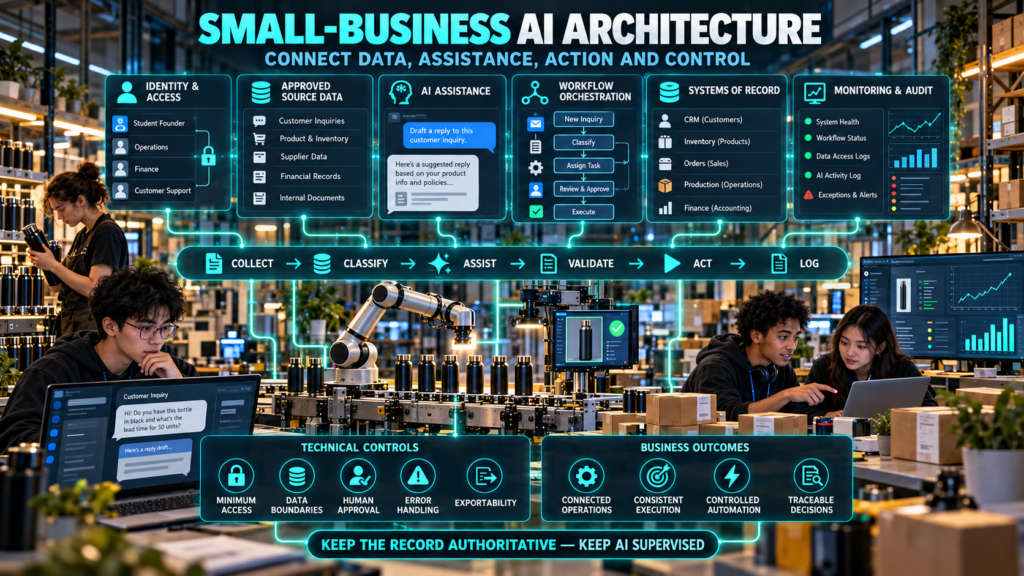
A practical architecture for AI tools for small businesses contains six layers. Each layer has a different owner, failure mode, and control requirement.
| Layer | Typical components | Main engineering question | Required control |
|---|---|---|---|
| Identity | Business email, SSO, MFA, recovery | Who can access the workspace? | Named accounts, MFA, rapid offboarding |
| Source data | Drive, CRM, email, forms, finance records | Is the source current and permitted? | Data classification and minimum access |
| AI service | Chat assistant, Gemini, design model | Can the result be trusted for this task? | Approved use cases and human review |
| Orchestration | Zapier, native workflow, webhook | What downstream action can occur? | Test environment, limits, approval gates |
| System of record | CRM, spreadsheet, help desk, accounting | Where is the authoritative record? | Deduplication, validation, backup |
| Monitoring | Logs, alerts, cost dashboard, error queue | How will failure be detected? | Owner, alert threshold, rollback procedure |
This design prevents the chat transcript from becoming the company’s unofficial database. The system of record remains authoritative, while the AI service drafts, classifies, summarizes, or recommends.
Integration Flowchart
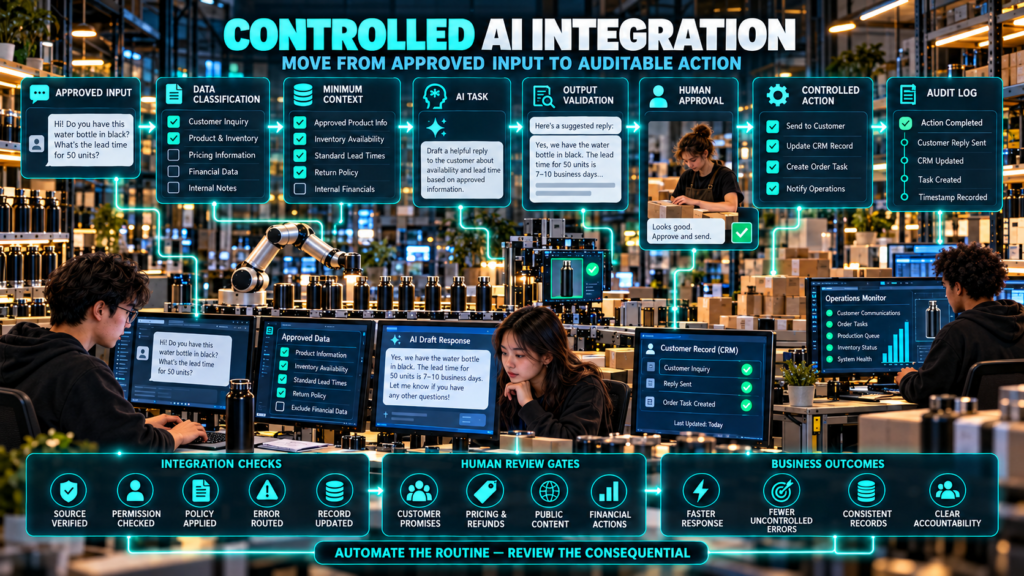
Approved input → data classification → minimum necessary context → model task → output validation → human approval → controlled action → system-of-record update → audit log
The human-approval stage for AI tools for small businesses can move depending on risk. A low-risk internal summary may be stored automatically, while a refund, price change, public advertisement, or customer commitment should wait for explicit approval.
Example: Lead-Response Workflow
- A web form validates the email address and records consent.
- Automation creates a lead in the CRM rather than in a private spreadsheet.
- The model classifies the inquiry using only necessary fields.
- A draft reply is created from approved product and policy information.
- The founder reviews the price, promise, and tone.
- The email is sent, and the final version is logged against the lead.
- An unanswered lead enters a follow-up queue after a defined interval.
This is a stronger use of AI tools for small businesses than allowing a chatbot to invent answers from an unrestricted website crawl. The workflow defines what the model may say, what it cannot decide, and where evidence is retained.
Deployment Challenges That Product Demos Hide
Data fragmentation is the first problem for AI tools for small businesses. A student business may store customer details across Gmail, WhatsApp, spreadsheets, payment tools, and social platforms, leaving no clean source from which an assistant can work.
Context limits are the second problem. A model can summarize the supplied material yet still miss an expired offer, a private exception, or the latest inventory position if those facts were not included.
Automation reliability is the third problem. Authentication tokens expire, application fields change, rate limits activate, and a workflow that succeeded during testing can fail silently during exams or holidays.
Vendor lock-in is the fourth problem. Prompts, agents, brand systems, and automation histories can become difficult to migrate, so AI tools for small businesses should be tested for exportability before they become operational dependencies.
Performance Evaluation Matrix
Score each use case for AI tools for small businesses from 1 to 5 after a two-week pilot. Do not score the platform as a whole; a tool can perform well for internal summaries and poorly for factual customer support.
| Metric | Measurement method | Minimum acceptance question | Weight |
|---|---|---|---|
| Accuracy | Blind review of 30 representative outputs | Does it meet the defined quality threshold? | 25% |
| Time saved | Median manual time minus supervised AI time | Does review erase the production gain? | 20% |
| Failure severity | Highest credible impact of a wrong output | Can a mistake be contained and reversed? | 20% |
| Integration effort | Setup and maintenance hours per month | Can the current team support it? | 15% |
| Data control | Contract, settings, access, retention, export | Is the data posture acceptable? | 10% |
| Unit economics | Monthly cost divided by accepted outputs | Is the cost lower than the alternative? | 10% |
The weighted score is:
Evaluation score = Σ(metric score × metric weight)
A high score does not authorize a high-risk use. Legal advice, credit decisions, health claims, hiring decisions, and academic assessment require separate controls regardless of convenience.
III. Commercial Solutions and Best Practices
The four AI tools for small businesses below occupy different positions in the stack. Pricing is a snapshot verified on September 25, 2026 and should be checked again before purchase.
Feature and Cost Comparison Table
| Platform | Best fit | Relevant 2026 commercial position | Principal limitation | Buying signal |
|---|---|---|---|---|
| ChatGPT Business | Research, analysis, drafting, files, internal assistants | Standard seats are listed at US$20 per user/month billed annually, or US$25 billed monthly, for most countries. A workspace requires at least two seats. Business workspace data is not used for model training.[4][5] | Requires at least two users; outputs still require verification | Repeated knowledge work across several business functions |
| Google Workspace Business Standard with Gemini | Email, documents, meetings, shared files, administration | Listed at US$14 per user/month on annual commitment; Workspace plans include Gemini capabilities across core apps.[6][7] | Strongest value appears when work already lives in Google Workspace | Existing Gmail, Docs, Drive, Meet workflow |
| Canva Business | Brand-controlled design, campaigns, presentations, visual assets | Listed at US$20 per person/month with no seat minimum; includes expanded AI and brand-management capability.[8][9] | Creative speed does not establish copyright clearance or factual accuracy | Frequent multi-channel creative production |
| Zapier | Cross-application automation and AI orchestration | Tiered by tasks; AI steps can consume tasks based on the selected model tier.[10][11] | Task overruns and brittle integrations can raise cost and maintenance | Stable manual workflow spanning multiple applications |
These prices for AI tools for small businesses are not directly comparable because the products solve different problems. A founder should not buy all four simply because each appears in a “best tools” list.
Solution 1: ChatGPT Business for Knowledge Work
Among AI tools for small businesses, ChatGPT Business is suited to research synthesis, spreadsheet analysis, proposal drafting, customer-message classification, document review, and reusable internal assistants. Its commercial value increases when the team repeatedly uses approved instructions and source material rather than starting from an empty chat every time.
OpenAI states that business data is not used to train its models by default and describes encryption and administrative privacy controls for business products.[4][5] Buyers should still configure access, retention, and sharing in line with their own risk profile.
For a student founder, the minimum viable deployment is one workspace, a small library of approved documents, and three repeatable tasks. Good candidates are weekly sales summaries, first-draft proposals, and structured competitor research with source links.
A solo founder should account for the two-seat minimum before purchasing ChatGPT Business. The subscription also excludes API usage, which is billed separately when an integration requires it.[4]
Do not use it as an autonomous accountant, lawyer, medical adviser, or final academic author. AI tools for small businesses can accelerate professional preparation, but licensed advice and institutional academic rules remain external constraints.
Solution 2: Google Workspace with Gemini for Work-in-Context
Among AI tools for small businesses, Google Workspace with Gemini is commercially attractive when business information already lives in Gmail, Docs, Drive, Sheets, and Meet. The integration reduces copying between services and can make summarization, drafting, and meeting follow-up easier to govern.
Google’s official plan information lists Gemini availability across Workspace applications and publishes edition-specific limits.[6][7] Buyers should compare storage, administration, AI capacity, and regional pricing rather than selecting a plan only from the headline monthly number.
A student operating a tutoring service could summarize inquiries, draft a weekly schedule, turn meeting notes into tasks, and produce a parent update from approved records. The founder should keep student information out of unnecessary prompts and confirm whether school, child-privacy, or contractual rules apply.
The main risk is permission sprawl. If every collaborator can search every Drive folder, the assistant may surface data that the person could technically access but should not use for the current task.
Solution 3: Canva Business for Controlled Creative Production
For creative production, AI tools for small businesses include Canva Business, which targets individuals and small teams needing brand controls, reusable templates, and AI assistance.[8][9] It is useful for advertisements, product sheets, social posts, presentations, and visual variations.
The business case is strongest when a founder publishes frequently and loses time rebuilding layouts. Create locked templates for logos, colors, disclaimers, price formatting, and calls to action before generating volume.
Generated creative still requires review for factual claims, licensing, likeness, cultural context, and platform policy. AI tools for small businesses can multiply output faster than a founder can inspect it, making a release checklist more important as volume rises.
Avoid publishing ten near-identical posts simply because generation is cheap. Commercial value comes from testing a small number of distinct messages against click, lead, or conversion data.
Solution 4: Zapier for Cross-Application Automation
For orchestration, AI tools for small businesses include Zapier, which connects web applications and combines conventional rules with AI steps. Its official site states that it supports more than 9,000 applications, while its 2026 documentation explains model-based task consumption for AI by Zapier.[10][11]
This makes the platform useful for lead routing, ticket tagging, content approvals, invoice reminders, and reporting. It also means cost depends on run frequency, workflow design, and the task weight of selected AI models.
Start with deterministic automation before adding generative steps. Moving a validated form entry into a CRM is easier to test than letting a model decide whether a customer deserves a refund.
Each production workflow needs a failure queue, notification owner, duplicate check, execution limit, and documented way to disable it. Those controls distinguish dependable AI tools for small businesses from an unattended chain of account permissions.
IV. A Practical Buying Framework for Student Entrepreneurs
The right AI tools for small businesses are determined by the bottleneck, not by the number of features. Use the following framework before entering payment details.
Step 1: Baseline One Workflow
Before buying AI tools for small businesses, record the current process for two weeks. Count monthly cases, median handling time, rework, error rate, and any delay that affects customers or revenue.
Do not claim “80% time saved” from one successful prompt. Compare accepted outputs under normal conditions, including review and correction time.
Step 2: Classify the Risk
Low-risk uses of AI tools for small businesses include internal brainstorming, formatting, and summaries that do not trigger action. Medium-risk tasks include draft marketing, lead classification, and internal recommendations.
High-risk tasks include payments, refunds, legal or health claims, employment decisions, sensitive personal data, and messages that create contractual expectations. These require stricter approval or should remain outside the model.
Step 3: Set a Budget Ceiling
Calculate the complete monthly cost of AI tools for small businesses: subscription, tax, usage, integrations, implementation time, review labor, and maintenance. Free plans are useful for exploration but may lack the data controls expected for live customer information.
A practical ceiling is the lower of the value released or the cost of the next-best method. AI tools for small businesses should not be funded by optimistic revenue that has not occurred.
Step 4: Run a Controlled Pilot
Test AI tools for small businesses with 30 representative cases, including edge cases and poor-quality inputs. Record every correction instead of remembering only the strongest outputs.
Do not connect write access to the production CRM during early testing. Use copies, test accounts, or approval-only drafts until performance and failure handling are understood.
Step 5: Approve, Redesign, or Stop
Approve AI tools for small businesses only if the use case meets quality, cost, and control thresholds. Redesign it if the failure is traceable to missing context or workflow design, and stop if the risk exceeds the benefit.
This discipline keeps AI tools for small businesses from becoming permanent subscriptions attached to temporary enthusiasm.
V. Business Outcomes and Strategic ROI Takeaways
ROI for AI tools for small businesses should be calculated from verified operating data rather than vendor demonstrations. The goal is not to prove that the model is intelligent; it is to prove that the workflow improves an outcome at an acceptable risk.
ROI Model
Monthly modeled benefit = valued net labour capacity released + verified incremental gross profit + avoided external spending + other non-overlapping savings.
Monthly total cost = subscriptions + usage charges + monthly allocation of setup cost + ongoing maintenance and other operating costs.
Monthly modeled net value = monthly modeled benefit − monthly total cost.
Monthly modeled return percentage = monthly modeled net value ÷ monthly total cost × 100, provided total cost is greater than zero.
Value released capacity using net hours saved after review and correction, multiplied by a stated hourly rate. If review time is already deducted from hours saved, do not subtract the same labour cost again. Count incremental gross profit only when evidence links the improvement to the workflow, and avoid counting the same benefit as both time saved and avoided rework.
Labor capacity released is not automatically cash savings. If the founder uses saved hours for study, customer acquisition, or product delivery, report it as capacity unless payroll actually decreases.
Scenario: Student-Run Service Business
Assume a student agency processes 120 inquiries, creates 24 campaign assets, and prepares four client reports each month. A pilot may show that assisted drafting and structured templates reduce handling time without changing headcount.
The business should measure accepted output per hour, first-response time, correction rate, lead conversion, and missed deadlines. These metrics connect AI tools for small businesses to operations without inventing a universal productivity percentage.
Performance Evaluation Matrix Table
| Use case | Primary KPI | Guardrail KPI | Review frequency | Scale condition |
|---|---|---|---|---|
| Inquiry drafting | Median response time | Material error rate | Weekly | Error rate stays below approved threshold |
| Content production | Accepted assets per hour | Brand or factual rejection rate | Per campaign | Conversion quality does not decline |
| Meeting summaries | Action items captured | False or missing commitments | Weekly sample | Named owners confirm reliability |
| Lead classification | Qualified-lead conversion | Bias and false-negative review | Monthly | Results remain stable by segment |
| Workflow automation | Successful runs | Duplicate and failed actions | Daily alert, monthly review | Recovery procedure is tested |
Strategic Takeaways
First, consolidate before expanding. A business with five overlapping assistants usually has a governance problem, not a capability advantage.
Second, use the product closest to the data and workflow. Workspace-native assistance often beats a more powerful isolated model when copying and permissions create friction.
Third, keep a human at consequential boundaries. Publishing, payment, contract, refund, hiring, and sensitive-data decisions deserve explicit accountability.
Fourth, retain an exit path. Export prompts, templates, customer records, workflow documentation, and evaluation data so the operation can survive a price or product change.
Finally, renew from evidence. AI tools for small businesses should survive the same scrutiny as any other commercial software: adoption, utilization, outcome, risk, and total cost.
VI. Risk Mitigation and Regulatory Framework
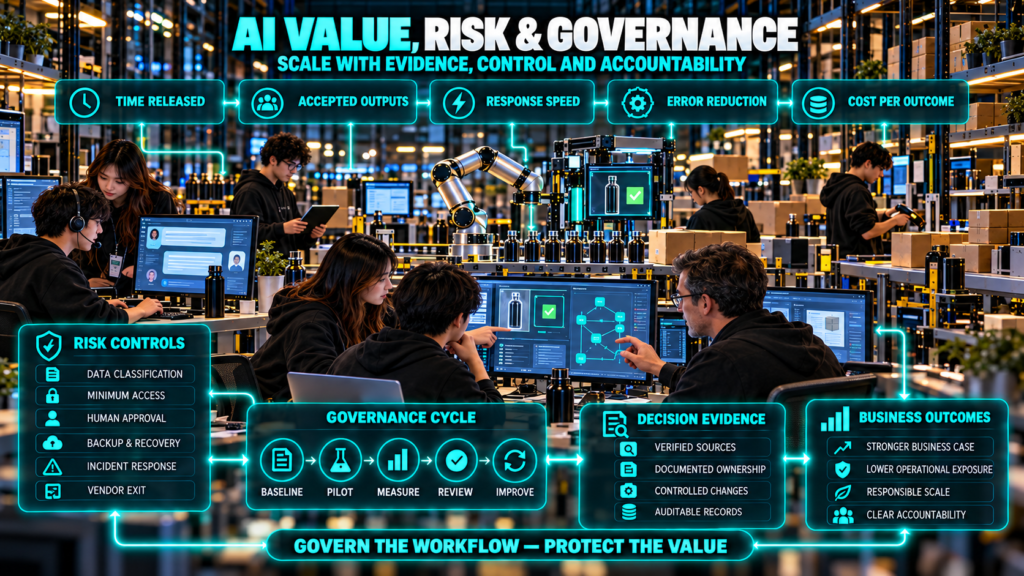
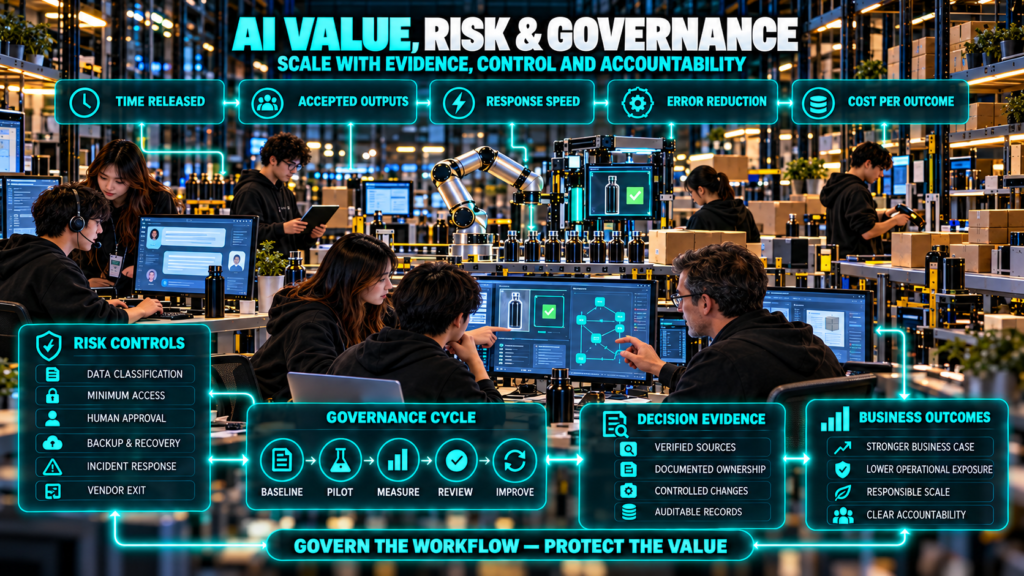
Governance for AI tools for small businesses can use NIST’s voluntary AI Risk Management Framework, whose Govern, Map, Measure, and Manage functions provide a practical control structure.[12] NIST’s Generative AI Profile adds risk-management actions tailored to generative systems.[13]
The EU AI Act became broadly applicable on August 2, 2026, subject to exceptions and amended timelines, and its Article 50 transparency provisions address specified AI-generated content and deepfakes.[14][15] A U.S. or Indian student business should assess these rules when it offers services to EU users or deploys covered systems in that market.
NIST-Aligned Governance Checklist
- Name an owner for every production AI use case.
- Document purpose, users, data sources, outputs, and prohibited uses.
- Classify data before it enters a model or connected application.
- Test accuracy, harmful failure modes, and representative edge cases.
- Record the model, plan, prompt or agent version, and connected systems.
- Require human approval for consequential external actions.
- Monitor quality, cost, complaints, access, and failed automations.
- Maintain incident response, rollback, export, and vendor-exit procedures.
- Review the use case after material vendor or workflow changes.
Privacy and Security Checklist
- Use business accounts rather than shared personal credentials.
- Enable multifactor authentication and remove departed collaborators.
- Grant the minimum Drive, CRM, email, and payment permissions required.
- Do not paste passwords, payment-card data, health records, or identity documents into unapproved services.
- Check vendor retention, training, deletion, subprocessors, and export terms.
- Separate school records from commercial customer data.
- Encrypt exported datasets and maintain tested backups.
- Log automated changes to customer and financial records.
Content, Consumer, and Academic Integrity Checklist
- Verify factual, price, performance, and legal claims before publication.
- Disclose synthetic or manipulated media when law, platform rules, or context requires it.
- Never generate fake reviews, testimonials, identities, or engagement.
- Check copyright, trademark, likeness, and license rights for creative assets.
- Follow the student’s institution rules for assignments, research, and attribution.
- Distinguish a founder’s commercial work from assessed academic work.
- Preserve source links and evidence for material business claims.
The FTC’s enforcement record makes one point especially important: calling a product AI-powered does not excuse deceptive performance or income claims.[3] Marketing for AI tools for small businesses must remain truthful, substantiated, and clear about meaningful limitations.
VII. Choosing a Starter Stack and Testing Its Value
Begin evaluating AI tools for small businesses with one workflow, not a shopping list. Choose a task that occurs at least weekly, consumes measurable time, and can be reviewed before it affects a customer.
For most student founders, the first decision is between a governed general assistant and the AI already included in the productivity suite where work lives. Add Canva Business when creative throughput is the constraint, and add Zapier only after the manual process and ownership rules are stable.
Use a 30-day pilot as an initial planning window, with baseline data, a budget ceiling and a written stop condition. Start with 30 representative cases, then expand testing where errors could materially affect customers or finances. Renew only when accepted output, review effort, reliability and measured value justify the cost.
VIII. Appendix and Research Integrity
Appendix A: Academic and Primary-Source Footnotes
- U.S. Chamber of Commerce, “U.S. Chamber’s Latest ‘Empowering Small Business’ Report Shows Majority of Businesses in All 50 States Are Embracing AI,” August 18, 2025. https://www.uschamber.com/technology/artificial-intelligence/u-s-chambers-latest-empowering-small-business-report-shows-majority-of-businesses-in-all-50-states-are-embracing-ai
- Federal Trade Commission, “AI Companies: Uphold Your Privacy and Confidentiality Commitments,” January 9, 2024. https://www.ftc.gov/policy/advocacy-research/tech-at-ftc/2024/01/ai-companies-uphold-your-privacy-confidentiality-commitments
- Federal Trade Commission, “FTC Announces Crackdown on Deceptive AI Claims and Schemes,” September 25, 2024. https://www.ftc.gov/news-events/news/press-releases/2024/09/ftc-announces-crackdown-deceptive-ai-claims-schemes
- OpenAI, “ChatGPT Pricing,” accessed September 25, 2026. https://openai.com/business/chatgpt-pricing/ https://help.openai.com/en/articles/8792828-chatgpt-business-overview
- OpenAI, “Enterprise Privacy at OpenAI,” updated January 8, 2026. https://openai.com/enterprise-privacy/
- Google Workspace, “Business Editions Overview,” accessed September 25, 2026. https://knowledge.workspace.google.com/admin/getting-started/editions/business-editions
- Google Workspace, “Google Workspace with Gemini,” accessed September 25, 2026. https://knowledge.workspace.google.com/admin/generative-ai/workspace-with-gemini/google-workspace-with-gemini
- Canva, “A Powerful New Plan for Small Businesses with Big Ambitions,” October 29, 2025. https://www.canva.com/newsroom/news/introducing-canva-business/
- Canva, “Canva Business,” accessed September 25, 2026. https://www.canva.com/canva-business/
- Zapier, “Plans and Pricing,” accessed September 25, 2026. https://zapier.com/pricing
- Zapier, “AI by Zapier: New Model-Based Pricing Starting June 15, 2026,” updated August 12, 2026. https://help.zapier.com/hc/en-us/articles/46597632373389-AI-by-Zapier-new-model-based-pricing-starting-June-15-2026
- National Institute of Standards and Technology, “AI Risk Management Framework,” accessed September 25, 2026. https://www.nist.gov/itl/ai-risk-management-framework
- NIST, Artificial Intelligence Risk Management Framework: Generative Artificial Intelligence Profile, NIST AI 600-1, July 2024. https://doi.org/10.6028/NIST.AI.600-1
- European Commission, “AI Act: Regulatory Framework for Artificial Intelligence,” accessed September 25, 2026. https://digital-strategy.ec.europa.eu/en/policies/regulatory-framework-ai
- European Commission, “Code of Practice on Transparency of AI-Generated Content,” July 20, 2026. https://digital-strategy.ec.europa.eu/en/policies/code-practice-ai-generated-content
Appendix B: Source-to-Claim Index
| Claim category | Footnote numbers | Evidence type |
|---|---|---|
| Small-business AI adoption | 1 | Industry survey report |
| Privacy and deceptive AI marketing | 2–3 | U.S. regulator guidance and enforcement |
| ChatGPT Business price and data posture | 4–5 | Vendor pricing and privacy documentation |
| Google Workspace price and Gemini availability | 6–7 | Vendor administrator documentation |
| Canva Business price and capabilities | 8–9 | Vendor announcement and product documentation |
| Zapier ecosystem and AI task pricing | 10–11 | Vendor pricing and help documentation |
| AI risk governance | 12–13 | U.S. technical standards publications |
| EU AI Act application and transparency | 14–15 | European Commission regulatory guidance |
Corporate Editorial Transparency and AI Usage Disclosure
AI-assisted tools were used to support research organization, drafting and language refinement. NezzHub retains editorial responsibility for the published article. Vendor inclusion does not constitute endorsement.
No vendor paid for inclusion in the comparison. Product selection reflects common small-business workflows, and links should not be treated as endorsements or affiliate relationships unless the publisher separately discloses such a relationship.
Author and Editorial Review
Author: Garikapati Bullivenkaiah
Technology research writer with LL.B., LL.M., M.A., and MBA qualifications. He writes about emerging technologies and their business, governance and legal implications. His multidisciplinary academic background informs his analysis of technology adoption, intellectual property, and organizational risk. His articles explain technical concepts and practical considerations for business owners, IT managers and technology decision-makers. LinkedIn Profile
Reviewed by: Chitikineni Ramadevi — Editor
Chitikineni Ramadevi holds an M.Sc. in Computers from Andhra University and has over 10 years of research experience in technology-related subjects. She reviews NezzHub articles for clarity, factual accuracy, source support and practical relevance.
Published by: NezzHub
Research approach: This article draws on primary sources, technical documentation and relevant industry research. References are provided within the article or its sources section.
Last reviewed: 09-25-2026
Corrections: To report a factual error or outdated information, please contact NezzHub.

Garikapati Bullivenkaiah is a seasoned entrepreneur with a rich multidisciplinary academic foundation—including LL.B., LL.M., M.A., and M.B.A. degrees—that uniquely blend legal insight, managerial acumen, and sociocultural understanding. Driven by vision and integrity, he leads his own enterprise with a strategic mindset informed by rigorous legal training and advanced business education. His strong analytical skills, honed through legal and management disciplines, empower him to navigate complex challenges, mitigate risks, and foster growth in diverse sectors. Committed to delivering value, Garikapati’s entrepreneurial journey is characterized by innovative approaches, ethical leadership, and the ability to convert cross-domain knowledge into practical, client-focused solutions.