















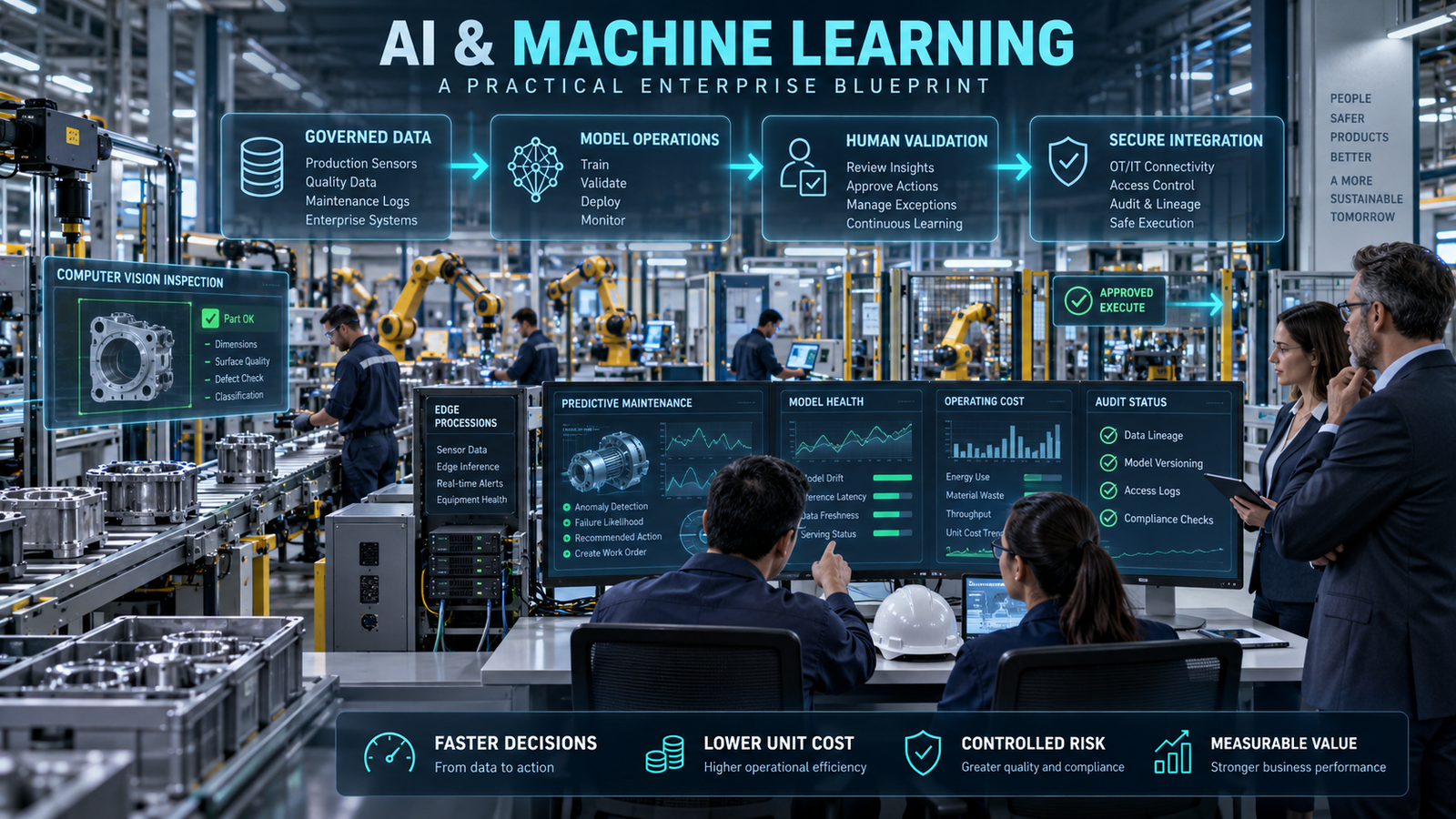
Executive Summary
AI and machine learning spending is moving from isolated experiments into core workflows, but procurement has outpaced operational discipline. Enterprise AI solutions now promise faster decisions, while machine learning platforms compress development cycles and AI implementation services reduce deployment friction.
Those advantages do not remove the hard work. AI governance software, representative evaluation data, security controls and finance-grade measurement are required before a model can become a dependable business system.
The commercial case for AI and machine learning is strong but uneven. Stanford’s 2025 AI Index reported that 78% of surveyed organizations used AI in at least one business function during 2024, up from 55% in 2023; reported generative-AI use reached 71%.[1]
Falling model costs strengthen the case. The same report estimated that inference cost for a system performing at the level of GPT-3.5 fell more than 280-fold between November 2022 and October 2024.[1]
Cheaper inference does not equal cheap deployment. Data engineering, integration, review queues, monitoring, cybersecurity, compliance and process redesign commonly exceed the model API bill.
The central finding is direct: AI and machine learning create value when a bounded workflow has a measurable baseline, reliable evidence, controlled actions and an accountable owner. A broad “AI transformation” program without those elements is a portfolio of liabilities disguised as innovation.
This paper provides the operating model. It covers architecture, integration flow, evaluation, deployment failure modes, commercial solution patterns, total cost of ownership, ROI calculations and a regulatory framework aligned with NIST, ISO and the EU AI Act.
I. The Current Market Landscape and Challenge
Adoption Has Accelerated Faster Than Control
AI and machine learning are no longer confined to research teams. Customer support, fraud operations, forecasting, document processing, software development and industrial inspection now place model output inside everyday decisions.
The speed of AI and machine learning adoption creates a governance gap. Business teams can subscribe to enterprise AI solutions within hours, while security review, data classification and model evaluation may take weeks.
That asymmetry produces “shadow AI.” Employees paste confidential material into unsanctioned tools because the approved workflow is slower or absent.
Blocking every tool rarely fixes the problem. Organizations need an approved route with identity controls, protected data, usable interfaces and clear boundaries on prohibited tasks.
The Real Bottleneck Is the System Around the Model
A model demonstration starts with curated inputs. Production receives missing fields, ambiguous language, stale records, duplicates, unusual customers and adversarial content.
Machine learning platforms can automate training and serving, but they cannot decide whether a label is legally or operationally valid. AI implementation services can connect systems, but the buyer still owns the decision policy.
The distinction matters. A classifier may achieve strong test accuracy while the overall workflow fails because human reviewers cannot process uncertain cases or downstream systems cannot accept corrected outputs.
Cost of Inaction
Organizations that avoid all experimentation may preserve manual queues, slow analysis and fragmented knowledge. They also lose the operational learning needed to evaluate vendors and negotiate contracts.
The cost is not only labor. Delayed fraud alerts, missed equipment faults and poor demand forecasts can create avoidable loss, excess inventory or service failures.
Yet premature automation creates a different cost. Incorrect decisions can scale faster than teams can detect them, particularly when no appeal, rollback or evidence trail exists.
The rational response is controlled adoption. Test one high-volume workflow, measure the result and stop projects that cannot beat the baseline.
Market Claims Versus Operational Evidence
Vendor accuracy figures are rarely transferable. Results depend on dataset, prompt, context length, hardware, quantization, sampling settings and evaluation rules.
MLCommons publishes reproducible MLPerf benchmarks for training and inference across systems.[2] Those results help compare hardware and software configurations, but they do not predict accuracy on a company’s contracts, customers or production images.
Enterprise buyers therefore need two evidence layers. Standard benchmarks support infrastructure comparison; private acceptance tests establish fitness for the intended workflow.
How to Start Learn Artificial Intelligence Step by Step
II. Deep-Dive Technical Analysis and Evidence
Architecture Overview for AI and Machine Learning
A production architecture for AI and machine learning is a chain of controls, not a single model. Each component must expose ownership, telemetry and a failure path.
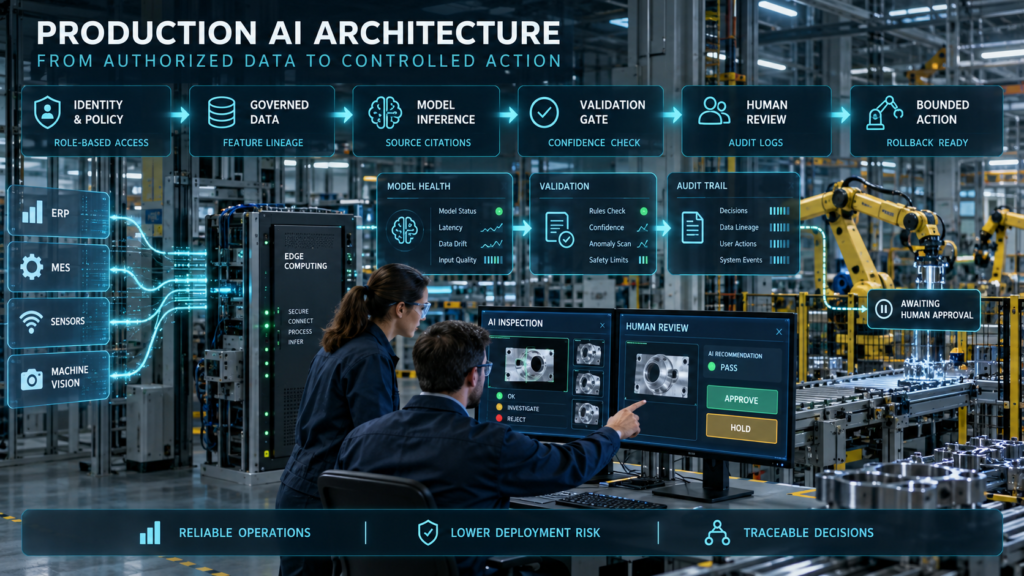
The minimum operating stack includes:
- Experience layer: employee, customer, partner, API or device interface.
- Identity and policy: authentication, authorization, consent and purpose limitations.
- Integration layer: API gateway, event bus, workflow engine and system adapters.
- Data layer: source systems, feature store, vector index, catalogue and lineage.
- Model layer: predictive models, foundation models, routing and fallback logic.
- Validation layer: rules, confidence thresholds, citations and safety filters.
- Action layer: human approval, bounded automation and transaction controls.
- Operations layer: logging, evaluation, drift, security and incident management.
Enterprise AI solutions should inherit existing access rights. Retrieval systems must never return documents that the requesting user could not open in the source repository.
AI governance software should connect model inventory, risk classification, approvals, evaluation evidence and incident records. A dashboard without enforceable workflow gates is reporting software, not governance.
Integration Flowchart: Evidence Before Action
flowchart TD
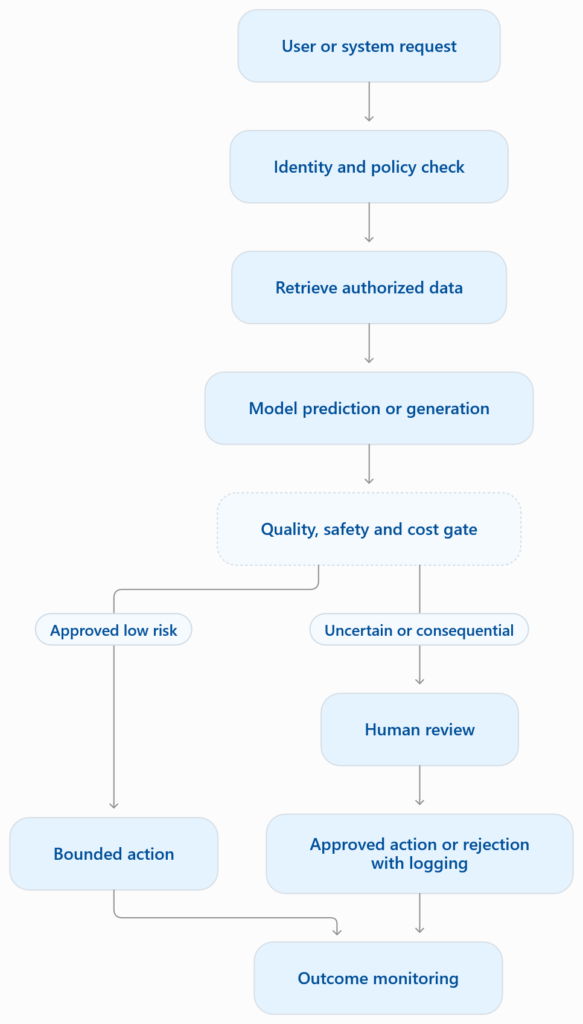
This pattern separates content from authority. The model proposes; policy determines whether the output can proceed automatically, requires review or must be rejected.
For generative workflows that depend on external information, retrieval should supply authorized evidence with traceable citations. For predictive workflows, training and inference should use consistent feature definitions and transformation logic. Historical training data should reflect the information available at each observation’s timestamp; live feature values can change as new information arrives.
Data Architecture and Model Choices
Structured prediction may use gradient-boosted trees, linear models or neural networks. Document and language workflows increasingly use foundation models with retrieval-augmented generation.
The correct choice is the smallest model that satisfies the service level. Larger models may improve capability but increase latency, cost, energy use and operational exposure.
Machine learning platforms usually support notebooks, pipelines, registries, feature management, deployment and monitoring. Their value depends on integration with identity, observability, security and the organization’s software-delivery process.
Open-weight models offer deployment control and portability. Hosted models reduce infrastructure work but add dependency on vendor pricing, model changes, service availability and data-handling terms.
Hybrid architecture is often superior. A local model can classify sensitive inputs while a hosted model drafts low-risk text after minimization and policy checks.
Retrieval-Augmented Generation Is Not a Truth Engine
Retrieval reduces unsupported answers by supplying relevant sources. It still fails when indexing is stale, access filters are wrong, chunks omit context or retrieved content contains malicious instructions.
The application must preserve source identity, access permissions and document version. Citations should link to the exact evidence used, not a generic homepage.
Prompt injection remains a leading risk in OWASP’s 2025 list for large-language-model applications.[3] Retrieved text must be treated as untrusted input because it can instruct an agent to ignore policy or expose data.
Performance Evaluation Matrix
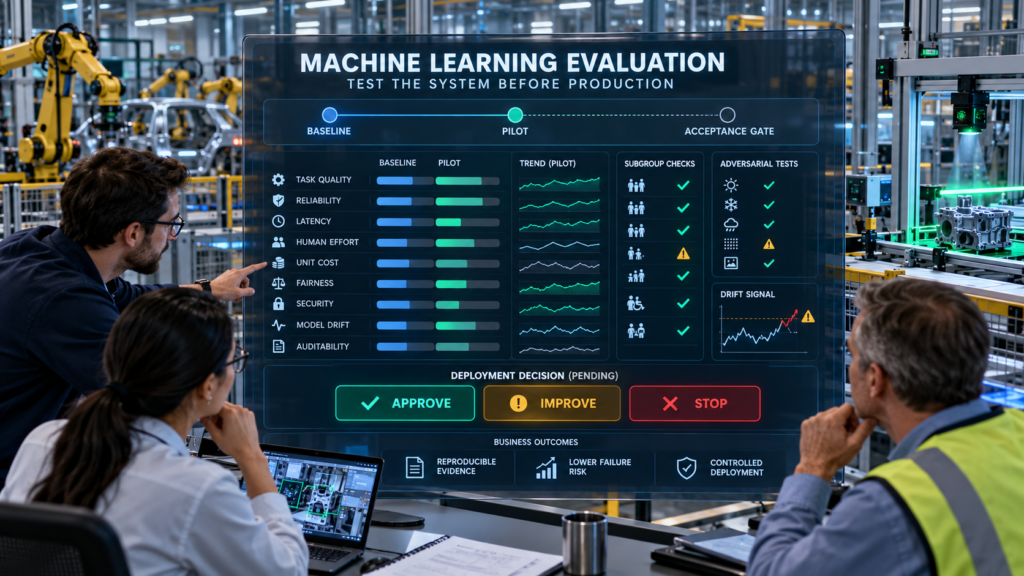
| Dimension | Required metric | Release rule | Commercial relevance |
| Task quality | Precision, recall, F1, groundedness or success rate | Preapproved threshold | Prevents attractive but unreliable demos |
| Reliability | Failure, timeout and retry rate | Within service level | Measures production availability |
| Latency | Median and tail response time | Fits user workflow | Controls adoption and infrastructure cost |
| Human effort | Review minutes and escalation rate | Below baseline | Exposes displaced labor |
| Unit economics | Cost per completed outcome | Finance-approved ceiling | Includes full operating cost |
| Fairness | Error gaps across relevant groups | Within risk tolerance | Detects uneven harm |
| Security | Adversarial success rate | Zero for critical paths | Tests injection and data leakage |
| Drift | Data and performance change | Alert and action thresholds | Protects performance after launch |
| Auditability | Reproducible decision records | Complete for consequential use | Supports disputes and investigation |
| Adoption | Eligible-user completion and abandonment | Sustained cohort target | Separates novelty from utility |
One average score is inadequate. AI and machine learning evaluation should report errors by customer type, geography, language, device or other materially affected group.
Validation Design
Create a locked AI and machine learning acceptance set before selecting the winning vendor. Include common cases, rare cases, ambiguous cases, adversarial inputs and examples with known business consequences.
Do not use the same set for prompt tuning and final acceptance. Repeated tuning leaks knowledge of the test set and creates an inflated result.
For stochastic outputs, run each case multiple times. Report both average quality and worst-case failure patterns.
Performance testing should include concurrency, long context, tool calls and fallback behavior. A model that responds well in isolation may miss the service level under a morning traffic spike.
Deployment Challenges
Challenge 1: Training–Serving Skew
Features calculated during training may differ from live features because of timestamp handling, missing values or transformation code. The result is silent performance decay even when the model artifact is unchanged.
Use shared transformation logic, feature lineage and point-in-time-correct datasets. Monitor live feature distributions against the validated baseline.
Challenge 2: Weak Labels
Historical decisions are not automatically ground truth. They may reflect inconsistent staff practice, outdated policy or selective recording.
Review label definitions with domain owners and sample disagreements. High inter-reviewer disagreement sets a practical ceiling on model performance.
Challenge 3: Model Supply-Chain Risk
Serialized models, third-party packages and downloaded weights can execute or introduce unsafe code. In 2025, CVE-2025-32434 highlighted a PyTorch torch.load remote-code-execution risk even when weights_only=True was used in affected versions.[4]
Pin and scan dependencies, verify model provenance, use safe serialization and isolate model-loading environments. Software bills of materials should include ML frameworks and serving images.
Challenge 4: Cost Expansion
Long prompts, retrieved documents, retries, agent loops and review queues expand cost beyond quoted token rates. GPU reservations also waste money when utilization is low.
AI implementation services should report cost per successful business outcome. Routing, caching, smaller models and context limits should be tested before purchasing more capacity.
Challenge 5: Drift and Model Change
Customer behavior, product mix and external conditions change. Hosted-model providers may also update behavior behind an API.
Maintain regression suites, version records and rollback capability. Shadow-test replacements before routing production traffic.
Challenge 6: Human Review Becomes the Bottleneck
High escalation rates can overwhelm reviewers and erase projected savings. Reviewers may also accept suggestions automatically, creating automation bias.
Measure queue length, decision time, override rate and overturn rate. Redesign the boundary if humans are only rubber-stamping machine output.
III. Commercial Solutions and Best Practices
Feature and Cost Comparison Table
This table compares AI and machine learning operating patterns rather than endorsing named products. Buyers should obtain current quotations because model availability, licensing and consumption prices change frequently.
| Solution pattern | Best fit | Strengths | Primary cost drivers | Main limitations |
| Hyperscaler managed stack | Rapid enterprise rollout and cloud integration | Broad services, elastic capacity, mature controls | Tokens, GPUs, storage, network, premium support | Lock-in, egress, regional availability, opaque updates |
| Independent model/API provider | Best-of-breed generative features | Fast access to leading models, simple APIs | Token volume, context, tool calls, service tier | Concentration risk, data terms, integration burden |
| Private/open-weight platform | Sensitive workloads and stable high volume | Control, customization, portability | Hardware, MLOps, tuning, patching, energy | Specialist staff, capacity planning, security ownership |
| Vertical AI application | Defined finance, health, legal or industrial workflow | Domain UI, faster implementation, packaged workflow | Seats, transactions, connectors, validation | Narrow use, vendor evidence, limited portability |
Enterprise AI solutions should be compared on the same acceptance set and workload model. Feature checklists do not reveal retrieval quality, permission leakage or review effort.
A Seven-Gate Buying Framework
Gate 1: Define the Workflow
Name the user, trigger, input, output, downstream action and business consequence. “Deploy AI” is not a project definition.
Gate 2: Establish the Baseline
Measure volume, cycle time, error, abandonment, escalation and loaded cost. The baseline must use the same outcome definition as the pilot.
Gate 3: Classify Risk and Data
Identify personal, health, financial, biometric, confidential and regulated information. Determine who could be harmed and whether an error is reversible.
Gate 4: Select the Architecture
Decide between hosted, private and hybrid deployment. Test at least two models to avoid confusing one provider’s behavior with the capability of the category.
Gate 5: Run a Controlled Pilot
Limit users, data, spending and permitted actions. Define stop conditions for security incidents, quality collapse, cost overrun and discriminatory effects.
Gate 6: Prove Economics
Calculate total cost per completed outcome. Include software, inference, integration, data work, evaluation, cybersecurity, governance, support and human review.
Gate 7: Authorize Scale
Require sign-off from business, technology, security, privacy and risk owners. Expansion must preserve rollback and complaint handling.
Contract Requirements for AI Implementation Services
Contracts should define permitted data use, training restrictions, retention, deletion, location, subprocessors and breach notification. Buyers need audit rights or equivalent independent evidence.
Service levels should cover availability, latency, version notice and recovery—not only support response. The supplier should document model, prompt and policy changes that can alter output.
Require export of evaluation results, configuration, prompts and logs in usable formats. Exit costs deserve the same scrutiny as implementation fees.
AI implementation services must disclose assumptions behind projected savings. A promise based on gross time saved is incomplete when review, remediation and adoption are excluded.
Platform Selection Scorecard
| Criterion | Suggested weight | Evidence to request |
| Workflow quality | 25% | Blind acceptance-test results |
| Security and privacy | 20% | Architecture, tests, certifications, incident history |
| Integration and identity | 15% | Connector demo with real permissions |
| Total cost | 15% | Workload-based three-year model |
| Governance | 10% | Inventory, approvals, audit and monitoring |
| Portability | 10% | Export and replacement exercise |
| Vendor viability | 5% | Financial and operational due diligence |
Weights should change with context. A clinical or credit decision should assign more weight to validation, governance and human appeal than a marketing-copy assistant.
IV. Business Outcomes and Strategic ROI Takeaways
Finance-Grade ROI Model

Use a transparent calculation:
Annual modeled net value = (V × S × C) + A − (L + I + O + R)
V is the annual number of successfully completed, adopted tasks. S is the measured net time saved per task in hours, and C is the loaded labor cost per hour. A is verified avoided loss or incremental contribution, excluding benefits already counted as labor capacity. L is annual licensing and inference cost; I is the annual allocation of integration cost; O is annual operating cost; and R is annual expected remediation cost. Include the costs of unsuccessful tasks and use one currency consistently.
The equation does not prove value. Every input must be measured or explicitly labeled as an assumption.
Illustrative Scenario—Not a Benchmark
Assume an operations team processes 400,000 eligible documents annually. A controlled pilot verifies four minutes of net time saved per document after review, at a loaded labor rate of $36 per hour.
Gross capacity value is $960,000. If annual licensing, inference, integration amortization, monitoring, support and remediation total $640,000, modeled net value is $320,000.
The benefit is cash only if headcount or external spending declines. If staff are redeployed, finance should classify the result as capacity, avoided hiring or improved service—not direct savings.
Where AI and Machine Learning Produce Defensible Value
Customer Operations
Retrieval, summarization and agent assistance can reduce search and drafting time. Grounded citations and approval controls are essential when responses affect contracts, refunds or regulated disclosures.
Finance and Risk
Machine learning can prioritize fraud cases, forecast cash flow and detect anomalies. Final adverse decisions require reason codes, monitoring and appeal when law or sector rules demand them.
Manufacturing
Vision inspection and predictive maintenance can reduce manual inspection and unplanned downtime. ROI must separate model accuracy from sensor upgrades and process changes.
Supply Chain
Demand forecasting and inventory optimization can reduce stockouts or excess stock. Backtests should include disruption periods, not only stable demand.
Software Engineering
Code assistants may accelerate routine work, documentation and testing. Organizations must measure review time, defects, security findings and maintainability rather than counting generated lines.
Strategic ROI Takeaways
AI and machine learning programs should fund workflows, not model brands. Model choice can change during the life of the system, while integration and control requirements persist.
Machine learning platforms earn their cost when they reduce repeated engineering, standardize deployment and improve traceability across several use cases. A platform serving one weak pilot becomes expensive shelfware.
Enterprise AI solutions need portfolio governance. Boards should see systems scaled, stopped and under remediation, plus value realized, incidents, unit cost and concentration risk.
V. Risk Mitigation and Regulatory Framework
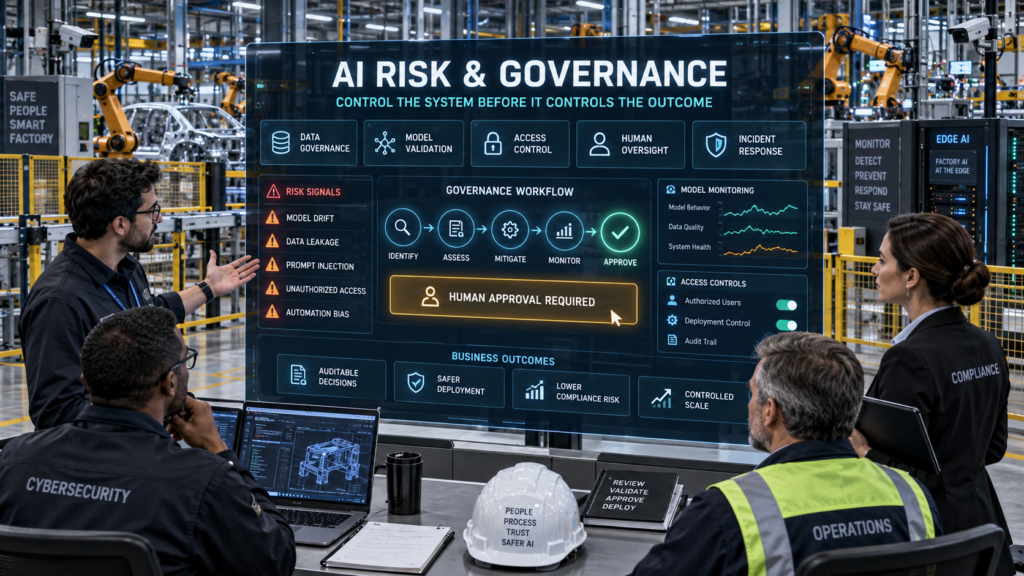
NIST, ISO and EU AI Act Mapping
NIST AI RMF 1.0 organizes voluntary risk management into Govern, Map, Measure and Manage.[5] Its Generative AI Profile adds risks such as confabulation, privacy, information integrity, security and harmful bias.[6]
ISO/IEC 42001:2023 specifies requirements for establishing and continually improving an AI management system.[7] ISO/IEC 23894:2023 provides AI-specific risk-management guidance.[8]
The EU AI Act applies according to system role and risk category, including obligations that can reach providers and deployers outside the EU when systems or outputs are placed in or affect the EU market. Its phased timetable must be checked against the current official implementation page before deployment.[9]
AI governance software can organize evidence for these frameworks, but it cannot confer compliance automatically. Legal applicability and control effectiveness require qualified review.
Governance Checklist
- Maintain an inventory of models, versions, data, tools and owners.
- Classify use cases by impact, affected people and reversibility.
- Document intended use, prohibited use and foreseeable misuse.
- Establish data authority, retention, deletion and access rules.
- Test quality, fairness, privacy, security, latency and cost.
- Red-team prompt injection, tool abuse and sensitive-data disclosure.
- Require meaningful human review for consequential decisions.
- Provide correction, complaint and appeal channels.
- Log evidence, model version, policy result, override and outcome.
- Monitor drift, incidents, cost, energy and vendor changes.
- Predefine pause, rollback, notification and remediation procedures.
- Exercise vendor exit and model replacement at least annually.
Risk Register
| Risk | Failure vector | Preventive control | Detection | Response |
| Unsupported output | Model invents facts | Retrieval, constraints, citations | Factuality sampling | Block and correct |
| Bias | Skewed data or labels | Representative data and policy review | Subgroup error tracking | Pause affected decisions |
| Privacy leakage | Prompt, log or connector exposure | Minimization, encryption, access control | DLP and audit alerts | Contain and assess |
| Prompt injection | Malicious input or retrieved content | Isolation, least privilege, allowlists | Adversarial monitoring | Revoke tools and investigate |
| Supply-chain compromise | Unsafe package, weight or image | Provenance, scanning, sandboxing | EDR and integrity checks | Isolate, patch and rotate secrets |
| Drift | Population or model change | Versioning and scheduled validation | Threshold alerts | Roll back or recalibrate |
| Automation bias | Reviewer over-trust | Training, evidence display, sampling | Override and error analysis | Redesign review boundary |
| Cost overrun | Context growth, retries, idle capacity | Budgets, routing, caching | Unit-cost dashboard | Throttle or resize |
Infrastructure and Environmental Constraint
Compute demand from AI and machine learning is a commercial and capacity risk. The U.S. Department of Energy reported that data-center electricity use represented about 4.4% of U.S. electricity in 2023 and could reach roughly 6.7%–12% by 2028.[10]
That projection is not an allocation to AI alone. It does show why location, power availability, cooling, utilization and model efficiency belong in technology deployment planning.
Final Decision Test
Before scale, answer five questions. Does the system beat a measured baseline, work for the affected population, survive adversarial testing, remain controllable when it fails and create value after every cost is included?
For AI and machine learning, an unknown answer is not approval. It is a requirement for a narrower pilot or additional evidence.
Preparing One Workflow for Production Approval
Select one repeatable, high-cost workflow and prepare a deployment evidence dossier. Include the baseline, architecture, data map, acceptance tests, threat model, regulatory assessment, workload budget, stop conditions and financial assumptions. Choose a pilot duration that captures representative workload conditions and provides enough evidence to assess quality, cost and risk.
Use that evidence to compare enterprise AI solutions, machine learning platforms, AI implementation services and AI governance software. Scale only after the workflow earns approval through measured performance and controlled risk.
VI. Appendix and Research Integrity
Appendix A: Academic and Primary-Source Footnotes
- Stanford Institute for Human-Centered Artificial Intelligence, Artificial Intelligence Index Report 2025, April 2025. The report documents organizational adoption and estimates a more than 280-fold reduction in GPT-3.5-level inference cost between November 2022 and October 2024. https://hai.stanford.edu/ai-index/2025-ai-index-report
- MLCommons, “MLPerf Inference v5.0 Results,” 2 April 2025. https://mlcommons.org/2025/04/mlperf-inference-v5-0-results/
- OWASP GenAI Security Project, “Top 10 for LLM Applications 2025” and “LLM01:2025 Prompt Injection.” https://genai.owasp.org/llm-top-10/
- NIST National Vulnerability Database, CVE-2025-32434, PyTorch torch.load remote-code-execution vulnerability affecting specified versions and configurations. https://nvd.nist.gov/vuln/detail/CVE-2025-32434
- National Institute of Standards and Technology, Artificial Intelligence Risk Management Framework (AI RMF 1.0), NIST AI 100-1, January 2023. https://nvlpubs.nist.gov/nistpubs/ai/nist.ai.100-1.pdf
- National Institute of Standards and Technology, Artificial Intelligence Risk Management Framework: Generative Artificial Intelligence Profile, NIST AI 600-1, July 2024. https://nvlpubs.nist.gov/nistpubs/ai/NIST.AI.600-1.pdf
- International Organization for Standardization, ISO/IEC 42001:2023, “Information technology—Artificial intelligence—Management system.” https://www.iso.org/standard/42001
- International Organization for Standardization, ISO/IEC 23894:2023, “Artificial intelligence—Guidance on risk management.” https://www.iso.org/standard/77304.html
- European Commission, “AI Act: Regulatory Framework for Artificial Intelligence,” official implementation overview, accessed 23 September 2026. https://digital-strategy.ec.europa.eu/en/policies/regulatory-framework-ai
- U.S. Department of Energy, “Electricity Demand Growth Resource Hub,” citing Lawrence Berkeley National Laboratory’s 2024 U.S. data-center energy-use report. https://www.energy.gov/oe/electricity-demand-growth-resource-hub
- Vaswani et al., “Attention Is All You Need,” Advances in Neural Information Processing Systems 30, 2017. https://arxiv.org/abs/1706.03762
- Sculley et al., “Hidden Technical Debt in Machine Learning Systems,” Advances in Neural Information Processing Systems 28, 2015. https://papers.nips.cc/paper/5656-hidden-technical-debt-in-machine-learning-systems
- Gebru et al., “Datasheets for Datasets,” Communications of the ACM, 2021. https://doi.org/10.1145/3458723
- Mitchell et al., “Model Cards for Model Reporting,” Proceedings of the Conference on Fairness, Accountability, and Transparency, 2019. https://doi.org/10.1145/3287560.3287596
- MLCommons, MLPerf Inference: Datacenter benchmark documentation. https://mlcommons.org/benchmarks/inference-datacenter/
Appendix B: Source-to-Claim Citation Index
| Claim | Footnote(s) | Evidence type |
| Organizational AI adoption increased in 2024 | 1 | Stanford research synthesis |
| GPT-3.5-level inference cost fell more than 280-fold | 1 | Stanford AI Index estimate |
| MLPerf offers reproducible system benchmarks | 2, 15 | Industry-standard benchmark documentation |
| Prompt injection is a leading LLM application risk | 3 | OWASP security guidance |
| PyTorch model-loading vulnerability example | 4 | NIST vulnerability record |
| Govern–Map–Measure–Manage structure | 5 | NIST framework |
| Generative-AI-specific risk profile | 6 | NIST technical publication |
| AI management-system requirements | 7 | ISO standard |
| AI risk-management guidance | 8 | ISO standard |
| EU AI Act phased applicability | 9 | European Commission guidance |
| Data-center electricity demand constraint | 10 | Government/LBNL reporting |
| Transformer architecture foundation | 11 | Peer-reviewed research |
| ML system technical-debt warning | 12 | Academic research |
| Dataset and model documentation practices | 13, 14 | Peer-reviewed research |
Corporate Editorial Transparency and AI Usage Disclosure
AI-assisted tools were used to support research organization, drafting and language refinement. NezzHub retains editorial responsibility for the published article. Vendor inclusion does not constitute endorsement.
Commercial and Methodology Disclosure
The feature-and-cost comparison evaluates solution patterns, not paid placements or endorsed vendors. Pricing, availability, model behavior and regulation can change, so buyers should verify current terms and obtain professional advice where required.
The ROI scenario is illustrative and not an industry benchmark. Readers should use their own observed workload data, costs and adoption assumptions when preparing an investment case.
Author and Editorial Review
Author: Garikapati Bullivenkaiah
Technology research writer with LL.B., LL.M., M.A., and MBA qualifications. He writes about emerging technologies and their business, governance and legal implications. His multidisciplinary academic background informs his analysis of technology adoption, intellectual property, and organizational risk. His articles explain technical concepts and practical considerations for business owners, IT managers and technology decision-makers. LinkedIn Profile
Reviewed by: Chitikineni Ramadevi — Editor
Chitikineni Ramadevi holds an M.Sc. in Computers from Andhra University and has over 10 years of research experience in technology-related subjects. She reviews NezzHub articles for clarity, factual accuracy, source support and practical relevance.
Published by: NezzHub
Research approach: This article draws on primary sources, technical documentation and relevant industry research. References are provided within the article or its sources section.
Last reviewed: 09-23-2026
Corrections: To report a factual error or outdated information, please contact NezzHub.

Garikapati Bullivenkaiah is a seasoned entrepreneur with a rich multidisciplinary academic foundation—including LL.B., LL.M., M.A., and M.B.A. degrees—that uniquely blend legal insight, managerial acumen, and sociocultural understanding. Driven by vision and integrity, he leads his own enterprise with a strategic mindset informed by rigorous legal training and advanced business education. His strong analytical skills, honed through legal and management disciplines, empower him to navigate complex challenges, mitigate risks, and foster growth in diverse sectors. Committed to delivering value, Garikapati’s entrepreneurial journey is characterized by innovative approaches, ethical leadership, and the ability to convert cross-domain knowledge into practical, client-focused solutions.