

















Executive Summary
AI in India can improve public services, business productivity and access to expertise, but reach is not the same as benefit. Enterprise AI solutions in India buyers deploy must work across languages, weak connectivity and uneven data quality while respecting the Digital Personal Data Protection framework.
This Article tests whether generative AI in India for businesses and public-sector systems can create broad value rather than isolated demonstrations. It also explains how buyers should assess AI implementation services in India vendors and establish responsible AI governance in India programs before scaling.
The national platform for AI in India is substantial. The Union Cabinet approved the IndiaAI Mission in March 2024 with a ₹10,371.92 crore outlay and a stated plan for at least 10,000 GPUs; by August 2025, a government factsheet reported national capacity exceeding 34,000 GPUs.[1][2]
Compute supply, however, does not prove social impact. AI in India becomes inclusive only when systems are affordable, locally usable, independently evaluated and paired with human appeal routes.
The commercial opportunity for enterprise AI solutions in India is clearest where an organization owns a costly, repeatable workflow and can measure the baseline. Claims about “transformation” are weak when teams cannot show task completion, error rate, latency, unit cost, adoption and distributional effects before and after deployment.
The core recommendation for implementing AI in India is practical: fund bounded workflows, not slogans. Build an evidence trail from source data to model output, maintain human authority for consequential decisions and scale only after performance holds across regions, languages and user groups.
I. The Current Market Landscape and Challenge
AI in India Is Riding on Digital Infrastructure—but the Two Are Not Identical
India’s identity, payments and public-service rails create favorable conditions for AI in India. Yet Aadhaar authentication, UPI payments and online forms are digital infrastructure; they should not be counted as AI outcomes unless a documented model performs a defined inference task.
That distinction matters commercially. A payment platform may use machine learning for fraud monitoring, but its total transaction volume cannot be presented as the number of people helped by AI.
The same caution applies to telemedicine. eSanjeevani expands remote access to clinicians, but the service is not automatically evidence that an AI diagnostic system is accurate, safe or clinically effective.[3]
AI in India therefore needs two scorecards. The first measures digital reach; the second measures model-specific effectiveness, cost and harm.
The National Investment Thesis
The IndiaAI Mission is organized around shared compute, indigenous models, datasets, applications, skills, startup financing and safe-and-trusted AI.[1] This structure tackles genuine bottlenecks that private buyers also face: scarce accelerators, fragmented data, specialist talent and weak evaluation practice.
BHASHINI addresses another constraint. An August 2025 government factsheet reported support for more than 35 Indian languages, more than 1,600 AI models and 18 language services.[2]
Those counts describe platform capacity, not universal quality. Translation accuracy can deteriorate with code-switching, dialect, domain terminology, noisy audio and speech impairments, so each intended population still requires testing.
The Cost of Inaction
Organizations that delay all experimentation with AI in India may keep expensive manual queues, slow customer response and weak search across internal knowledge. They may also lose the operational learning needed to buy enterprise software intelligently.
The opposite failure is costlier: purchasing a broad assistant without a defined workflow. That creates recurring inference fees, integration debt, privacy exposure and low adoption while producing no defensible return.
For public agencies, inaction can preserve backlogs and unequal access. Premature automation can make those inequalities harder to see by turning historical bias into a fast, consistent output.
The real decision is not “AI or no AI.” It is which task, under which controls, creates enough verified value to justify its total cost and residual risk.
Who Benefits—and Who Can Be Excluded

AI in India serves “everyone” only if procurement includes people with low literacy, disabilities, older devices, intermittent connectivity and non-dominant language use. Generative AI for Indian businesses must meet the same inclusion test; an English-first chatbot requiring a modern smartphone may lower service costs while shifting failure onto the least connected users.
The ILO’s 2025 global index found that one in four jobs has some exposure to generative AI, with transformation more likely than full replacement for many occupations.[4] Exposure is not a forecast of job losses, and India-specific outcomes will depend on task design, training and labor-market institutions.
Business leaders should track who receives productivity gains and who absorbs review work. A system that saves a professional ten minutes but adds twenty minutes of correction for an operations team has not automated the workflow; it has moved the labor.
Definitive, High-Growth AI Jobs in the USA: Roles, Salaries and 2026 Trends
II. Deep-Dive Technical Analysis and Evidence
Architecture Overview for Enterprise AI Solutions in India Teams Can Operate

A production system for AI in India is not a model endpoint. It is a chain of identity, data, retrieval, inference, policy, observability and human-control components.
The minimum architecture contains:
- Experience layer: web, mobile, voice, messaging or employee application with accessible fallbacks.
- Identity and consent: authentication, purpose notice, authorization and records of user choices.
- Integration layer: APIs, event streams and workflow adapters connecting ERP, CRM, ticketing or public registries.
- Data layer: governed source systems, catalogues, retention rules, encryption and lineage.
- AI orchestration: model routing, retrieval, prompt templates, tool permissions and safety policies.
- Evaluation layer: offline test sets, online monitoring, red-team suites and subgroup analysis.
- Human-control layer: review queues, override, appeal, incident response and accountable ownership.
In regulated enterprise AI solutions in India deployments, the human-control layer is part of the product. It cannot be added after launch as a disclaimer.
Integration Flowchart: From Request to Accountable Action
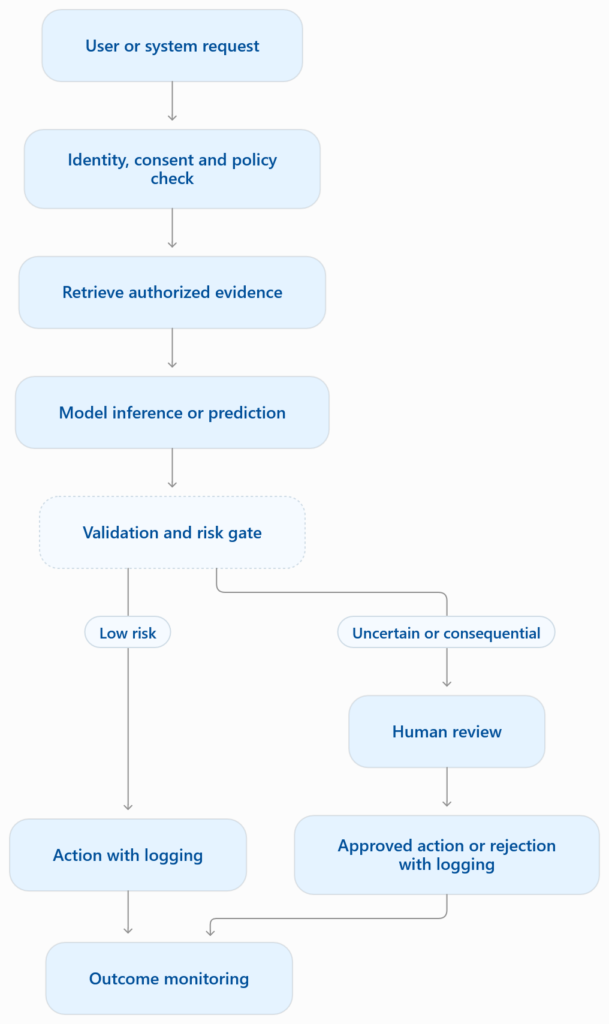
Human review determines whether a proposed outcome can proceed. An accessible appeal or correction route should remain available after a decision, with authority to investigate and change the outcome where appropriate.
This flow is intentionally gated. Direct model-to-action automation should be limited to reversible, low-impact tasks with narrow permissions and tested recovery procedures.
For generative AI for Indian businesses, retrieval should return authorized evidence with citations rather than allowing the model to answer from parameters alone. Sensitive documents must be filtered by the requesting user’s existing access rights before they reach the model.
Data Engineering Friction
Enterprise records often contain duplicates, missing identifiers, mixed scripts, scanned documents and inconsistent dates. Model sophistication cannot compensate for a broken customer master or a policy library with expired versions.
Data teams should establish a canonical record, provenance, quality thresholds and retention schedules first. The DPDP framework adds duties around lawful processing, notices, safeguards and breach handling for digital personal data.[5][6]
Localization introduces harder edge cases. A single conversation may combine Hindi, English and a regional language, while names and addresses appear in several transliterations.
Training and evaluation sets must represent those patterns. Accuracy reported on clean English benchmarks should never be used as evidence for a multilingual production channel.
Model and Deployment Choices
Large hosted models offer rapid deployment and broad capability, but they introduce variable inference costs, vendor dependency and cross-border data questions. Smaller or open-weight models can reduce marginal cost and support private deployment, yet require engineering for tuning, serving, patching and evaluation.
Edge inference helps with latency, resilience and data minimization. It also faces memory, power and update constraints, especially on low-cost devices.
A hybrid design is often rational for AI in India and for generative AI for Indian businesses. Sensitive extraction or classification can run in a controlled environment, while a larger hosted model handles low-risk drafting after data is minimized.
Performance Evaluation Matrix

| Dimension | Required metric | Release threshold example | Why it matters |
| Task quality | Precision, recall, groundedness or task success | Set from harm analysis | Average accuracy hides costly errors |
| Language | Score by language, dialect and code-switching | No critical subgroup below floor | Prevents English-only success |
| Reliability | Failure and timeout rate | Within workflow service level | Measures real availability |
| Human effort | Review minutes per case | Lower than baseline | Detects displaced labor |
| Cost | Fully loaded cost per completed task | Below baseline after review | Captures inference and operations |
| Safety | Severe incident rate | Zero in pre-release critical tests | Blocks unacceptable failure modes |
| Fairness | Error-rate gaps across affected groups | Within approved tolerance | Exposes uneven harm |
| Privacy | Unauthorized disclosure test rate | Zero in controlled tests | Tests access boundaries |
| Adoption | Eligible-user completion rate | Sustained target by cohort | Separates novelty from utility |
| Auditability | Decisions traceable through retained evidence and version records | 100% for consequential cases | Supports investigation and appeal |
Thresholds must be chosen before the pilot results are known. Teams that set the target after seeing the score are measuring their ability to rationalize, not model performance.
Deployment Challenges That Usually Surface Late
Challenge 1: Evaluation Data Is Not Production Data
Historical labels may encode inconsistent human decisions. New users may submit shorter, noisier or multilingual inputs that were absent from the test set.
Run shadow mode before automation. Compare model recommendations with actual outcomes without allowing the model to control the decision.
Challenge 2: Inference Cost Is a Moving Target
Token use expands when prompts, retrieved documents and conversation histories grow. Retries, guardrails, monitoring and human review can exceed the headline API price.
Teams implementing AI services in India should track cost per successful outcome, rather than cost per call. Cache appropriate reusable content, route simpler tasks to smaller models and limit unnecessary context. Apply access checks, freshness controls and privacy safeguards to cached material.
Challenge 3: Model Updates Change Behavior
A vendor may revise a model behind an API. Even a nominally improved release can alter formatting, refusal behavior or performance in a regional language.
Pin versions when possible, maintain regression suites and require a change window. AI implementation services in India contracts should specify notice, rollback and incident obligations.
Challenge 4: Automation Creates New Attack Paths
Prompt injection, poisoned documents, excessive tool permissions and sensitive-data leakage turn an assistant into a security boundary. Traditional input validation alone is insufficient because retrieved content may contain adversarial instructions.
Apply least privilege to tools, isolate untrusted content, validate outputs before action and maintain allowlists for high-impact operations. Treat model output as untrusted data.
Challenge 5: People Need a Real Appeal Route
A “human in the loop” is meaningless if reviewers lack time, authority or supporting evidence. Appeal must pause adverse action and route the case to someone who can change the outcome.
Responsible AI governance in India programs should measure overturn rates and appeal delays. For AI in India, a high overturn rate signals a weak model or an inappropriate decision boundary.
III. Commercial Solutions and Best Practices
Feature and Cost Comparison Table
The following comparison covers operating models, not endorsed vendors. Pricing changes rapidly, so buyers should obtain written quotations and model the workload with their own token, storage, network and support assumptions.
| Solution pattern | Best fit | Main advantages | Cost drivers | Principal trade-offs |
| Hyperscaler managed AI | Fast enterprise pilots and global integration | Mature security tooling, elastic scale, broad model choice | Tokens, accelerators, storage, egress, premium support | Lock-in, opaque model changes, data-location review |
| India-based managed AI or SaaS | Local workflows, language support, domestic service | Regional expertise, implementation proximity, packaged use cases | Subscription, seats, connectors, customization | Smaller ecosystem, vendor concentration, variable maturity |
| Private or open-weight platform | Sensitive data and predictable high volume | Control, customization, portability, private networking | GPUs, MLOps staff, tuning, patching, energy | Higher operational burden and capacity risk |
| Vertical managed service | Banking, health, agriculture or public service | Domain workflows, implementation support, prebuilt controls | Per-case fee, integration, validation, audit | Narrow flexibility, dependence on vendor evidence |
No enterprise AI solutions in India option is automatically cheaper. A hosted service can win at low volume, while a private platform may become economical only after utilization is stable and operations are mature.
A Seven-Gate Procurement Framework
Gate 1: Define the Decision Boundary
Name the exact task, user, input, output and consequence. “Improve customer service” is not a scope; “draft a cited response for a trained agent who approves it” is.
Gate 2: Establish the Baseline
Measure current volume, completion time, error rate, escalation, abandonment and fully loaded cost. Without a baseline, ROI becomes a story chosen after launch.
Gate 3: Classify Data and Harm
Identify personal, financial, health, biometric, confidential and regulated data. Map who could be harmed, how severe the harm could be and whether the action is reversible.
Gate 4: Test Representative Cases
Build a locked test set covering common, rare, adversarial and subgroup cases. Include regional languages, code-switching, poor scans and ambiguous requests when those appear in production.
Gate 5: Run a Controlled Pilot
Use a limited cohort, capped spend, human review and stop conditions. Record every version of prompts, retrieval sources, models and policy rules.
Gate 6: Prove Unit Economics
Calculate total cost per completed outcome. Include integration, licenses, inference, data preparation, monitoring, security, evaluation, support, review and remediation.
Gate 7: Authorize Scale
An accountable committee should sign off on performance, privacy, security, accessibility and workforce readiness. Expansion should be reversible if drift or harm emerges.
Contract Requirements for AI Implementation Services in India Buyers
AI implementation services in India contracts should specify data use, retention, location, subprocessors and whether customer content may train provider models. They should also define model-version notice, service levels, security testing, audit evidence, incident reporting and secure deletion.
Require export of prompts, evaluation results, logs and configuration in usable formats. Portability is a commercial control, not an engineering luxury.
Avoid guarantees framed only as “industry-leading accuracy.” The contract should name the test set, metric, threshold, population and remedy when performance falls below target.
Building Generative AI for Indian Businesses Without a Demo Trap
Generative AI for Indian businesses should start with retrieval, summarization, classification or drafting where a knowledgeable user can verify the output. Do not begin with autonomous approval of loans, benefits, diagnoses, hiring or disciplinary action.
Select two models during the pilot so procurement can compare quality, latency and cost. A fallback model also reduces operational dependence on one provider.
Use short, task-specific prompts and curated evidence. Long system prompts often conceal unclear policy rather than solve it.
IV. Business Outcomes and Strategic ROI Takeaways
The ROI Equation
Use a transparent equation:
Annual modeled net value = annual realized capacity value + verified avoided loss or additional contribution − annual technology, integration, operating and remediation costs.
Estimate realized capacity value from the annual number of successfully completed tasks, net time saved per task and an appropriate labor-cost rate. Use matching time units: divide minutes saved by 60 when the rate is quoted per hour. Include review and rework when measuring net time saved.
Distinguish released capacity from cash savings. Count financial savings only where expenditure falls, hiring is demonstrably avoided or additional contribution is supported by evidence. Keep every cost in the same annual period and avoid overlapping categories.
This formula is not proof of benefit. Each input must come from observed workflow data, finance-approved cost rates and documented assumptions.
Illustrative Business Case—Not a Market Benchmark
Assume a support operation processes 600,000 eligible cases a year. A controlled pilot verifies three minutes of net saving per case after review, at a loaded labor rate of ₹500 per hour.
Gross annual capacity value would be ₹15 million. If annual technology, integration, evaluation, operations and expected remediation total ₹10 million, modeled net value is ₹5 million before tax and financing effects.
The case fails if demand does not convert released time into useful capacity. Finance teams must state whether savings represent cash reduction, avoided hiring, faster service or redeployed labor.
Value by Sector
Financial Services
AI can support fraud triage, document extraction and agent assistance. The RBI’s 2025 FREE-AI report provides a sector-specific reference for responsible and ethical enablement, but regulated entities still retain accountability for customer outcomes.[7]
Healthcare
Useful applications include scheduling, coding assistance and clinician-supervised documentation. Diagnostic or treatment recommendations demand clinical validation, safety monitoring and clear professional authority.
Agriculture
Image-based advisory, localized weather interpretation and market information may reduce information gaps. Performance depends on crop, geography, camera quality and access to local agronomic support, so nationwide accuracy claims require nationwide evidence.
Manufacturing and Logistics
Computer vision, forecasting and predictive maintenance can reduce inspection effort or unplanned downtime. Buyers need sensor-quality baselines and must separate model performance from maintenance-process improvement.
Government Services
Search, translation and assisted form completion can lower administrative friction. Eligibility, enforcement and benefit decisions require reason codes, human review and accessible appeal.
Strategic Takeaways for Decision Makers
AI in India has a plausible path to broad value because it combines a large digital user base, public compute investment, multilingual infrastructure and a deep software workforce. None of those assets guarantees equitable outcomes.
The durable advantage in AI in India comes from workflow knowledge and evaluated local data, not model access alone. Foundation models will commoditize faster than trustworthy integrations, operating discipline and public confidence.
Boards should demand a portfolio view: experiments stopped, systems scaled, value realized, incidents, subgroup performance and concentration risk. Counting pilots rewards activity rather than outcomes.
V. Risk Mitigation and Regulatory Framework

Applicable Governance Baseline
India’s Digital Personal Data Protection Act, 2023 and the DPDP Rules, 2025 provide a phased framework for digital personal data. Notification does not mean every provision became operational immediately. Rule 1 provides immediate commencement for Rules 1, 2 and 17–21, commencement after one year for Rule 4, and after eighteen months for Rules 3, 5–16, 22 and 23.[5][6] Organizations should check the applicable Act provisions, commencement notifications and sector requirements before describing an obligation as currently enforceable.
NITI Aayog’s work provides a foundation for responsible AI governance in India programs by emphasizing safety, equality, inclusivity, privacy, transparency and accountability.[8] NIST AI RMF 1.0 organizes voluntary controls around Govern, Map, Measure and Manage.[9]
Indian organizations supplying AI into Europe must also analyze the EU AI Act by role, system type and market. The Act applies on a phased schedule, with several provisions already applicable by September 2026 and separate later dates for some high-risk systems.[10]
Responsible AI Governance in India Checklist
- Assign a named business owner and an independent risk reviewer.
- Inventory every model, version, data source, tool and downstream action.
- Document purpose, affected people, foreseeable misuse and prohibited uses.
- Establish a lawful basis, notice, retention period and deletion process for personal data.
- Test quality by language, region, gender and other relevant groups.
- Red-team prompt injection, data extraction, unsafe advice and tool abuse.
- Provide meaningful human review for consequential outcomes.
- Make correction and appeal channels accessible outside the AI interface.
- Log evidence, model version, overrides and final outcomes.
- Monitor drift, complaints, incidents, cost and energy-intensive workloads.
- Predefine shutdown, rollback, notification and remediation procedures.
- Review vendors, subprocessors, concentration and exit arrangements.
Risk Register
| Risk | Failure vector | Preventive control | Detection | Response |
| Hallucination | Unsupported generated statement | Retrieval, constrained templates, citations | Factuality sampling | Block, correct and retrain workflow |
| Bias | Uneven data or labels | Representative testing, policy review | Subgroup error monitoring | Pause affected use and remediate |
| Privacy breach | Prompt, log or connector leakage | Minimization, encryption, access control | DLP and audit alerts | Contain, assess and notify as required |
| Prompt injection | Malicious user or retrieved content | Isolation, least privilege, allowlists | Adversarial monitoring | Revoke tools and investigate |
| Drift | Population or vendor-model change | Version control and periodic validation | Trend and threshold alerts | Roll back or recalibrate |
| Automation bias | Reviewer overreliance | Training and evidence display | Override and error analysis | Redesign review and authority |
| Exclusion | Language, device or disability barrier | Accessible channels and human fallback | Completion by cohort | Add channels and targeted support |
| Cost overrun | Long context, retries or idle GPUs | Budgets, routing, caching | Unit-cost dashboards | Throttle, resize or renegotiate |
Final Decision Test
Before launch, ask five questions. Does the system solve a measured problem; outperform the baseline; work for the intended population; remain controllable when it fails; and create value after every cost is counted?
If any answer is unknown, the project is not ready to scale. The appropriate next step is a bounded test, not a broader promise.
Preparing Evidence for Inclusive Deployment
Prepare an evidence dossier for one clearly defined workflow. Include its baseline, architecture, data map, representative test set, threat model, compliance mapping, pilot budget, stop conditions and finance-approved value calculation. Choose a pilot duration that provides enough evidence across the intended languages, user groups and operating conditions.
Compare providers using the same test cases and acceptance criteria. Expand only when the workflow improves measurable outcomes, remains controllable and works for the intended population, including users who need accessible channels or human assistance.
VI. Appendix and Research Integrity
Appendix A: Academic and Primary-Source Footnotes
- Press Information Bureau, Government of India, “Cabinet Approves Ambitious IndiaAI Mission,” 7 March 2024. The release records the ₹10,371.92 crore outlay, seven mission components and planned public-private compute capacity of at least 10,000 GPUs. https://www.pib.gov.in/PressReleaseIframePage.aspx?PRID=2012355
- Press Information Bureau, Government of India, “Empowering Governance through Digital Infrastructure,” 15 August 2025. The factsheet reports more than 34,000 GPUs by May 2025 and BHASHINI support for 35+ languages, 1,600+ models and 18 services. https://www.pib.gov.in/FactsheetDetails.aspx?Id=149256
- Ministry of Health and Family Welfare, Government of India, eSanjeevani official portal. The source establishes teleconsultation access; it is not used here as evidence of autonomous AI diagnosis. https://esanjeevani.mohfw.gov.in/
- International Labour Organization and NASK, “Generative AI and Jobs: A Refined Global Index of Occupational Exposure,” 20 May 2025. https://www.ilo.org/publications/generative-ai-and-jobs-refined-global-index-occupational-exposure
- Government of India, Digital Personal Data Protection Act, 2023, as published through MeitY’s acts and policies resources. https://www.meity.gov.in/documents/act-and-policies
- Ministry of Electronics and Information Technology, “Digital Personal Data Protection Rules, 2025,” notified 14 November 2025. https://www.meity.gov.in/documents/act-and-policies/digital-personal-data-protection-rules-2025-gDOxUjMtQWa https://www.meity.gov.in/static/uploads/2025/11/53450e6e5dc0bfa85ebd78686cadad39.pdf?utm_source=chatgpt.com
- Reserve Bank of India, “Framework for Responsible and Ethical Enablement of Artificial Intelligence (FREE-AI),” committee report, 2025. https://rbidocs.rbi.org.in/rdocs/PublicationReport/Pdfs/FREEAIR130820250A24FF2D4578453F824C72ED9F5D5851.PDF
- NITI Aayog, “Approach Document for India: Part 2—Operationalizing Principles for Responsible AI,” August 2021. https://www.niti.gov.in/sites/default/files/2021-08/Part2-Responsible-AI-12082021.pdf
- National Institute of Standards and Technology, “Artificial Intelligence Risk Management Framework (AI RMF 1.0),” NIST AI 100-1, January 2023. https://nvlpubs.nist.gov/nistpubs/ai/nist.ai.100-1.pdf
- European Commission, “AI Act: Regulatory Framework for Artificial Intelligence,” official implementation overview, accessed 23 September 2026. https://digital-strategy.ec.europa.eu/en/policies/regulatory-framework-ai
- NITI Aayog, “National Strategy for Artificial Intelligence,” June 2018. The report frames India’s early national approach around social sectors and inclusive growth. https://www.niti.gov.in/sites/default/files/2023-03/National-Strategy-for-Artificial-Intelligence.pdf
- NITI Aayog, “Principles for Responsible AI,” February 2021. https://www.niti.gov.in/sites/default/files/2021-02/Responsible-AI-22022021.pdf
- NIST, “Artificial Intelligence Risk Management Framework: Generative Artificial Intelligence Profile,” NIST AI 600-1, July 2024. https://nvlpubs.nist.gov/nistpubs/ai/NIST.AI.600-1.pdf
- International Labour Organization, “Artificial Intelligence Adoption and Its Impact on Jobs,” 31 May 2025. https://www.ilo.org/publications/artificial-intelligence-adoption-and-its-impact-jobs
Appendix B: Source-to-Claim Citation Index
| Claim in this Article | Footnote(s) | Evidence type |
| IndiaAI Mission outlay and planned compute | 1 | Primary government release |
| Reported 2025 GPU capacity and BHASHINI scope | 2 | Primary government factsheet |
| eSanjeevani provides teleconsultation access | 3 | Official service portal |
| One in four jobs has some GenAI exposure globally | 4 | ILO research paper |
| Indian digital-personal-data duties | 5, 6 | Statute and notified rules |
| Financial-sector responsible AI reference | 7 | RBI committee report |
| Indian responsible-AI principles | 8, 12 | NITI Aayog policy papers |
| Govern–Map–Measure–Manage framework | 9 | NIST technical framework |
| EU AI Act applicability and phased timeline | 10 | European Commission guidance |
| India’s inclusive national AI policy direction | 11 | NITI Aayog strategy |
| GenAI-specific risk controls | 13 | NIST technical profile |
| Job augmentation versus displacement caution | 4, 14 | ILO research |
Performance and Commercial Claims Policy
This article does not claim that a listed public platform, vendor category or architecture automatically delivers a stated return. The ROI scenario is explicitly illustrative and must be replaced with audited workload data before an investment decision.
Vendor pricing, availability and model behavior can change without notice. Buyers should verify current terms, conduct security and legal review, and preserve dated evidence used in procurement.
Corporate Editorial Transparency and AI Usage Disclosure
AI-assisted tools were used to support research organization, drafting and language refinement. NezzHub retains editorial responsibility for the published article. Vendor inclusion does not constitute endorsement.
Author and Editorial Review
Author: Garikapati Bullivenkaiah
Technology research writer with LL.B., LL.M., M.A., and MBA qualifications. He writes about emerging technologies and their business, governance and legal implications. His multidisciplinary academic background informs his analysis of technology adoption, intellectual property, and organizational risk. His articles explain technical concepts and practical considerations for business owners, IT managers and technology decision-makers. LinkedIn Profile
Reviewed by: Chitikineni Ramadevi — Editor
Chitikineni Ramadevi holds an M.Sc. in Computers from Andhra University and has over 10 years of research experience in technology-related subjects. She reviews NezzHub articles for clarity, factual accuracy, source support and practical relevance.
Published by: NezzHub
Research approach: This article draws on primary sources, technical documentation and relevant industry research. References are provided within the article or its sources section.
Last reviewed: 09-23-2026
Corrections: To report a factual error or outdated information, please contact NezzHub.

Garikapati Bullivenkaiah is a seasoned entrepreneur with a rich multidisciplinary academic foundation—including LL.B., LL.M., M.A., and M.B.A. degrees—that uniquely blend legal insight, managerial acumen, and sociocultural understanding. Driven by vision and integrity, he leads his own enterprise with a strategic mindset informed by rigorous legal training and advanced business education. His strong analytical skills, honed through legal and management disciplines, empower him to navigate complex challenges, mitigate risks, and foster growth in diverse sectors. Committed to delivering value, Garikapati’s entrepreneurial journey is characterized by innovative approaches, ethical leadership, and the ability to convert cross-domain knowledge into practical, client-focused solutions.