





















Cloud AI uses artificial intelligence that is running on “the cloud” (as opposed to on your local computer or on-site servers). This allows you and/or your organization to access significant computing power, storage, and rapid processing by accessing AI models over the Internet; you pay only for what you need and scale up or down as your requirements change.

Cloud AI enables companies/organizations to develop applications that recognize images, understand spoken language, translate between languages, detect fraudulent activity, forecast demand, or summarize content without purchasing costly hardware. Cloud service providers deliver prebuilt services (vision, language, recommendation APIs) and managed environments for developing and deploying custom machine learning models.
The typical cloud AI workflow will follow this general process: collect the data you want to use, store the collected data securely, clean and label the collected data, train a model using the cleaned, labeled data, test the trained model, and deploy the tested model as an endpoint that applications can invoke against.
The cloud is designed to enable distributed computing, which can significantly reduce training time for large datasets and complex deep learning models. Additionally, the cloud simplifies collaboration on AI applications, enabling data scientists, engineers, and product teams to work in the same environment with the same toolset and versions.
Cloud-based artificial intelligence (AI) offers additional advantages over traditional on-premises solutions, including easier integration with existing systems and applications.
In many cases, cloud-based AI connects directly to the organization’s data warehouse, streaming tools, and/or other business applications, allowing for predictive results to be applied in real-time; i.e., identifying fraudulently occurring transactions as they occur and providing customers with up-to-date inventory suggestions based upon their purchase history. Additionally, organizations can use observability tools to monitor model performance, drift, and latency, enabling them to identify when retraining is necessary.
Cloud-based AI requires companies to have appropriate governance policies and procedures in place to ensure that all data processed by their AI is properly secured through methods such as encryption, access control, auditing, and logging.
The company must also establish guidelines and policies regarding how they collect and stores customer information. Additionally, an organization should consider responsible AI practices, such as testing for bias, having humans review critical AI decisions, and establishing transparency about the limitations of its AI system.
In addition to improving integration and governance, cloud-based AI enables robotics and IoT devices to operate as if they had a “brain” in the cloud. This allows these devices to offload complex computations, enabling them to learn from one another and update their knowledge bases quickly.
Lastly, cloud-based AI has enabled developers to deliver advanced AI capabilities at lower costs than those traditionally required to develop AI-based products and services. This has enabled smaller development teams to build successful products using more advanced capabilities than they previously could.
Are there any robotic vacuum cleaners that have been watching their way through a room? They are both smart and clever; they are solo acts. Each vacuum cleaner will learn your house layout, map the locations of your furniture (such as a table leg), and remember the location of the dog’s bed. However, all of this information is stored on the individual vacuum cleaner’s computer and cannot be shared with others.
So, even though artificial intelligence is incredibly powerful, why can’t we create a “super-brain” for every machine? It isn’t because of the intelligence of the machine; it is because of practicality.
In order to provide a robot with a “brain”, the robot must have a processor that resides inside the robot itself. The term for this is on-board processing, which means that each calculation and decision the robot makes must occur on a computer physically integrated into the robot. Just like the small processor in your cell phone, the onboard processor of a robot is severely limited by the amount of power available to the robot and how much heat the processor can generate.
A true AI brain is essentially a supercomputer; it is very expensive to build, very large, and requires an enormous amount of electrical energy to operate. Therefore, placing such an AI brain inside a small delivery drone or a household robot is completely impractical.
Therefore, most stand-alone robots are developed to perform repetitive, predictable tasks. When a robot encounters something entirely unexpected (such as a new piece of furniture), it usually becomes stuck. What if your vacuum cleaner could instantly learn from every other vacuum cleaner in the world? For example, if a vacuum cleaner in another city could determine the best route to navigate a difficult-to-navigate shag rug, it would immediately know how to do it without repeating the same mistakes.
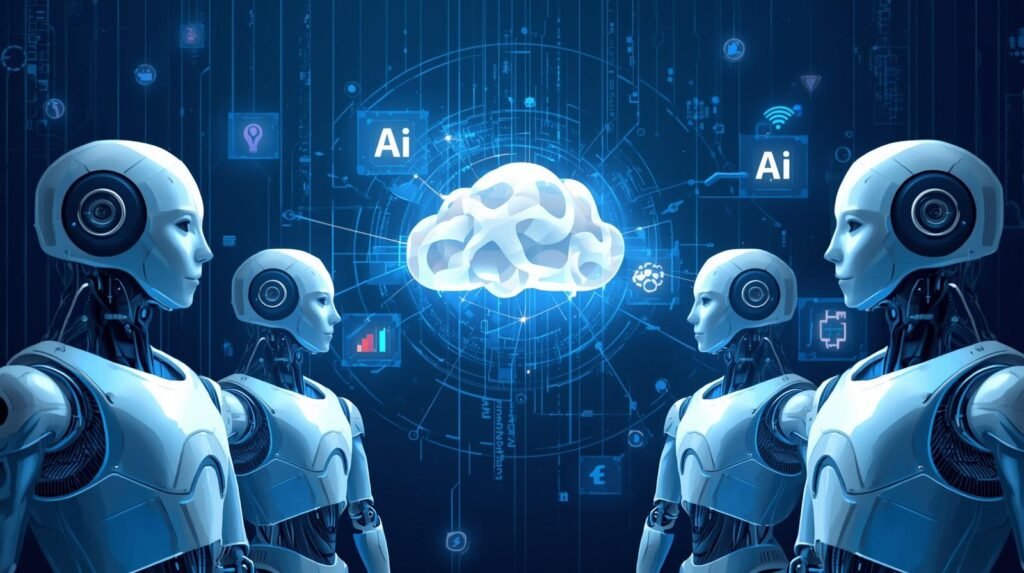
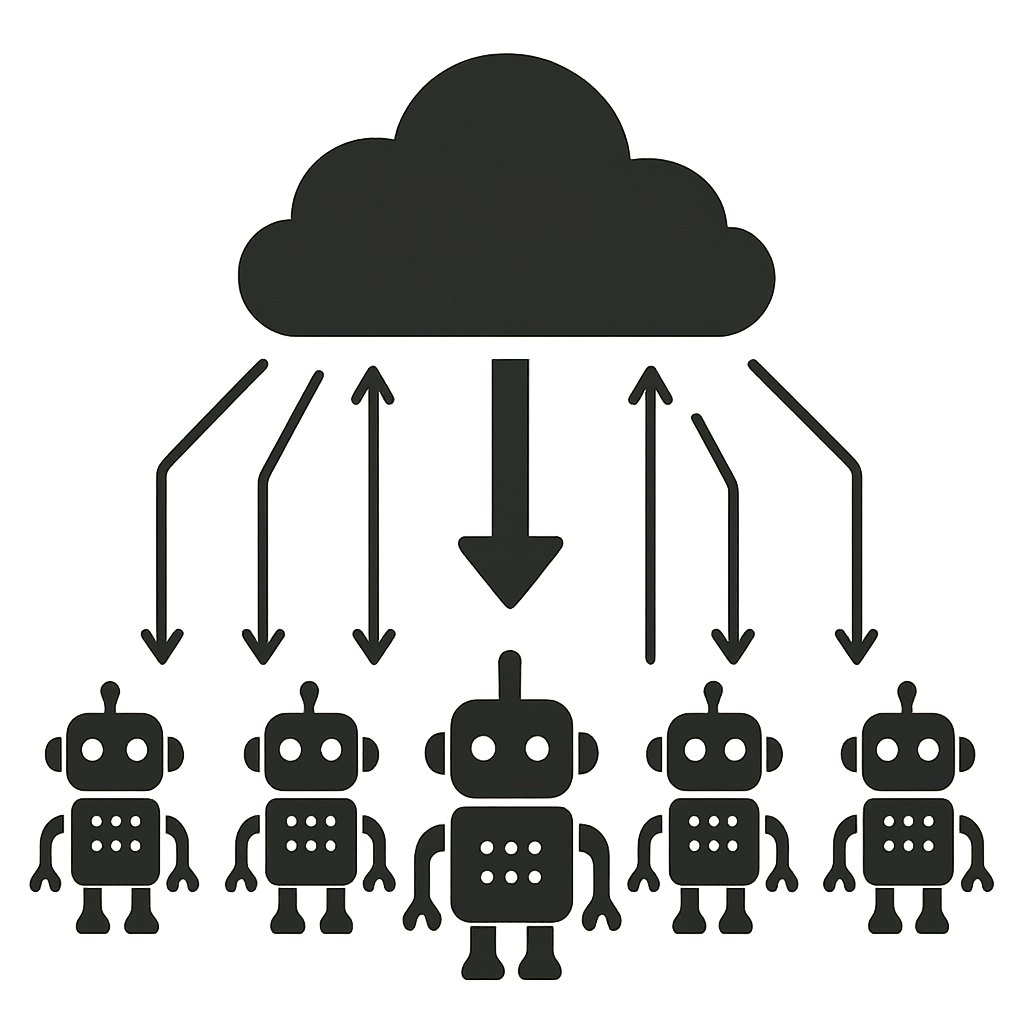
This is not science fiction; this is the fundamental concept behind Intelligent Cloud AI. Instead of operating independently, this approach enables each machine to connect to a massive, distributed “brain” in the cloud. This revolution in robot learning allows many independent machines to function as a single, continually improving team.
What Is the ‘Cloud Brain’? It’s a Giant Digital Library for Robots
The solution to robotics’ physical limitations is deceptively simple: rather than attempting to build an enhanced super-intellect within each robotic unit, robots will access one that exists outside them by renting space from a larger, global brain referred to as “the cloud.”
Do not think of the “cloud” as a series of soft, white clouds floating above us. Data centers worldwide are large, physical facilities referred to as “warehouses” that house thousands of individual computer units interconnected via the Internet. The sheer scale of this network creates a global, collective brain that robots can use as needed.
Imagine a gigantic public library with limitless books on its shelves and a million librarian employees who have read every book available and can answer your questions instantly. The cloud serves two functions for robots: a virtually limitless repository of information and a virtually limitless repository of computational thinking power.
When a robot requires assistance solving a difficult problem, it connects via the Internet to a global repository of thought and problem-solving capability located in a data center, providing the robot with access to virtually unlimited intelligent problem-solving capability as needed. With cloud computing, a robot can access advanced intelligent capabilities and problem-solving without having to support them itself.
Cloud Intelligence: Centralized Intelligence That Enables Robots to Learn Collectively

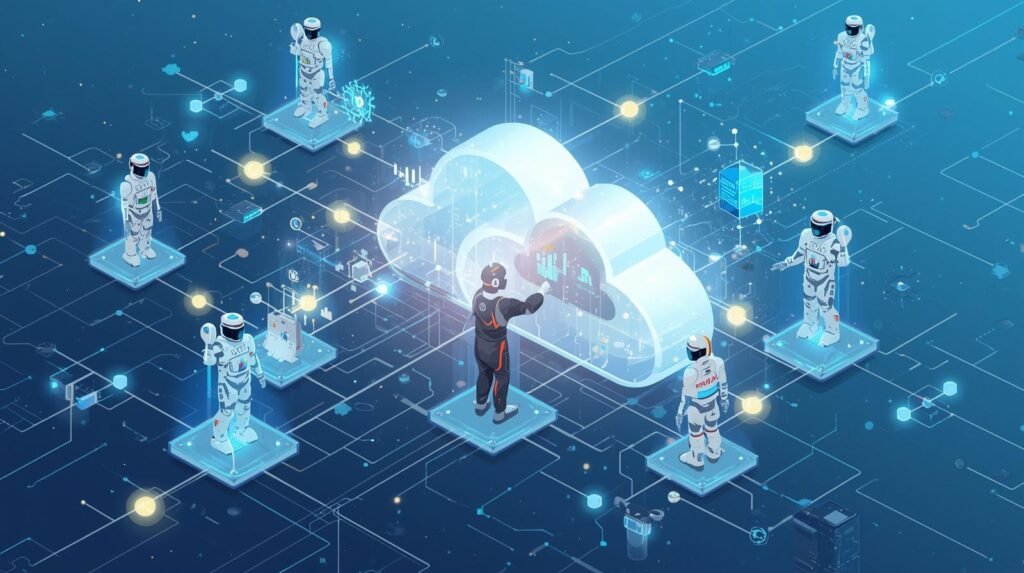
Cloud intelligence is cloud-based centralized intelligence (in shared servers) as opposed to localized within a single robot. As multiple robots are connected, they can share their findings, including what they see, which movements were successful, and any errors. Cloud systems will clean and label this data, and train new models that each individual robot can download.
This is where cloud AI has value: it provides the computational power and tools to derive insights from large volumes of unstructured data, without requiring a robot to have a “supercomputer”.
When using cloud intelligence, an entire warehouse fleet can develop a common understanding of how to navigate the warehouse. For example, if one robot identifies that a particular type of floor marking creates wheel slip, the entire fleet can be updated by the end of the day.
Additionally, with cloud intelligence, vision models can be trained on new box types after only a handful of robots have encountered them, and these updates can be deployed to all locations. The backend of cloud AI pipelines manages data storage, training, testing, and the safe rollout of AI.
The collective learning environment provided by cloud AI also supports “experience replay”. Robots send edge-case scenarios, such as glare, dust, and crowds, to enable cloud intelligence to build a more robust perception and planning model.
This results in faster learning curves and more predictable behaviors across devices. Cloud AI can also serve as a simulation environment, enabling robots to run millions of trials virtually before deployment in the real world. Once a better policy is identified, cloud intelligence deploys it, and each robot maintains its own local reflexes for immediate safety stops.
In addition to their ability to act in “real-time,” robots do not depend upon the network for each decision they make. Robots use lightweight models, running them directly on the device, to enable quick responses; they sync with the cloud based on available bandwidth. Additionally, updates can be staged: initially distributed to a limited number of test devices, the update will then be rolled out to the entire fleet once it has been tested.
This hybrid model enables both rapid deployment (speed) and the ability to learn from the data collected by each robot (learning), while simultaneously ensuring the safety of each robot through human oversight in large numbers, regardless of where those robots are located – and whether there is reliable Wi-Fi available to the robot, or if the robot’s use of resources (downtime) is strictly limited.
In order to ensure that the cloud intelligence used in each robot is trustworthy, teams using this type of cloud-based intelligence require robust governance, including but not limited to encryption, access controls, and audit trails, as well as clearly defined policies governing which types of sensor data are stored locally versus being transmitted to the cloud.
Teams must also establish mechanisms to monitor and track each robot’s cloud intelligence performance, so that if an update proves detrimental to functionality, it can be rolled back rapidly. When these requirements are met, the set of previously autonomous robots becomes a coordinated learning network. Ultimately, cloud intelligence functions as a “shared brain” across all robots, enabling each robot to become increasingly intelligent with each shift.
AI in Cloud: Running Advanced Artificial Intelligence Directly on Cloud Platforms

AI in the Cloud means running advanced artificial intelligence directly on Cloud platforms, where models, data, and computing power coexist. This approach enables teams to use on-demand GPUs, managed tools, and secure storage in one place, rather than relying on individual devices or office servers to handle heavy processing. This is why cloud-based AI has become a practical way to quickly deploy modern AI capabilities.
In real-world projects, AI in Cloud covers the full lifecycle, including data collection, data preparation, model training, and deployment as scalable services. AI in Cloud also makes it easier to expose models through api’s so apps can call them for image recognition, speech-to-text, search, recommendations, forecasting, and document understanding. With Cloud AI, organizations can scale from a small pilot to millions of requests without rebuilding the system.
AI in Cloud is especially helpful when data is large or changing fast. Streaming pipelines can ingest new events into feature stores, and automated workflows can retrain models on schedule. AI in Cloud can also host simulations and testing environments to evaluate accuracy, bias and reliability before updates are applied by users. For teams, Cloud AI reduces the operational burden of managing infrastructure, patching servers, and provisioning capacity.
The principles of security and governance remain in place. The AI in Cloud is meant to have data encryption, roles, auditing of all activity, and retention policies regarding what data the AI has on hand. Also, teams need to monitor for model drift, latency, and failure modes, and plan for rollbacks if a model does not perform as expected in an initial release. With proper oversight, AI in Cloud enables teams to deploy responsibly and enable their systems to remain manageable.
In robotics and other edge devices, the AI in Cloud acts like a centralized “brain” for training and coordination, but the critical safety action stays at the device level. Edge devices can send edge cases to the cloud, and improved models can be sent back to the edge devices. Therefore, cloud AI enables advanced capabilities across many more products quickly and easily, without requiring every endpoint to be a high-end compute machine.
Cloud-Based AI: AI Systems Operating Remotely Using Shared Cloud Resources
Cloud-based AI refers to AI systems that run in remote environments and use cloud computing, storage, and managed services, rather than relying solely on a single on-premises device. The primary advantage of cloud-based AI is that companies can use advanced models and massive computational power without purchasing, installing, or maintaining their own proprietary hardware. Cloud-based AI systems are often made available via cloud AI platforms, which include prebuilt APIs and tooling that enable users to build custom solutions.
One of the main benefits of using cloud-based AI is its scalability. As the demand for processing increases – such as when a company experiences a spike in customer chat activity, image uploads, or sensor data – the system can automatically increase its processing capacity and then scale back down once demand decreases.
Cloud-based AI makes it easier to deploy applications globally because the same model can be deployed across multiple regions simultaneously and receive the same updates. Many companies use cloud AI systems to develop prototypes faster and bring them to production more quickly.
Operationally, cloud-based AI systems typically include data ingestion, secure data storage, data preparation, model training, model testing and validation, and model deployment. In a cloud-based AI system, applications call the model over the network, and the results are returned in near real-time. Additionally, cloud-based AI can help continuously improve performance by storing the results of each model invocation, monitoring for drift, and retraining the model periodically with new data. For engineering teams, cloud AI systems reduce the burden associated with managing GPUs, drivers, and scaling policies.
Cloud-based AI refers to AI systems that run in remote environments and use cloud computing, storage, and managed services, rather than relying solely on a single on-premises device. The primary advantage of cloud-based AI is that companies can use advanced models and massive computational power without purchasing, installing, or maintaining their own proprietary hardware. Cloud AI systems are often delivered via cloud AI platforms, which provide prebuilt APIs and tooling that enable users to build custom solutions.
One of the main benefits of using cloud-based AI is its scalability. As the demand for processing increases – such as when a company experiences a spike in customer chat activity, image uploads, or sensor data – the system can automatically increase its processing capacity and then scale back down once demand decreases. Cloud-based AI makes it easier to deploy applications globally because the same model can be deployed across multiple regions simultaneously and receive the same updates. Many companies use cloud AI systems to develop prototypes faster and bring them to production more quickly.
Operationally, cloud-based AI systems typically include data ingestion, secure data storage, data preparation, model training, model testing and validation, and model deployment. In a cloud-based AI system, applications call the model over the network, and the results are returned in near real-time. Additionally, cloud AI can help continuously improve performance by storing the results of each model invocation, monitoring for drift, and retraining the model periodically with new data. For engineering teams, cloud AI systems reduce the burden associated with managing GPUs, drivers, and scaling policies.
Intelligent Cloud Computing: Computing Systems That Adapt, Learn, and Optimize Automatically

Intelligent Cloud Computing refers to intelligent cloud-based systems (both hardware and software) that dynamically adapt, learn, and optimize themselves in response to changing conditions. In terms of how this works, the actual application of Intelligent Cloud Computing is based on combining flexible cloud infrastructure with automation, monitoring, and machine learning to allow platforms to continually “tune” performance, cost, and reliability without requiring as much user intervention.
A major driver of Intelligent Cloud Computing is cloud AI, which enables systems to identify patterns, anticipate demand, and support better resource-allocation decisions.
Using Intelligent Cloud Computing, applications can proactively scale up before anticipated traffic increases, rather than simply react to slowdowns once they have begun. Additionally, Intelligent Cloud Computing enables platforms to distribute workloads across geographically dispersed regions, select faster data paths, and adjust cache behavior to reduce latency.
Using cloud AI, Intelligent Cloud Computing platforms can combine historical trends with real-time signals to forecast usage and proactively provision compute capacity to maintain consistent response times. Intelligent Cloud Computing also provides capabilities that support self-healing. If a service begins to degrade, Intelligent Cloud Computing can enable the platform to restart components, redirect traffic, or revert a problematic deployment.
The security of Intelligent Cloud Computing is enhanced by continuously detecting risks through multiple methods. For example, logs, network signals, and identity-related events can be analyzed by cloud AI to alert to anomalous behavior, isolate suspicious activity, and recommend policy modifications. Additionally, Intelligent Cloud Computing enables automatic enforcement of least-privileged access, credential rotation, and configuration drift verification to minimize human error.
Cost optimization is another key advantage of intelligent cloud computing. With intelligent cloud computing, users can scale their instance sizes, run workloads at lower costs, and eliminate unused resources. Additionally, with cloud AI, users can identify areas where they may be wasting resources (such as excess cluster provisioning or underutilized storage tiers) and have them automatically corrected. Users can also leverage intelligent cloud computing to determine whether a job should use a CPU, GPU, or other accelerator, optimizing for both performance and cost.
Intelligent cloud computing simplifies data and AI project pipelines by automating training job scheduling, managing experiments, and monitoring model performance post-deployment. Additionally, cloud AI enables automatic retraining of models when data changes occur, and guardrails and approval workflows ensure safe updates. In summary, intelligent cloud computing creates an adaptive “autopilot” layer in the cloud that utilizes cloud AI, and continues to learn from telemetry, optimize operations, and keep systems running fast, secure, and efficiently.
Cloud AI Services: Scalable AI Tools Delivered Through Powerful Cloud Infrastructure
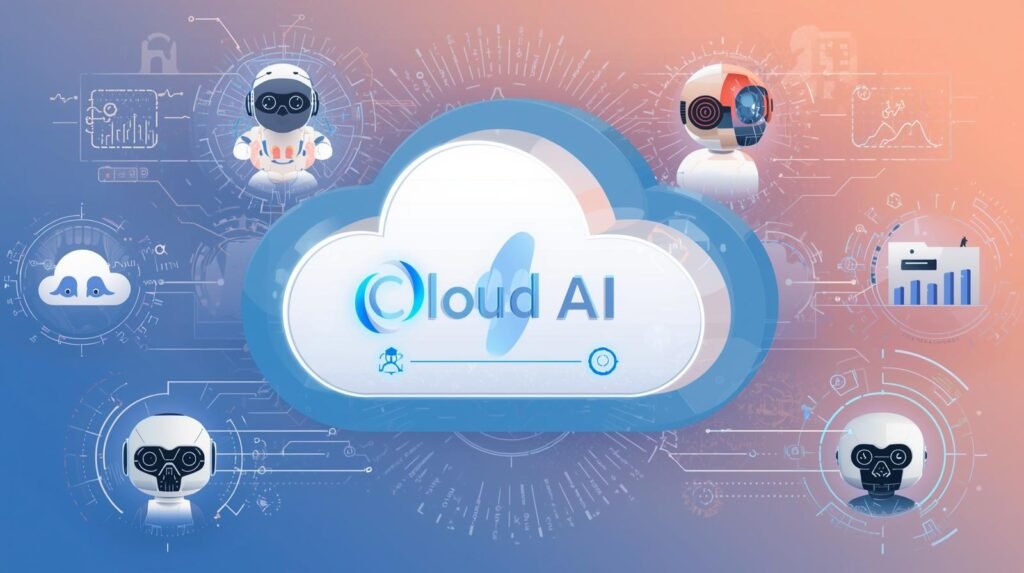
Cloud AI Services are scalable AI tools that leverage robust cloud-based infrastructure, enabling development teams to embed intelligence into their products without building everything in-house. Organizations using Cloud AI Services have access to a wide range of features and capabilities, including image recognition, voice recognition, language translation, document scanning and processing, recommendation engines, and forecasting (all accessible via an easy-to-use API).
One of the most significant advantages of Cloud AI Services is their elastic scaling. For example, if traffic spikes during a sale, product launch, or a seasonally higher-usage period (e.g., holiday shopping), the Cloud AI will automatically scale up to meet the increased request volume and then scale back down once demand subsides. Therefore, Cloud AI Services can support both small pilot projects and high-traffic applications. Additionally, because the cloud provider is responsible for managing the specialized hardware (including provisioning, patching, and maintaining serviceability), the organization’s need to manage this hardware is greatly reduced.
When using Cloud AI Services, data is typically collected, secured, and processed; models are selected or customized; and the output is delivered to the application in real time. Cloud AI can also be used to support customization and fine-tuning of the model if the available off-the-shelf model does not meet the desired accuracy requirements. Finally, once deployed, Cloud AI Services include performance metrics (such as latency, error rates, and throughput) that enable the development team to ensure the experience remains fast and reliable.
Governance is still important. With Cloud AI Services, you need to have defined access control, encryption, auditing, and data retention policies in place when using the service. For high-risk or sensitive uses of Cloud AI, there will likely be additional requirements, such as a bias-check process, human reviews, and thorough evaluations, before rolling out an update. The versioning and staged deployment features provided by Cloud AI Services will enable teams to test and validate changes before deploying to production.
In the case of robotics, IoT, and enterprise automation, Cloud AI Services can also act as a “shared intelligence” layer. Devices send their data (and edge cases), and cloud-based models improve over time. Once the models are ready, updates can be rolled out to multiple endpoints. In this context, Cloud AI acts as a reliable “engine room,” and Cloud AI Services provides the standardization, scalability, and ease of maintenance for AI capabilities across various products and teams.
AI Cloud Integration: Seamless Integration of AI Models with Cloud Environments

AI Cloud Integration is the process of connecting AI Models to cloud environments so they can be built, deployed, secured, and improved as any other cloud service. With AI Cloud Integration, teams move beyond experimental phases and make AI. Reliable enough for use in real products. A strong approach to AI Cloud Integration also ensures the model has access to the right data at the right scale and delivers predictions that applications can actually use.
In practice, AI Cloud Integration establishes connections between data sources (apps, databases, sensors) and cloud storage & processing, then into training or fine-tuning workflows. It also establishes a connection between deployment targets (managed endpoints, containers, or serverless functions), enabling applications to call the model via APIs. This is where Cloud AI provides the most value: on-demand compute, managed hosting, monitoring, and tracking, which help teams release models more quickly and scale without rebuilding infrastructure.
Operational discipline is a key part of AI Cloud Integration. Models should follow CI/CD patterns, including automated tests, staged rollouts, and version control for code, data, and artifacts. AI Cloud Integration also includes observability: tracking latency, errors, drift, and real-world outcomes to let teams know when performance is slipping. Many organizations are using Cloud AI tooling to automate scaling, securely log requests, and manage model variants across environments.
AI Cloud integration should always include security and governance to be implemented immediately upon deployment. The organization’s use of AI Cloud integration is to provide the most secure environment possible by enforcing least privilege access, encrypting all data in transit and at rest, maintaining audit logs, and defining clear retention policies for both training and inference data.
If an AI model’s decisions have high consequences for the organization or its customers, AI Cloud integration must enable human oversight of model decisions, bias analysis, and clear documentation of the model’s limitations. Simply utilizing cloud AI does not diminish an organization’s responsibility for implementing and consistently applying these elements, but it does provide a more robust framework for doing so.
Ultimately, when implemented correctly, AI Cloud integration delivers a stable AI capability that does not act as a fragile add-on to existing technology infrastructure. The flexibility of Cloud AI enables organizations to integrate their models with other business applications, safely update them, and maintain model reliability as traffic, data, and application requirements change.
How a Robot ‘Talks’ to Its Cloud Brain in Three Simple Steps
The “conversation” between a robot on the ground and a computer in a remote facility can be both fast and easy. The two are not conversing; they are simply rapidly exchanging information about the robot’s surroundings. In essence, this is how robots use cloud computing to navigate the physical world. The entire process is based on a simple three-step cycle.
Imagine that you are on your way home with your delivery robot when it runs into a tree that has fallen across the road ahead of it. Instead of running over the tree or stopping to figure out how to get around it, the robot follows the three basic steps below to find a solution.
Step 1. See the Problem (Information from Sensors). The robot gathers information about the situation using sensors, including cameras as “eyes” and scanners as “touch.” Using these sensors, the robot captures a digital image of the obstacle and determines its dimensions and location. That is the raw data.
Step 2. Phone a Friend (Sending Data to the Cloud). The robot then sends the data package to the cloud supercomputer, known as the cloud brain. The Internet operates quickly and serves as a channel to deliver the robot’s “What should I do?” question to the cloud.
Step 3. Get the Answer (Instructions from Cloud). The cloud-based artificial intelligence performs real-time analysis of the digital image sent by the robot in under a second. It determines the type of object the robot is seeing by recognizing the image of the fallen tree, and it returns a simple message to the robot: “Stop, turn around, and try the next street.”
A robot does not have to know anything about a tree. It only needs to follow the simple instructions it receives from the cloud. The cloud is doing all the hard thinking for the robot. What really makes this technology so revolutionary is what the cloud then does with its answer next.
The Real Magic: How One Robot’s Mistake Makes Every Robot Smarter
That solution for the downed tree does not simply disappear. Rather than treating this as a one-time fix for a particular machine, the cloud AI views it as an important piece of knowledge and experience. This is when the shared brain becomes truly powerful, transforming a group of individual machines into a unified, intelligent system. This is the distinction between one person learning from a problem and an entire species of problems and learning from them instantly.
The way this system operates is more akin to a “hive mind” than a single intelligent machine. The experience of one machine is now the knowledge of all machines. Since the central AI learned about the downed tree, it updated its overall model of reality with this new knowledge. When the next machine in the fleet encounters a similar object (even in a different city a week later), the shared brain knows the solution and instantly instructs the machine how to avoid the downed tree.
As a result, we have a system that continually learns autonomously. Every delivery, every obstacle, and every unexpected problem creates a more capable and reliable network without a human having to program each machine individually again. Each machine is a member of a large and constantly learning team.
Where You Can See This ‘Hive Mind’ in Action Today
Autonomous driving technology is a prime example of how “the hive mind” is taking shape. Self-driving cars are designed to learn from each other and improve their performance through shared learning experiences. For instance, when a single vehicle successfully navigates an unmarked, difficult intersection, it immediately transmits its experience to a cloud-based brain that analyzes the data and then sends the lesson learned back to all vehicles, improving each vehicle’s ability to navigate a similar intersection in the future.
This same concept is being applied behind the scenes of your online shopping experience. Thousands of robots operating in a large warehouse are working together as a cohesive unit. A cloud-based AI is acting as a “traffic control center,” in real time adjusting each robot’s path to avoid collisions and congestion. When a robot finds a new route or path, it transmits that knowledge to the rest of the robots in the warehouse so that all robots can benefit from its discovery.
You may be noticing small, wheeled delivery robots appearing on city sidewalks. Because of their size, these robots do not have space to house a powerful onboard computer to help them navigate their environment. Instead, they connect directly to the internet cloud to access and utilize the computing resources available there. Additionally, the robots will share important lessons learned (such as how to safely and efficiently cross a broken curb) with all other robots in the network.
Cloud vs. Local Brain: When Do Robots Need to Think for Themselves?
What occurs when an intelligent robot loses its Internet signal? Will it simply cease functioning? Actually, that is not what will occur. The same thing is true about your own mind. Deep thought is used for complex planning; however, you do not have to think (or reflect) to pull your hand away from a hot stove. That is called a reflex—a fast, automatic reaction that is pre-programmed into your body for protection. Robots are very much the same way as humans.
The reason for this necessity to include reflexes in intelligent robots is that, in some cases, time can literally be deadly. A self-driving vehicle, for example, may not have enough time to send a request to a data center and then receive a response before a child dashes into the street. The onboard computer will have to make an instantaneous decision to apply the brakes. In emergency situations such as this one, the localized brain is a much faster decision maker than a more powerful cloud-based brain.
Having the robot perform rapid-fire decision-making is referred to as edge computing—the processing occurs at the “edge” of the network, not in the distant cloud. This is not a contest between the two brains—it is a partnership. The localized “reflex” brain handles emergency situations, while the more powerful cloud brain analyzes the broader picture, learns from past events, and makes the overall system smarter for the future.
How Super-Fast 5G Is the Fuel for Smarter Cloud Robots
To achieve a successful Cloud Brain Strategy, the connection between the Robot and Cloud must be faultless. Slow or choppy Internet connections are like trying to have a serious conversation over a poor-quality video call — constant freezing and delays make real-time interaction impossible. Given that the robot must receive instructions immediately, this digital stutter could be the difference between success and failure.
Here is where 5th Generation Wireless Technology (5G) provides a significant advantage by enabling connectivity. The most notable aspect of 5G is the extreme reduction in the communication “delay” in comparison to previous generations. The time it takes for a signal to travel from the robot to the cloud and back is virtually zero. The difference between sending a letter and engaging in an instant conversation reflects the level of responsiveness that a 5G network with extremely low latency can enable.
The connection speed provided by 5G enables incredible new capabilities. Think about remote surgery, where a surgeon located in one city is able to control a robotic arm in order to perform a complex operation on a patient located thousands of miles away. Each surgeon’s movement must be transmitted to the robotic arm without delay for the arm to execute it accurately. The degree of responsiveness required to accomplish this task is precisely the type of responsiveness that a 5G network with very low latency is designed to provide.
In summary, the highly reliable connectivity provided by a 5G network makes a “Cloud Brain” for mobile robots practical. As long as the connection is reliable, the robot itself may be a simple machine at a lower cost than previously possible, requiring only a stable signal to connect to a common, collective intelligence.
The Future Isn’t Owning a Robot—It’s Subscribing to One
A robot, however, is much more than just a smart, self-sustaining machine. It has a virtual umbilical cord—a connection to a large, shared brain in the cloud that provides collective intelligence to guide the robot.
The brainpower shared among robots via the cloud is creating a new category of users for advanced robots, using a model known as Robotics-as-a-Service (RaaS). Think of this as similar to how you would use Spotify or Netflix. You do not purchase all available music or movies. Instead, you pay a subscription fee and have access to all.
In a similar fashion, a small business that cannot afford a fleet of expensive delivery robots can simply “subscribe” to the RaaS service. Since the robots are cloud-enabled, they receive the latest software updates and the collective knowledge and experience of the entire network, delivering immediate effectiveness.
Therefore, the standalone robot era will be replaced by an era of connected intelligence. The next time you see a robot, don’t simply ask what it does. Instead, ask yourself, “Is it thinking independently or is it linked to a larger brain?” Now, you have the ability to recognize the great difference.













Comments 4