






















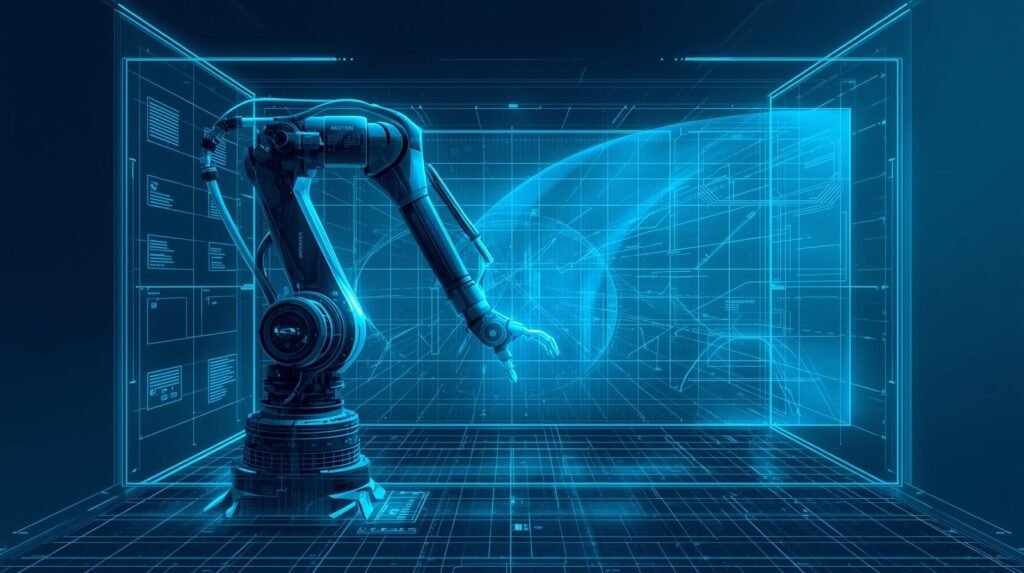
“Think about creating an entire factory line to build a massive robotic project. When you are done, you realize that a critical piece is missing. This is a $1 million, two-ton robot arm, and it can’t be installed due to improper fit. Additionally, if the robot is off by a tiny amount, the arm will catastrophically fail. Also, if a catastrophic failure occurs while the robot is operating, it could damage equipment or injure workers.

The challenge to test robots in the physical world to ensure they operate correctly has existed for some time. It takes multiple time-consuming tests to validate every new software version on the production robot. As such, this process significantly slows the development cycle.
In addition to being costly, this process poses an actual risk to humans and property. The robot’s erratic behavior caused by a software bug doesn’t simply terminate the program. Instead, it causes the robot to malfunction. Malfunctioning could potentially destroy the equipment (robot), or the person using it. Can you imagine simulating all of the different processes involved in testing a robot, with the ability to break the robot 100 times without spending a dime?”
Summary
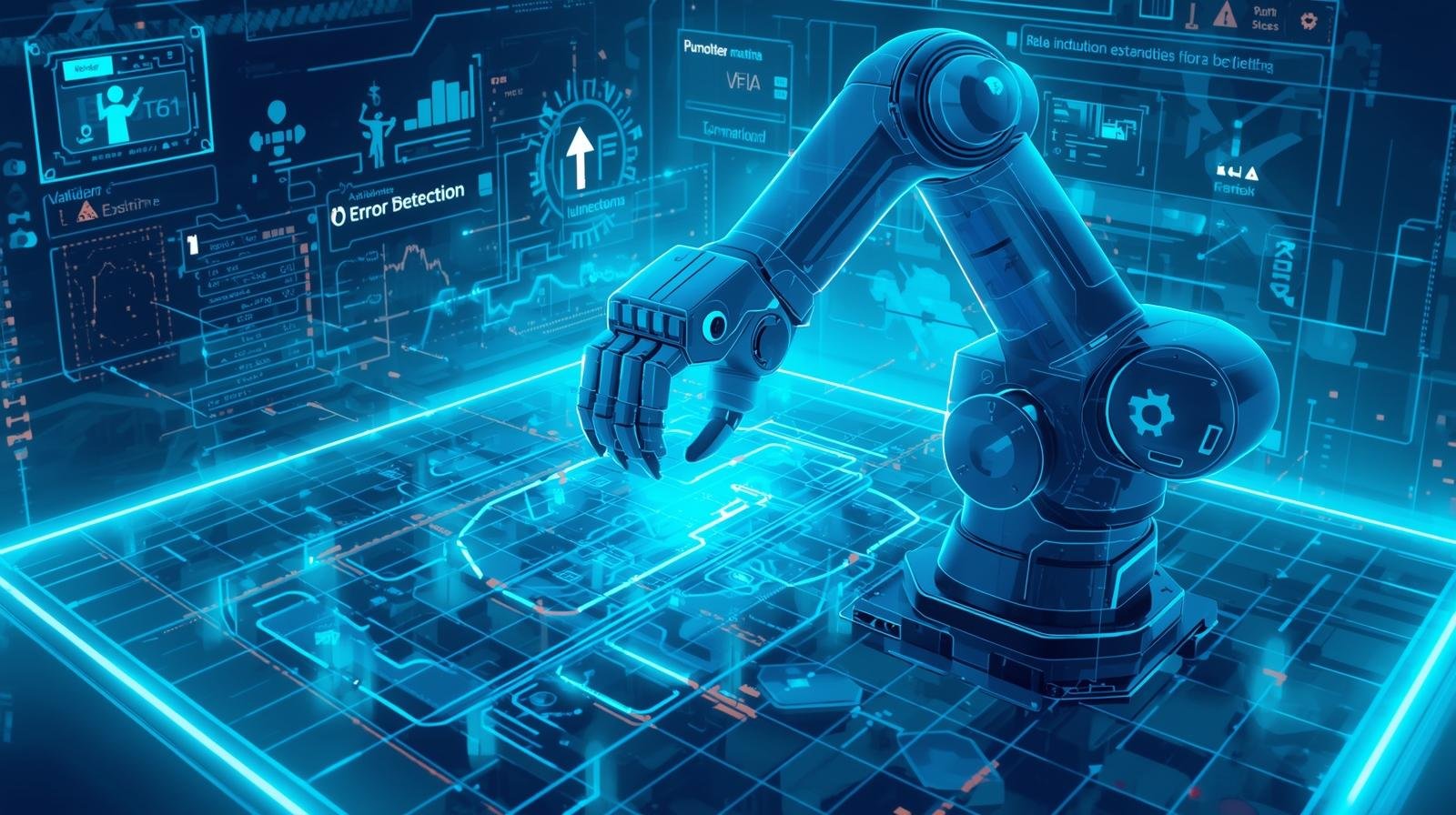
Virtual robotic testing is conducted using a highly accurate computer model of a robot and the physical environment in which it operates — referred to as a “digital twin” — to test the same control software that would be utilized in the physical device, but in a safe simulated environment prior to utilizing the actual hardware. This eliminates several significant barriers to robotics development by eliminating the need for trial-and-error testing and reducing the time and money spent on physical testing.
There are many benefits to utilizing virtual robotic testing; one of the largest benefits is financial. Mistakes that may lead to repair costs, unnecessary material waste (paint, welding wire, etc.), and lost production time and income due to downtime are virtually eliminated when testing is conducted in a simulated environment. The ability to run simulations rapidly also allows developers to quickly evaluate a variety of options to optimize paths, cycle times, and task sequences. Developers can use “offline programming” to develop robot code before receiving the physical robot, greatly reducing the time required to set up the robot on-site.
In addition to cost savings and rapid development, virtual robotic testing offers a major benefit—safety. Developers can safely simulate catastrophic failures such as collisions, emergency stops, and other rare failure modes without risking injury to personnel or damage to equipment. Collaborative robots, which will operate in close proximity to humans, are particularly beneficial to this type of testing.
The article provides a few examples of how virtual robotic testing is being used today. They include: automotive manufacturers, large e-commerce distribution centers, and NASA’s Mars Rover program. The article concludes by stating what is referred to as the “reality gap.” Although virtual robotic testing can greatly reduce the amount of physical testing required to achieve acceptable performance, it cannot completely eliminate the need for some physical testing.
Virtual Robot Testing
Virtual robot testing is the process of evaluating a robot’s performance using simulation before (and/or at the same time as) in real-world testing. Virtual robot testing provides an opportunity for teams to assess a robot’s design, movement path, and control methods before damaging the robot, losing production time, or damaging equipment. Virtual robot testing has the potential to greatly benefit companies that have expensive prototype development equipment, limited access to laboratory testing facilities, or rapidly changing prototypes.
#Robot Fleet Management: A Smart Essential Guide in 5 Steps
Virtual Robot Testing typically starts with creating the digital representations of the robot itself, as well as the cell or work envelope where the robot will be used, and all of the equipment that the robot will interact with, such as, but not limited to, grippers, conveyor belts, fixtures, and safety zones.
The second step of the virtual robot testing workflow is to develop test scenarios to verify whether the robot has sufficient reach, clearance, cycle time, and collision avoidance. The best simulations will also include models of sensors and their associated noise, so that teams can simulate how various types of sensors function (e.g., camera-based vision systems, laser-based LIDAR systems, force feedback systems) under various conditions. This allows teams to find out about their robot’s performance in the “ideal world”, sooner than they could through real world testing.
The most significant benefits of using virtual robot testing are reduced costs and time savings, resulting from faster development and testing. In addition to being faster, virtual robot testing allows users to test their application across dozens of environments and configurations in minutes, rather than the hours spent waiting for a physical robot. For example, virtual testing can allow users to experimentally determine the optimum speed, acceleration, and constraint levels for navigating a specific path.
Therefore, you will be more likely to build a robust application that operates effectively across a variety of object types and environments. Moreover, since there are no physical robots used in the testing phase; therefore, you will not have to be concerned with costly repairs should damage occur during the testing phase of development.
Lastly, virtual robot testing allows you the opportunity to “stress test” your application and see how it reacts under extreme conditions (e.g., occluded markers, glare, changing payload, close tolerances, and obstructions). Testing your application under the conditions described above before releasing it to the shop floor will help you identify potential problem areas and develop remedies before they become issues. A further method of describing this process is “operator training”. Virtual robot testing simulates a robotic system’s operation, allowing operators and maintenance personnel to practice operating and maintaining it without the risks associated with physically operating one.
Virtual Testing vs Physical Testing (Time & Cost Contrast Table)

Statistic: Virtual testing can reduce robot development time by up to 40%
Source: Deloitte Industry 4.0 Report
https://www2.deloitte.com
Robot Simulation: Test Robots Virtually Before Real-World Deployment
Robot simulation enables teams to test a robot’s behavior in a fully detailed replica of their manufacturing area (factory), warehouse route, or customer location using a simulated digital environment. This simulation occurs before a robot is physically placed in the area.
Teams model the robot, the tools it uses, and the environment; they then run a series of simulation tests based on real-world conditions. The results from these simulations allow the teams to determine what works well, what does not, and where improvements need to be made. Robot simulation is most often used in conjunction with virtual robot testing. Virtual robot testing utilizes automated test cases to evaluate the performance, safety, and reliability of robots before damage occurs to the actual hardware.
#What Is SLAM? Smart Essential Guide to How Robots Know Their Location
An overall package for simulating an industrial arm robot should include a three-dimensional geometric representation of the robot, kinematic analysis to determine its motion, and physical simulations to model its movement under real-world conditions. Industrial arm robots are also useful because they can verify several parameters, including reach, cycle time, joint limits, and a safe path to avoid collisions with fixtures, people, and other objects.
Conversely, a package for simulating a mobile robot should contain representations of maps, obstacles, sensor noise, and traffic flow patterns to allow evaluation of navigation and recovery behaviors. Combining virtual robot testing with robot simulation testing will enable teams to automate testing by creating test cases that execute the same test multiple times for each software update, ensuring no regressions occur.
The largest benefit of robot simulation is that it allows teams to test many facets of their project simultaneously. Normally, teams would have to wait until the lab was available to perform the necessary testing for this type of project. Now, teams can run all necessary testing (including “what if”) for a project at once, such as changes to the layout, payload, or camera position.
Early-stage design issues are well-suited to robot simulation. Issues include choosing a gripper type, setting acceleration rate limits, and determining the optimal arrangement of the elements in a workcell.
Additionally, robot simulation offers advantages in cost and safety. A physical system failing will result in damaged equipment, wasted components, and potentially create hazardous working conditions. Robot simulation reduces the likelihood of the physical system failing by identifying potential problems before they occur in the real world. Problems may be caused by physical-system faults such as collision(s) with other object(s) due to a lack of sufficient clearance between the objects, loss of a stable grip on the object, or a lack of sufficient sensor coverage.
The best way to maximize the benefits of robot simulation is to first select one mission-critical process (such as pick-and-place, palletizing, inspection, etc.) and define a set of measurable criteria to determine when the process has been successfully completed. Next, use virtual robot testing to ensure all possible scenarios are covered. After the physical robot is installed, it will have already proven itself reliable and consistent under various conditions by passing virtual robot simulation and testing.
How Virtual Robot Testing Works (Loop Workflow Table)

Example: A delivery robot is tested in hundreds of virtual city layouts overnight.
Source: NVIDIA Isaac Simulation
https://developer.nvidia.com/isaac-sim
Your Robot’s Personal Flight Simulator: What is a “Digital Twin”?
The use of simulators enables pilots to safely test their skills with digital models of new aircraft. This testing occurs prior to flight and gives pilots confidence in their ability to control their aircraft successfully. Robotics engineers also utilize the technology described above as a Digital Twin. The Digital Twin is a 3D model of the robot stored on a computer. Through the Digital Twin, robotics engineers can run as many tests as necessary without risking damage or loss of the physical robot.
To be effective, a Digital Twin must include more than just the robot’s digital model. A complete digital model of the future work area where the robot will be working must be developed. For example, if the robot will eventually be performing duties in a warehouse, the Digital Twin would require details such as the locations of the shelves the robot needs to reach, the boxes the robot needs to pick up, and the conveyor belts the robot needs to communicate with. Each test run utilizing the Digital Twin should mirror the operating environment that the robot will experience during normal operation.
One major advantage of using a Digital Twin is that both the physical robot and the Digital Twin will run the same programming language. As a result, when engineering and/or testing issues arise, engineers can easily identify and resolve them at a lower cost of failure. As such, the Digital Twin allows robotics engineers to develop and test innovative solutions at no financial risk.
How to Build a Robot’s Virtual Playground
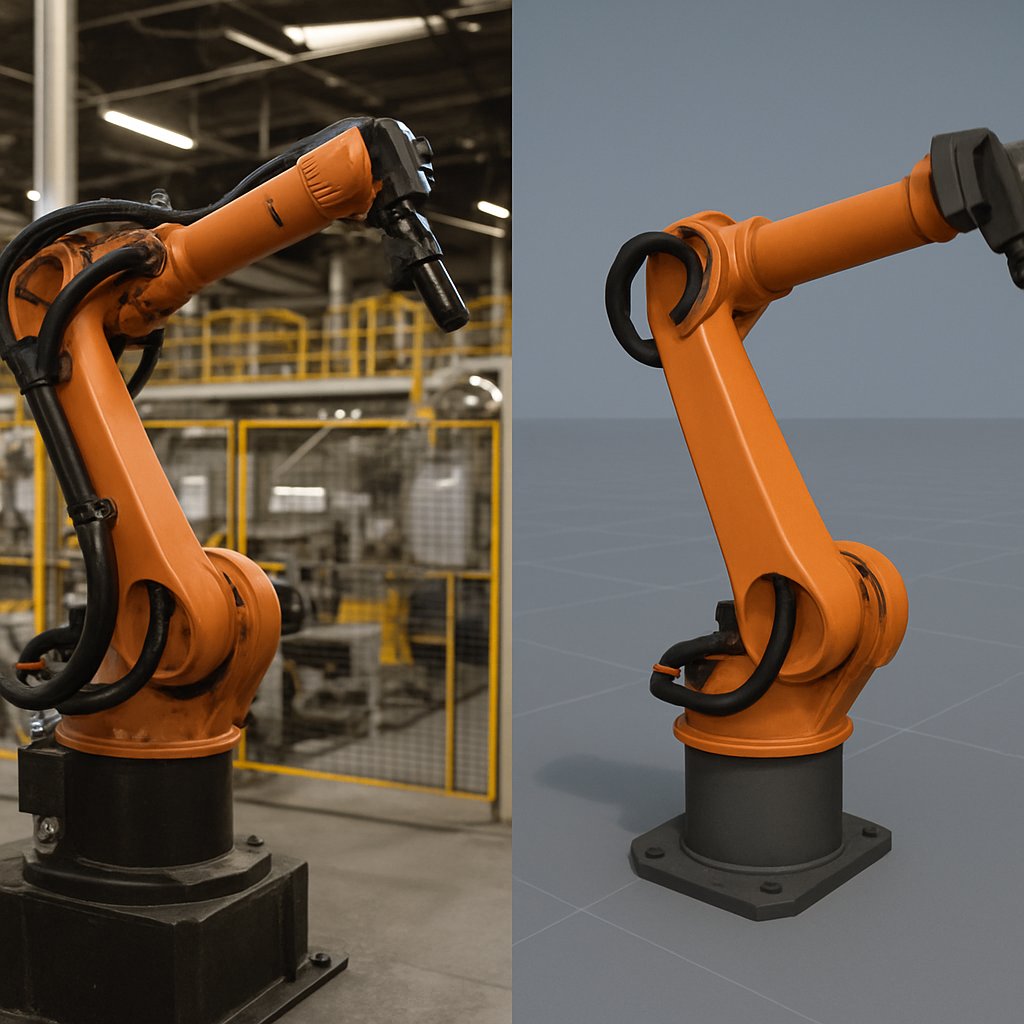
The beginning of the creation of the virtual robot begins by building an accurate 3D version of the robot and its working environment (the digital plan) – each joint of the robot, each screw and wire in the physical robot, along with every factory floor obstacle, conveyor belt, etc., is included in the virtual model. Building a realistic virtual environment is very similar to developing the virtual environments we experience in video games today.
Creating an exact model of the robot in the virtual environment is only part of the solution. The virtual environment must also behave like the actual environment. The physics engine serves as the “rule book” for the virtual environment; it sets the rules of the game, including gravity, friction, and momentum. When a user drops a virtual robotic arm, it doesn’t fall onto a solid steel table. It is also why a virtual box falls down when you drop it. Without using a physics engine, the simulation would only be a picture – not a true testing ground for engineers.
When a fully accurate virtual model of the robot is combined with the physics engine (the rulebook), the simulation’s reliability increases dramatically. Engineers can now have full faith that if a test passes in the virtual environment, it will pass in the physical world. With that level of confidence, companies can address problems ranging from automotive manufacturing on Earth to robotic exploration on Mars.
#Hybrid Cloud Edge Robotics – Smart Essential Guide
Benefit 1: Test Without Breaking the Bank
There are many benefits to simulating a robot’s operation. One of those big advantages comes from having the ability to make mistakes, like a robot swinging too wide and causing damage, without any consequences. When a digital model of a robot crashes into equipment because it was programmed to swing too wide, the issue can be quickly and easily corrected by adjusting the parameters of its digital program.
However, when a physical robot damages equipment by swinging too wide and crashing into it, the cost of correcting the problem could exceed $100,000. Therefore, the potential to make costly mistakes, such as allowing the robot to swing too wide and crash into equipment while still learning and resetting without penalty, offers the greatest advantage in using digital models of robots and will greatly help companies from incurring the large financial burden of catastrophic mistakes.
Another great benefit of using digital robot models is the elimination of unplanned downtime. For example, if a key robot on a production line were to fail unexpectedly, the entire line would have to shut down, incurring tens of thousands of dollars per hour in losses. In contrast, developing robot programming through virtual commissioning allows companies to create programs for their robots before the robot touches the production floor for the first time, eliminating lost revenue from a single piece of equipment failure.
Virtual testing also saves money by producing less waste. Physical testing of robots working in processes such as welding and painting generates waste from all materials involved, including paint, which is discarded after every mistake. Digital testing does not consume physical materials, so no waste is produced. This is a great way to lower your robot development costs and is very fast.
Benefit 2: Work at Light Speed by Testing Thousands of Scenarios Overnight
Time elapses faster inside a digital twin than outside, within the robot. Robots are subject to the laws of physics, while simulations can be executed much more quickly with more processing power. It is similar to watching a video that has been sped up; while an actual robot may require ten minutes to perform a given task, the same task could be performed in just a few seconds in a simulated environment.
Because simulations can run much faster than real time, engineers can evaluate many thousands of alternative solutions or methodologies to accomplish a specific task overnight. Engineers can discover the most productive (efficient) methodology for a specific task and save as many as seconds of production time per task. After one year of continuous robot operation, these productivity savings could equal several days of productive time.
The increased processing speed associated with executing simulations provides the engineer with a tremendous advantage. Engineers can use a technique known as Offline Programming to develop the robot’s entire sequence of actions, test it, and refine the programming instructions before the physical robot is delivered.
Once the physical robot has been delivered to the customer and installed, the optimal sequence of actions will be available for download from the simulation into the robot. Not only did the engineers save themselves the weeks it would have taken to program the robot on the shop floor, but the robot will also start producing sooner than it would have if those weeks had been spent programming it.
Benefit 3: Practice for Disaster in a Perfectly Safe World
If a robotic arm in a car factory swings too aggressively, or if a programming error causes a robotic warehouse employee to knock into a storage unit, in both cases, there are monetary and sometimes fatal consequences. An engineer cannot possibly test all the ways a robotic system could fail. But the digital twin of a robotic system (which doesn’t have negative consequences) allows the engineer to test ALL possible ways it could fail.
A physical simulation model, based on digital physics, operates the digital twin. A physical simulation model is very similar to what you see in a video game. A video game prevents a player from passing through solid objects because of collision detection. Digital simulations use the exact same collision-detection concept. The digital twin knows precisely the location and dimensions of every 3-D object, including the arm of the digital twin itself, as well as the digital conveyor belt adjacent to it. Therefore, an engineer can simulate a crash or emergency stop 1000 times and study each outcome without causing damage to the real equipment.
In fact, the rigorous safety testing described above is a necessary precursor for robots to exit their “enclosures” and work alongside humans. Safety is the foremost reason collaborative robots (“cobots”) exist. By demonstrating that a robot will automatically and safely bring itself to a halt as soon as a human enters too close proximity to it, manufacturers can create workplace environments where humans and machines collaborate to accomplish complex tasks.
Simulation Tools: Digital Tools That Make Robot Testing Safer and Faster
Simulation tools can provide engineers with a means to simulate and test robotic systems and their behaviors prior to actual deployment on the hardware. Simulation tools enable engineers to evaluate how well the robotic system moves, senses its environment, and makes decisions through controlled simulations. Simulation tools reduce the risks associated with testing and accelerate the development cycle. By combining simulation tools with virtual robot testing, engineers can identify problems earlier and use more efficient methods to verify solutions than with physical robots.
At a minimum, simulation tools should include all aspects of the robotic system and its workspace, as well as the tasks it will perform. For example, simulation tools for an industrial robotic system would include all aspects of the robotic cell, such as conveyor systems, tooling, components, and safety boundaries. Similarly, simulation tools for a mobile robotic system would include the environment map, obstacles, traffic flow, lighting conditions, and other relevant factors. Replicating the robotic system’s environment is critical to ensuring that the virtual testing is repeatable.
One of the main benefits of using simulators is that you can create an unsafe-but-safe-for-testing scenario (failures on purpose) for robotic systems. There are many ways you can use simulators to test robotic systems. You can test robotic systems at high speeds. You can introduce sensor failures. You can add unexpected objects to the environment. You can simulate misaligned parts. You can do all of this without risking collision or damage to the robotic system. Virtual robot testing converts edge cases into test suites.
These test suites will run every time the code is changed. Therefore, when teams demonstrate that their robotic systems perform well once, they also show that their systems will remain stable as their software evolves.
A second benefit of simulation tools is that it enables you to test your robot in a virtual setting. Teams can try out iterations of their robots virtually without being held back by the need to have access to the actual robotic systems. They can also avoid losing production time due to the hardware requirements of robotic systems. They can also avoid moving the physical robotic systems to make the necessary changes.
Simulation tools need several important functions: simulate physics and kinematics, determine when collisions occur, model sensors (LiDAR, camera, etc.), and provide a way to log information to help explain why some test runs succeed and others fail. In addition to providing all the previously mentioned items, it is very important to integrate simulation tools into your overall workflow.
Simulation tools should provide APIs or scripting capabilities, and/or integrate seamlessly with other popular robotics frameworks so that the simulation can communicate with your real-world software stack. Virtual robot testing can be run automatically overnight, generate metrics (cycle time, success rate, number of close calls), and identify problem areas if you already have an established pipeline.
The first step in using simulation tools is to identify a part of your workflow that needs improvement, define how you will measure whether your work has passed or failed, and create workflows that simulate every possible condition in the physical world. As soon as you start using simulation tools and treat them as a part of your validation process, they will act as a safety net, allowing you to develop robots much faster and with less risk than before, while greatly reducing the amount of uncertainty.
Automated Testing: Automated Tests Validate Robot Behavior Without Manual Effort
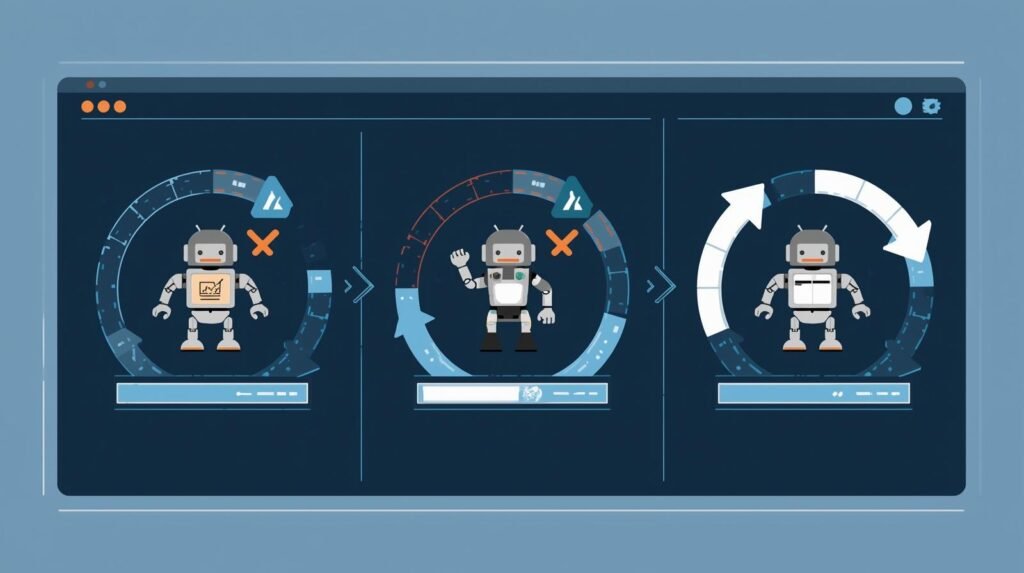
By employing automated testing methods for robotic teams, the ability to repeatedly run tests to verify that each team member’s robot meets specifications is enabled. Testing is performed using automated testing, which involves a tool to continuously check robotic functionality. Teams using this method do not need to manually rerun the same test.
They can use the automated testing tool to run previously defined test cases and capture their results. If either the test case being tested or the manner in which it was run changes, a regression will be identified. Combining automated testing with virtual robot testing provides a cost-effective way to demonstrate that your navigation, manipulation, and safety logic will work under various conditions, such as varying lighting conditions.
The process of adjusting a robot’s control systems typically has little effect on the robot. However, when adjustments are made to controllers, higher speed limits can be established, but higher levels of overshooting can also occur. Adjustments to a robot’s perception systems can allow for good operation in daylight but poor operation in shadow. These issues are resolved through automated testing, which translates a true requirement into a test case. These types of checks include, but are not limited to, “no collision”, “task completed within the allotted time frame”, or “robot stopped within a safe distance”. Using virtual robot testing, these checks can be run in a simulated environment.
A good method for automating the testing process is by defining testing levels. Unit testing is the lowest level of testing, where each individual component of the software is tested (e.g., math utilities, planners, and state machines). After all components have been tested individually, the next step is to test how they interact as a whole. This type of testing is referred to as integration testing.
For example, you could integrate the planner and the sensor data. End-to-end testing involves testing the entire mission (i.e., pick, place, inspect, and/or deliver) to verify that the robot successfully completes it. Success can be measured by metrics such as success rate, total mission completion time, and the number of “near miss” events during the mission. Using virtual robot testing for end-to-end testing is an economical way to develop test plans that may be expensive or impossible to perform on physical hardware.
One of the largest benefits of using virtual and automated testing is the ability to ensure consistent results. Humans become fatigued and do not always perform the required tasks. In addition, humans sometimes interpret the outcomes of their actions differently from others, whereas automated testing consistently performs the same task(s) and measures the resulting outcomes.
The use of virtual robot testing increases confidence in the quality of the final software/hardware upon completion of the test. The ability to test consistently as well as to test for unusual events (loss of sensor input, sudden appearance of an obstacle, slippery surface, etc.) also allows developers to assess safety and reliability of their products. Use of virtual environments eliminates the possibility of damage to the hardware being tested.
You will need to establish clear, measurable acceptance criteria before creating a library of tests to run against. It is best to develop these acceptance criteria based on common usage scenarios.
Automated testing can be made effective by including the ability to log failures and replay failures. Also, automated testing should be integrated into your continuous integration process to run all tests after each developer submits changes to your codebase. Virtual robot testing and automated testing provide a positive feedback loop. Bugs found through testing are added to your test library. Each subsequent release of your product becomes more reliable with fewer people involved in the process.
Virtual Testing: Identify Failures Early Using Virtual Robot Tests
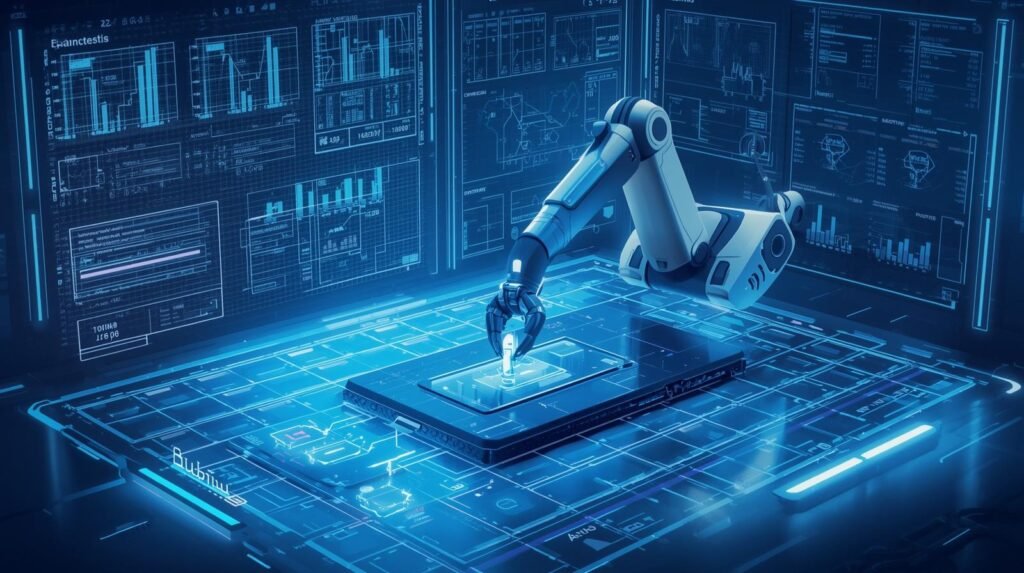
Virtual Testing lets Robotics Teams identify failures sooner by simulating how the team’s Robot will behave before a live demonstration. Virtual Testing lets you test the motion, sensors, and decision-making without damaging your hardware, losing production time, or risking injuries. Implementing Virtual Testing as Virtual Robot Testing establishes a methodical process for verifying robot performance across a range of conditions.
A significant advantage of virtual testing is that it enables teams to find problems much sooner than they would with standard testing. Instead of learning about an accident on the day the project goes into commission, teams can identify potential clearance issues, unattainable poses, or unstable trajectories by running a simulation.
Virtual testing for mobile robots allows teams to identify failures in navigation (such as bad obstacle avoidance), localization drift, and brittle recovery logic. Teams also use virtual robot testing suites to verify that they have not introduced new bugs while fixing old ones.
Because of the variability of robotics, virtual testing is most useful when it simulates the “stress” conditions the team expects their robot to experience. To simulate these conditions, teams may want to add sensor noise, lighting changes, reflective surfaces, payload shifts, slippery floors, and random obstacles to their virtual testing environment. The variety of simulated environments allows teams to create an inventory of possible environments that the robot will be placed in outside of the lab, so instead of relying on chance to see how well their robot performs at the limits of what it has been trained to do, teams can demonstrate the limits of their training and generate evidence.
Speed and coverage are two major advantages of virtual robots. Simulated robots do not have many of the same limitations as real robots. Because they can run at speeds far greater than real-time robots (and can run concurrently with other systems), it is possible to run hundreds or thousands of simulations per second. Virtual robot testing allows you to monitor metrics such as success rate, time to complete tasks, number of collisions, minimum safe distance from obstacles, and time to recover from errors. Because of these capabilities, virtual robot testing will move from being a demo to becoming a key business decision-making tool.
To get the most out of virtual testing, establish clear pass/fail criteria that mirror those of the physical world. These may include margin of safety, cycle time, path smoothness, and docking accuracy. To automate the simulation, and to record all data generated by the simulation, to analyze trends in real time. When a test fails, use the virtual robot testing system to replay the event and generate logs so you can quickly determine the cause. Follow these procedures consistently, and virtual testing can serve as a reliable safety net for companies, helping minimize the potential for last-minute surprises during the development phase and build confidence in their products prior to deployment.
Speed Advantage of Virtual Testing (Scenario Scaling Table)

Statistic: AI simulation systems can test thousands of edge cases in a single day, far beyond human capability
Source: Waymo Simulation Research
https://waymo.com/research
Software Robotics: Software-Driven Systems That Control and Simulate Robots
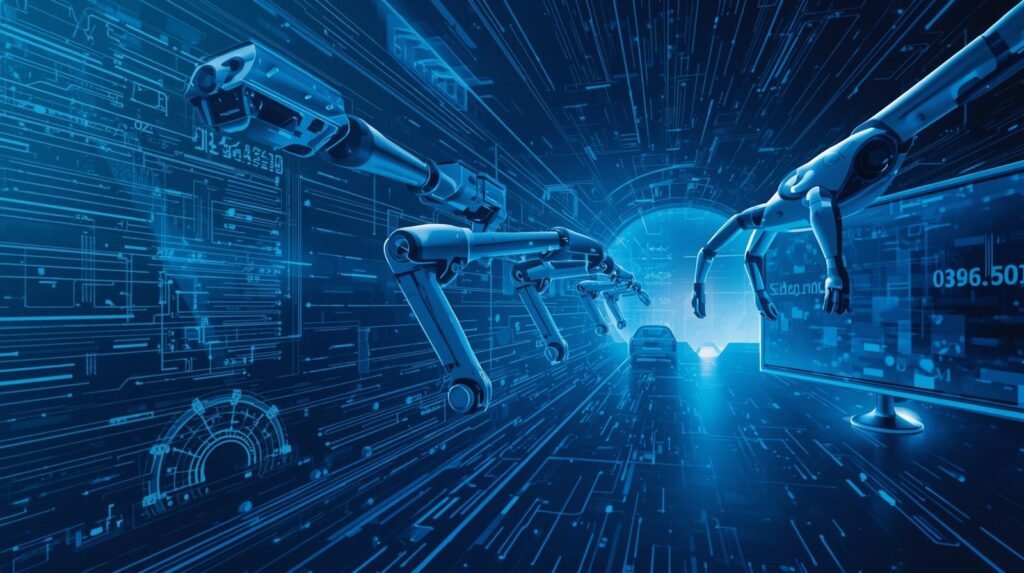
The term “software robotics” refers to systems controlled by software that create plans for how a robot will perform tasks (and verify that those tasks were performed), usually before the robot physically acts. As of today, software robotics integrates motion planning, sensing/perception, human and machine safety, and device coordination into a single software package, in which all components of the robot can be developed, tested, optimized, and deployed as needed. Combining software robotics with virtual testing of the entire robot system has enabled the rapid development of robots in terms of speed, safety, and volume.
At the control layer, software robotics converts the user-defined objective into a physical action (e.g., moving to a point, following a path, or grasping something). At the same time, it accounts for system constraints (e.g., joint limits, max acceleration, max weight, safe zones). Several teams also use software robotics to define the interface for their sensor/actuator devices (e.g., cameras, Lidar, grippers, motor controllers), allowing the robot to sense and respond to its environment. Due to the dependence on physical-world safety and reliability, a high degree of reliability is required; even a minor change in software could greatly affect it.
Software Robotics utilizes simulation and other technologies. Software Robotics developers use digital representations of the physical environment to verify that the behavior they are developing will operate properly within that environment. They are also utilizing those digital representations to simulate how their robot system will behave in various situations. The most common example is the cost of time in the lab and/or the cost of failure.
Virtual robot testing executes the same behaviors on multiple scenarios so the developer can evaluate whether the desired result was achieved (e.g., did not collide with an object, maintained a steady grip, successfully docked, or came to a safe stop). Virtual Robot Testing enables development teams to maintain quality in their application by turning all of the requirements into automated tests.
The practical steps to implement these workflows are as follows: first, you will need to use simulation tools to test and validate your behavior; second, you will need to create test suites (standard and extreme) for your virtual robots; third, you will need to perform validation tests on your physical robotic hardware. Using software robotics provides several benefits for identifying failures. Software robotics includes the ability to log/telemeter data from simulated and real-world environments, so you can compare the data traces directly. By doing so, you can adjust parameters and rerun the test suites until you reach the desired performance level.
In addition to providing engineering benefits, software robotics offers broader benefits. For example, you can use the platform as a means of training (operators can safely practice procedures within a simulated environment); collaboration (teams can utilize the same simulated environment and reproduce issues with consistency); and continuous improvement (each bug can be used as a means of creating a new test case). The combined impact of software robotics and virtual robot testing enables an iterative development process that lowers risk, reduces the time to verify each change, and increases deployment reliability.
In the future, as companies continue to adopt robotics, software robotics will likely be the greatest differentiator. The more intelligent the software in a robotic system, the greater its capabilities and reliability.
Virtual Robotics: Explore Robotics Concepts Inside Digital Environments
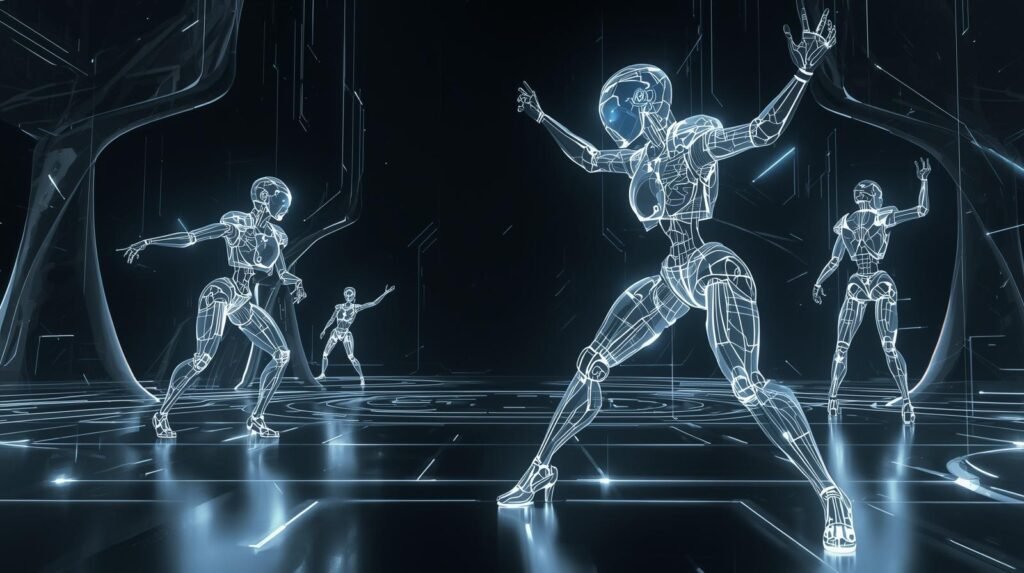
Virtual Robotics refers to the development and learning of robot behaviors, the creation of algorithms, and the design of entire systems within a simulated environment rather than with actual physical hardware. Through the Virtual Robotics process, users can become familiar with basic concepts (kinematics, control loop implementations, collection & interpretation of sensor data, autonomous operations) in a safer, more easily reproducible way.
One of the largest benefits of utilizing Virtual Robotics is the rapid testing and verification of changes to your robotic system. Users can quickly change the size of their robots, add new sensors, adjust the terrain in which the robots operate, and modify control parameters without waiting hours, days, or even weeks for results.
The ease of testing and verification that Virtual Robotics provides makes it ideal for educational settings and early-stage R&D and prototyping, where the goal is to validate ideas that may carry higher risk or be too expensive to implement in physical systems. Once users have tested the idea, Virtual Robot Testing can be used to formalize that exploration and establish clear pass/fail criteria.
Virtual Robot Testing involves testing a robot’s actions in various situations, such as successfully avoiding obstacles, grasping objects, creating smooth paths to follow, docking accurately in space, and safely stopping when needed. In addition, by repeating each situation under the same conditions, Virtual Robotics allows users to isolate problem sources and compare different versions of the same code. The high degree of repeatability in Virtual Robot Testing has made it a popular choice for Regression Suites, which allow users to verify that recent updates have not affected pre-existing functional capability.
Another positive aspect of utilizing Virtual Robotics is that it can cover every possible edge case. Examples of edge cases include sensor noise, changing lighting conditions, slippery floors, unexpected obstacles, and communication delays. By simulating these edge cases with virtual robots, users can run thousands of combinations and track the success rate, the time to complete a task, the number of collisions, and the time to recover from an error.
In order to get the most value out of using virtual robotics, you need to identify what you would like to learn or develop (Example: “Navigate through a crowded hallway”, “Pick parts out of a bin”). Then, you should create a few small groups of scenarios based on realistic operating conditions. Once you have completed that step, you can use virtual robot testing to automatically test the scenarios, collect data regarding the outcome of the tests, and replay the part of the simulation where errors were made.
Over time, virtual robotics can be a valuable resource for establishing a baseline for training, designing system iterations, and successfully deploying systems — because virtual robot testing allows you to measure system performance as they grow increasingly complex.
From Car Factories to Mars: Where Virtual Testing is Used Today
Simulated environments enable many industries to fully automate robot programming today. Offline robot programming has changed the face of manufacturing and will continue to do so. Many thousands of robotic arms in the automotive industry are programmed and coordinated in advance to perform every weld, movement, and function of a new car model before production begins.
E-commerce companies also use simulations to plan the best possible routes for their delivery robots, which sort millions of packages daily. Each company uses its own simulation to find the best way to move products through a digital twin of a warehouse, testing hundreds of thousands of approaches.
NASA is perhaps the most interesting user of this technology. When sending a multi-billion-dollar rover to Mars, there are no second chances. To prevent errors, NASA engineers use an extremely accurate simulation of the Martian surface to test each command before it is sent over millions of miles. All the movements required for the rover to traverse difficult terrain, collect samples from Martian soil, and perform other tasks are practiced in the simulation to ensure safe operation.
What Virtual Testing Helps Detect Early (Failure Detection Table)

Statistic: Early detection can reduce post-deployment failures by up to 60%.
Source: McKinsey Robotics Insights
https://www.mckinsey.com
The Catch: Why You Still Need the Real Robot
Virtual worlds allow for incredible detail and capabilities. However, no virtual world is a perfect crystal ball. Consider a cake recipe where every ingredient is measured to the cup, and the baking time is specified exactly. The resulting cake should be very close to the one shown in the recipe.
However, if the cake were baked in an oven set slightly warmer than the temperature called for in the recipe, it could look very different from the picture in the recipe. Likewise, slight variations in friction, motor temperatures or air pressure between a simulated environment and the complex and often unpredictable “real world”, can also cause slight variations in the behavior of a real robot compared to its “digital twin.”
While there are many benefits to testing robots in virtual worlds, the ultimate objective is not to create an exact replica of how the robot will behave in the “real world.” Instead, the primary goal of testing in virtual worlds is to develop the robotic systems’ programs as closely as possible to the actual systems, so that only minimal adjustments to the robot’s movements are needed to account for minor real-world variables.
Since most large-scale problems, such as pathing and safety rules, have already been addressed by engineers in the risk-free virtual world, the physical robot can now be used to make final adjustments to the robotic system’s movements to account for minor real-world variables. This would convert a long and expensive process into a simple and affordable check-up.
Worldwide Use Cases of Virtual Robot Testing (Use Case Map)

Example: NASA tests Mars rovers in simulation to avoid mission-critical failures before launch.
Source: NASA Robotics Simulation
https://www.nasa.gov/robotics
Building Tomorrow’s Robots, Today
Virtual robot testing allows engineers to test their robots in a virtual environment rather than on the actual production floor of the manufacturing plant. This method has two primary advantages. First, it allows engineers to test their robots in a virtual environment, saving them considerable time and money during development. Secondly, testing robots in a virtual environment creates new avenues for engineers to develop and test new robots and enhance the quality of their existing robots.
Virtual robot testing enables engineers to quickly test, assess, and modify robots. Therefore, the use of virtual testing environments for robots will be instrumental in accelerating development, increasing efficiency, and ultimately improving the quality of the robots being developed.
FAQ’s
1. What is Virtual Robot Testing?
Virtual Robot Testing is a process that tests the robot’s control system using a virtual simulation of the robot and its operating environment, ensuring the robot behaves as desired before executing the control code on the robot.
2. How does a Digital Twin differ from a 3D Model?
The digital twin is more than just a visual representation of the robot and its operating environment. The digital twin also simulates the physics of the robot’s operation, including the forces (gravity, friction) and events (collisions) that occur during operation. The digital twin operates the same control code that the actual robot will execute.
3. How will Virtual Robot Testing Save Time & Money?
In addition to preventing costly equipment damage and downtime, reducing wasted materials (paint/weld trials, etc.), and enabling offline programming, virtual testing will allow developers to test at rates faster than the robot’s operational speed, thereby accelerating the development and testing process.
4. What types of Issues Can Virtual Testing Catch Early On?
Examples of things that can be detected using virtual testing include:
collision detection
positions that are difficult to reach
dangerous movement patterns
suboptimal path planning
cycle time problems
failure scenarios (i.e., emergency stops, unexpected obstacles)
5. Will Virtual Robot Testing Replace Real World Testing Completely?
No. As a result of the “reality gap” (slight real-world variations such as friction and temperature), there will be a need for some form of final validation and fine-tuning of the robot after virtual testing.












Comments 2