




































Small businesses are always looking for more efficient ways to do their work without breaking the bank. The collaborative robot market, also known as cobots, has grown rapidly as a cost-effective and safe way for small businesses to develop better, more efficient processes. This article will explore how cobots for small businesses can help increase operational efficiency, reduce employee workload, and grow your business.

Tired of hearing from employees who call in to miss their scheduled time performing the dull, routine task on your production line? Have you considered alternatives to posting another boring job advertisement before someone else does?
You have an alternative solution to this problem that never gets tired, never gets bored, and never quits after six months to pursue a degree and become a “real” engineer or whatever.
Historically, the automation industry was defined by huge, spark-spewing machinery usually found within the confines of massive manufacturing facilities and out of reach for most businesses. However, a new type of automation is emerging that enables companies to design their own future factory; today, this automation takes the form of “Collaborative Robots,” or “Cobots.”
Cobot systems are designed to fit the needs of small- to medium-sized businesses. Cobot systems enable your company’s employees to perform less desirable, mundane jobs so your talented employees can do what they enjoy: interesting, meaningful work. This isn’t about developing a “factory of the future”, it is about making your business more productive today.
#What Are Cobots? Powerful & Friendly Robots That Work with Humans
Summary
“Cobots for Small Businesses: Powerful & Practical” makes the case for collaborative robots (cobots) as a feasible alternative for small teams seeking to automate, given the capital and space constraints of smaller industrial robots. Cobots were designed to assist humans in an environment in which humans make all decisions regarding quality checking, exception handling, and other non-repetitive activities, and the cobot is used for the heavy lifting of repetitive, precise, or hazardous tasks such as labeling, packaging, pick-and-place, light assembly, machine tending, and low-level inspection.
The article outlines several reasons why cobots are beneficial for small businesses facing labor shortages, demand volatility, and rapid changes in product offerings.
Some of the most significant benefits of cobots include the ability to maintain consistent cycle times, minimize errors and rework, and quickly adapt to new areas of need as your operations evolve. The article addresses the business aspect of cost-effective automation by suggesting that a pilot-first approach should be used to implement cobots, measure return on investment through throughput, scrap, and downtime metrics, and reduce integration requirements compared to caged robots.
Finally, the article correlates cobots to other types of efficiency tools including digital work instructions, inventory tracking, and standardization of workflow and demonstrates that when you combine physical and process automation, small businesses will improve their ability to produce products, maintain profit margins, create safer working conditions for employees, and compete with larger organizations without having to hire staff at the same rate of growth.
The article also provides guidance on how to get started with cobots in your organization by starting with a single task that has a consistent volume of production, involving your operators in the process, establishing basic safety and maintenance procedures, and utilizing the results of the initial projects as the foundation for expanding automation in your organization on a project-by-project basis..
What’s a ‘Cobot’? Think Power Tool, Not a Caged Machine
Cobots are designed to break down the barriers between humans and robotic assistance.
Design differences revolve around safety. If someone accidentally comes into contact with the cobot (because of its sensor technology), it will either slow down or stop. A safety enclosure is not needed because the cobot uses sensor technology to integrate safely into the workstation, as humans do.
A cobot is simply a very adaptable and very versatile power tool; instead of hiring employees to replace them with a new hire, you can allow your existing employees to move the repetitive, tedious, or mundane parts of their job to the cobot, which would free up time to use their skill set for other areas of their job such as quality control or problem solving. This could possibly make your entire business more productive.
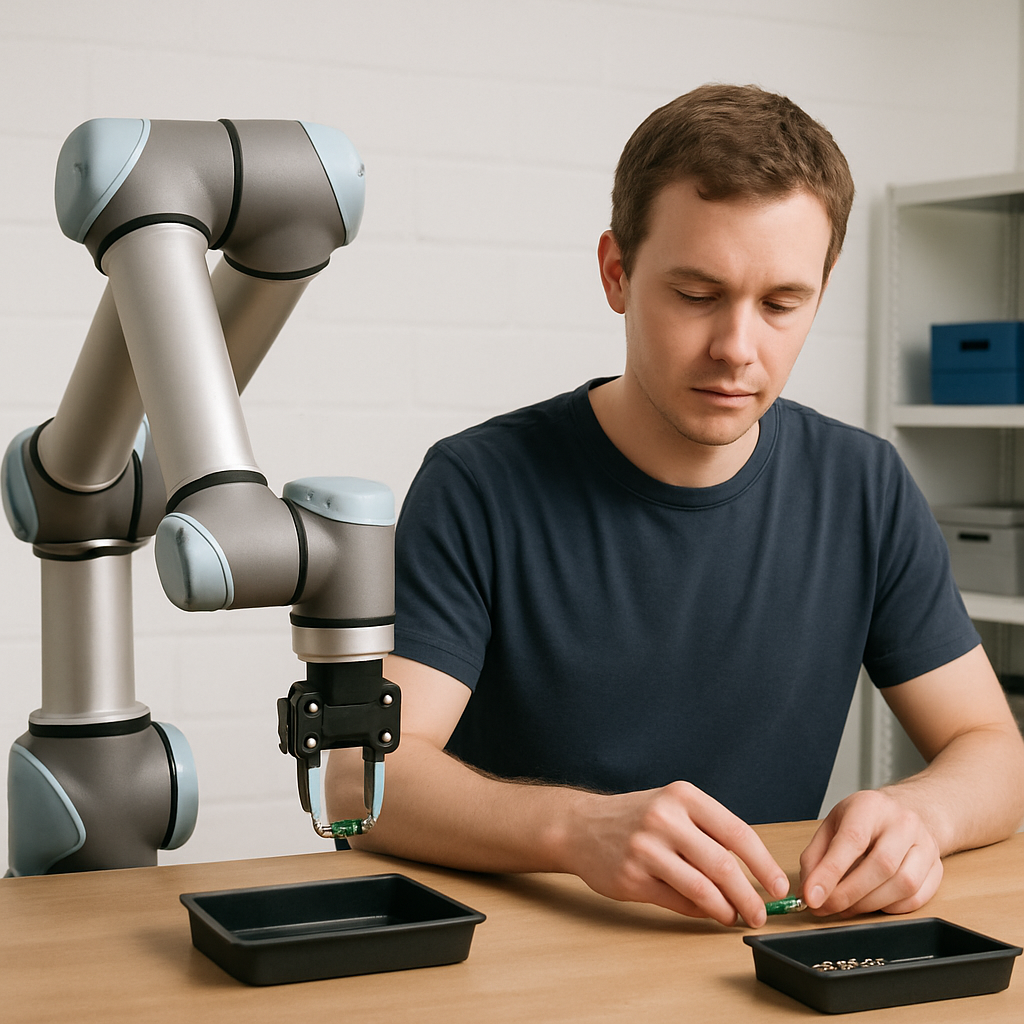
Cobots for Small Businesses: A collaborative robot assisting a small business worker in a shared workspace
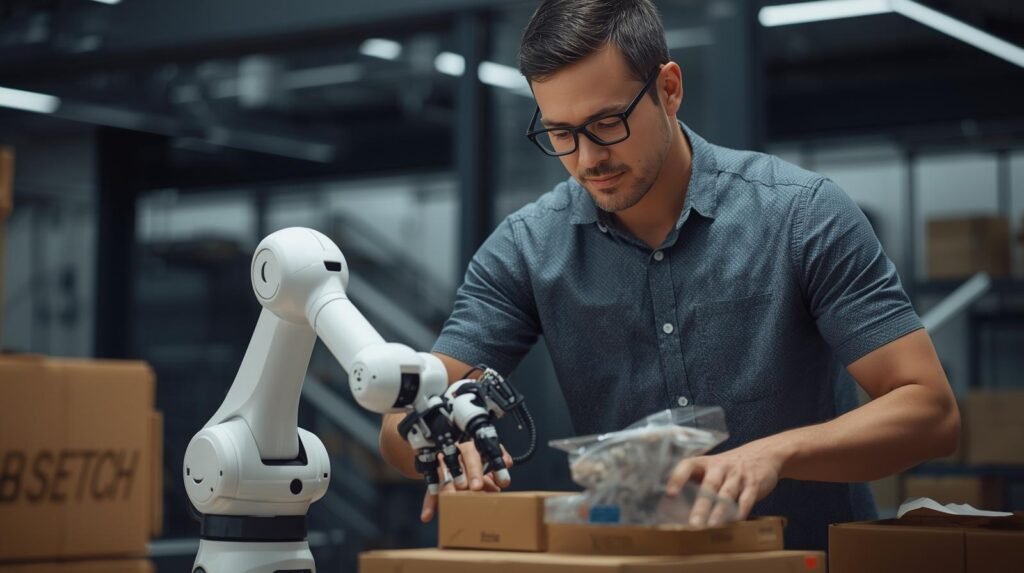
Cobots for Small Businesses are designed as collaborative robots, meaning they can be used alongside people. They can perform repetitive, precision tasks or physically demanding tasks. For many business owners, the biggest advantage of Cobots for Small Businesses is that they provide practical benefits such as increased production throughput, reduced errors, and consistent product quality without requiring businesses to hire a large workforce or rebuild their workflow processes.
The other major difference between Cobots for Small Businesses and larger industrial robots is ease of implementation and reassignment. Typically, cobots for small businesses are designed to perform a variety of functions, including packaging, placing parts (pick-and-place), tending machines, assembling lighter-weight components, labeling products, and inspecting products for defects.
The flexibility of function for cobots provides significant advantages for smaller manufacturers who produce in low-volume batches, face seasonal demand fluctuations, or manufacture multiple product lines that may change quickly. It is much simpler for a manufacturer to address a bottleneck by using a cobot at that location rather than redesigning the manufacturing process.
#Revolutionary Smart AI Improves Manufacturing Quality Checks
A further advantage of using Cobots for Small Businesses as the first step into automation is that they are typically cheaper than their larger counterparts. Cobots for Small Businesses usually occupy less floor space, have fewer safety features to install, and are quicker to set up. Most companies will deploy one cobot to perform one task and track how much time is saved per cycle and how much scrap is eliminated. Companies will then expand the deployment of cobots when there is evidence of a Positive ROI.
In addition, the Cobots for Small Business solutions will also help to alleviate labor issues. If you’re having trouble finding or retaining qualified employees for repetitive and/or physically demanding tasks, a cobot could handle those less desirable tasks. This would allow your employees to continue providing value to your customers in areas such as customer service, troubleshooting, product customization, and maintaining the quality of products delivered to them. In doing so, the Cobots for Small Businesses will improve your employees’ morale, protect your output, and meet your customers’ needs by delivering the products they want on time.
However, to achieve maximum benefits with Cobots for Small Businesses, initially limit your implementation of cobots to one well-defined use case; e.g., producing the same type of part consistently, with measurable success metrics, and performing a repetitive process. In addition, minimize employee training requirements, develop a simple routine for maintaining your cobots, and design the workplace to create a safe working environment. When you implement Cobots for Small Businesses thoughtfully and intentionally, they will increase your company’s productivity and competitiveness.
Small Business Automation: Automation helps small businesses scale without hiring more staff
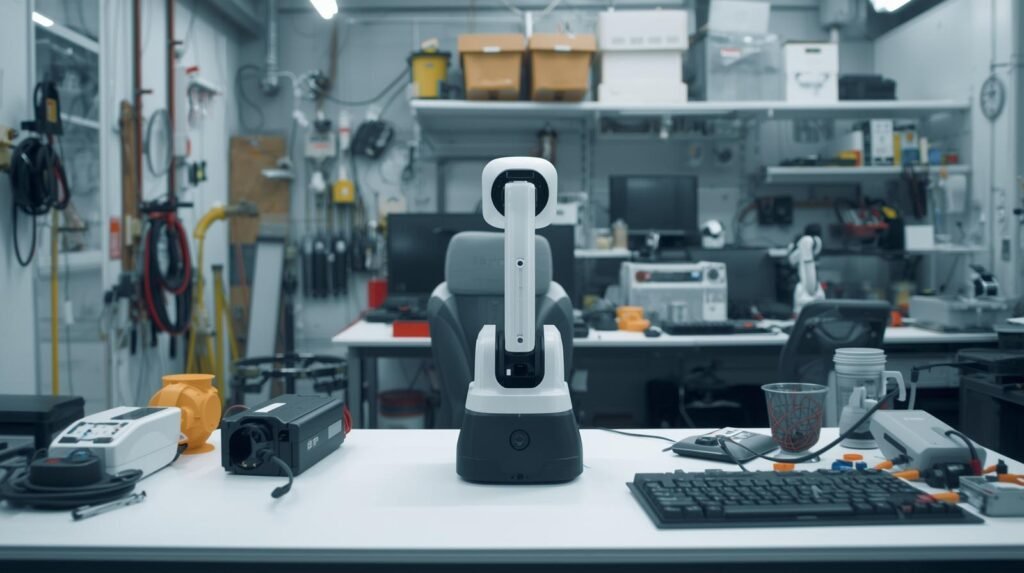
Small Business Automation provides Small Business Owners with increased efficiency and consistency, as well as the ability to add or remove employees as needed. Because Cobots for Small Businesses automate repetitive, predictable work within a Small Business using software and machines, employees can focus on customer service, product quality, problem-solving, and innovation. In fact, most Small Business owners will see their demand grow at a much higher rate than they can hire, train, and supervise additional employees.
Cobots for Small Businesses are among the most effective ways to start Small Business Automation by automating routine, predictable physical tasks. These Cobots for Small Businesses will automate many of the functions associated with a Small Business, such as, but not limited to, packaging and labeling, machine tending, light assembly, kitting, and inspection – all performed in the same workspace as your employees. Combining Small Business Automation tools, such as Digital Work Orders, Barcode Scanning, and Inventory Alerts, will build on the improvements to the process flow from Order to Shipment: fewer handoffs, less rework, and improved flow.
The benefits of increasing scale in a Small Business are derived from transforming Tribal Knowledge into Repeatable Processes. Therefore, Small Business Automation creates Standardized processes for generating quotes, scheduling jobs, and identifying exceptions – ensuring that regardless of who performs the function, the performance does not depend on a specific “go to” individual. The use of Cobots for Small Businesses also helps stabilize cycle time and reduce variability. Since Cobots for Small Businesses do not call in sick, they repeat the exact same motion each time, enabling Small Business owners to meet tight deadlines as volumes increase.
Another key benefit of Small Business Automation for cost management is the elimination of “unseen” labor typically involved in coordinating, status updates, redundant data entry, and other manual follow-up. Cobots for Small Businesses can also help eliminate waste caused by errors and fatigue when manually handling parts of a manufacturing process. Additionally, Cobots for Small Businesses can be assigned to different areas within your business as your product lines change, minimizing the loss of your original investment while still allowing flexibility to expand your business.
Begin by mapping out one (1) process that includes multiple delays and/or errors. Next, automate the smallest component of this process that yields a quantifiable improvement. Then train your employees to monitor the automated process; provide them with the tools to identify issues and implement improvements as needed. By using data, you can continue to improve the efficiency of the automated process. When selecting the right first project for either Small Business Automation or Cobots for Small Businesses, you can scale your capacity, protect your margin, and grow your business without hiring additional employees to support each new customer.
Cobots Don’t Replace Your Best People—They Empower Them
Businesses have many concerns about automation – including costs – but most are concerned about how automation will affect their workforce. Cobots, however, provide the opposite. A cobot should be considered a useful tool for accomplishing dull, dirty, or dangerous tasks that lead to worker fatigue, increased turnover, and decreased overall morale. Instead of replacing employees, using cobots for filling open positions could make these jobs more attractive to employees and more sustainable for businesses.
Using cobots to perform routine, mundane tasks typically handled by employees will allow employees to develop and leverage their uniquely human abilities (such as problem-solving, quality control, and adaptability) to grow their careers. For instance, consider your best welder. If they spend their entire day performing thousands of tacking welds, then why would you want them to continue to perform these same repetitive welds? With a cobot performing repetitive tack welds, your skilled welder can now focus on the high-value work of assembling frames and finalizing the product, which requires your welder’s experience, knowledge, and skill.
The shift in responsibilities that employees face due to the inclusion of cobots in their workplace enables employees to begin developing the abilities to complete higher-level tasks. The person who was once responsible for loading parts into a machine can now be educated and become the cobot’s operator and educator. As an educator, they can assist in training others to set up new tasks, troubleshoot cobot issues, and manage the efficiency of the cobot-based process.
This allows them to move from manual labor to operating and maintaining automated systems, thus increasing their job satisfaction and security. Creating a job that is no longer stressful but instead has technical challenges and a sense of fulfillment increases employee motivation and productivity.
Before vs After Cobot Adoption

Insight: Cobots shift humans from repetitive work to higher-value tasks.
Source:
- McKinsey Automation Report
https://www.mckinsey.com - Universal Robots Case Studies
https://www.universal-robots.com
Cobot Benefits: Cobots improve productivity while keeping humans in control
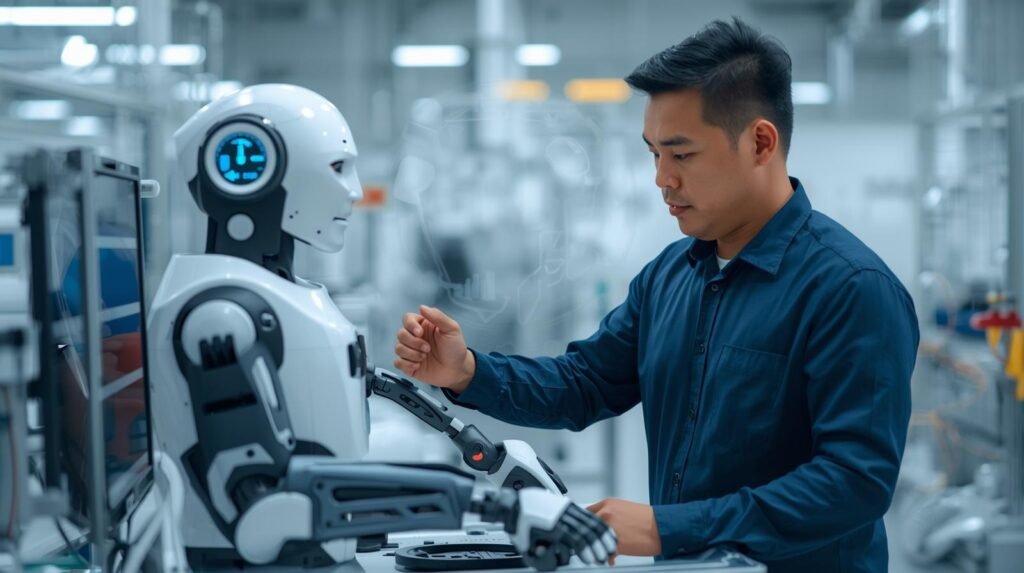
When an automation system produces additional output (increases production), it can be said to have many of its greatest advantages as a Cobot. Many small business owners would likely find that cobots for small businesses make sense in terms of finding a middle ground – they provide a reliable second set of hands that perform the repetitive portion of the job, but the employee remains responsible for making decisions related to how the job is performed, evaluating the quality of the finished goods, etc.
There are two primary Cobot Benefits: increasing productivity and preserving flexibility. In the case of cobots for small businesses, these systems run continuously through a cycle to perform pick-and-place, packaging, labeling, and machine tending, while an employee supervises the job and only intervenes when necessary. This method allows employees to continue to exercise control over their priorities and exceptions, rather than relying on a single, inflexible automation system to handle all aspects of the job.
#Industrial Robot Arms: A Powerful & Smart Guide to How They Work in 7 Steps
Consistency is another way Cobot Benefits manifest. Since Cobots for Small Businesses will be performing the same motion over and over again, they reduce the possibility of defects caused by fatigue, hasty handling, and other such factors. This method will provide consistent output as long as the employee establishes benchmarks and verifies the output; it allows the employee to use human judgment to determine what constitutes a “good” product.
,Ergonomics and safety are also ways cobots benefit. The Cobots for Small Businesses will perform countless awkward, repetitive lifts and extended-reach positions, as well as repetitive use of the shoulders and wrists, leading to worker fatigue. If employees can remain at their workstations while performing tasks with a lower risk of physical injury (e.g., setup, inspection, restocking) rather than doing physically demanding tasks all day, they can focus on the added value of their role in the production process.
The combination of the financial, physical safety, and ergonomic advantages of Cobots, along with the ability to invest in a Cobot for a small business in phases or stages, is one of the best aspects of Cobots for Small Businesses. Begin by purchasing and installing a Cobot for a specific and defined task that generates either a large amount of waste (in terms of materials) or lost time. After you have realized the cost savings from reducing the waste generated by the initial task, then purchase another Cobot that performs an additional task that also reduces costs to your bottom line.
In addition to the financial advantages of Cobots for Small Businesses, their modular nature allows the same unit to be used to manufacture a variety of products and/or to meet seasonal demands without redesigning the entire system. For example, to take advantage of both the financial and physical safety/ergonomic advantages of Cobot, select a stable initial task, create measurable criteria to determine if the initial task was successful (cycle time, defect rate, downtime), and teach your employees how to modify and update the programs safely.
By using a similar approach to creating a pilot program that clearly defines ownership and focuses on a limited set of initial tasks and operations, your company can increase productivity with Cobots for Small Businesses while maintaining control over the production process. This is probably the most realistic advantage of using Cobots for Small Businesses.
Business Efficiency Tools: Cobots act as efficiency tools that streamline daily operations
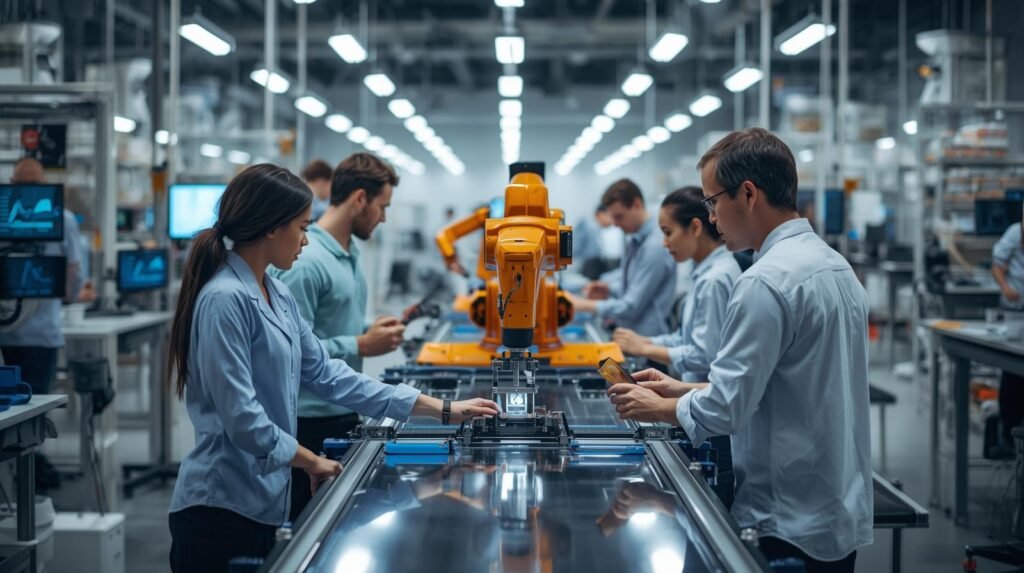
Business Efficiency Tools help small businesses accomplish more with less. One of the most beneficial Business Efficiency Tools is the cobot. Increasingly, many small business owners consider cobots when looking for Business Efficiency Tools. Small business owners view cobots as flexible assistant tools that will allow for more time away from time-consuming, repetitive tasks; however, people continue to make decisions about quality control and customer satisfaction. The right application of Business Efficiency Tools enables small businesses to run their daily operations more efficiently without a total overhaul.
Production and Fulfillment are two areas where Cobots for small businesses can automate routine tasks, such as pick-and-place, packaging, labeling, kitting, and light inspection. Routine tasks provide stability and efficiency. Most routine tasks are repeatable, making them well-suited to Business Efficiency Tools that eliminate stop-and-go work and maintain a consistent flow to maximize production. The greatest benefit of utilizing Cobots for Small Businesses as Business Efficiency Tools lies in maintaining a steady production flow and minimizing bottlenecks and downtime caused by constantly switching between tasks.
Cobots are seen as effective Business Efficiency Tools because they can consistently perform repetitive tasks. Since Cobots for Small Businesses perform each cycle identically, the potential for errors resulting from manual handling (i.e., mislabeled products and minor defects)and the rework necessary to correct those errors is minimized. Using an operator to monitor for exceptions and verify the results of the Cobots for Small Businesses increases process reliability while still allowing human judgment. This synergy turns automation into everyday business efficiency tools, not a rigid automated system.
Cobots can help with labor efficiency. Cobots for Small Businesses can take care of physically demanding and/or the most monotonous tasks. In doing so, they will allow employees to focus on higher-value work, including machine setup, troubleshooting, product quality checks, customer communication, and other customer service tasks. As a result, small businesses can become much less reactive in their daily operations, which is an important aspect of successful Business Efficiency Tools.
The first step in using cobots as Business Efficiency tools is to identify a reliable task, determine how that task will be measured (e.g., cycle time, defects, downtime, on-time delivery), and develop the pilot prior to operator training and the refinement of handoffs from people to cobots. Specifically, this includes defining how parts are delivered to the cobot, the overall workstation configuration, and the minimum set of safety procedures. After developing sufficient confidence with the cobot completing the first task, the cobot can then be deployed to the second constraint, with additional Business Efficiency Tools added over time and their use expanded throughout the organization.
Cobots for Small Businesses improve labor efficiency through streamlined, consistent processes and enable small-business teams to expand their day-to-day execution capabilities — precisely what Business Efficiency Tools are designed to accomplish.
4 Everyday Tasks a Cobot Can Take Over in Your Business Today
Cobot capabilities vary depending on the assigned tasks. A cobot is capable of performing multiple types of tasks depending on the type of end effector (hand) attached. Therefore, one cobot can accomplish numerous tasks that could create bottlenecks in a small company. Below are four of the most commonly used and useful applications for cobs in small businesses:
1. Packaging & Palletizing: The cobot will continuously pick up finished products, put them in packages, and pack the packages into shipping pallets. As such, cobs are particularly suitable for repetitive activities at the end of a production process that are difficult to staff.
2. Machine Tending: In machine tending, the cobot places raw material in a machine (i.e., CNC milling machine or an injection molding machine) and removes finished product from that machine. Thus, this will allow your high-cost machines to operate continuously throughout the day/night, including employee breaks.
3. Quality control inspection. A camera or sensor on the cobot allows it to check each product for flaws. Therefore, there is no way a single defect will reach your customer.
4. Assembling & dispensing. The cobot can provide precise torque when tightening parts or the right amount of adhesive to assemble them, with consistent, repetitive movements.
The cob’s ability to accomplish multiple jobs is primarily because of the ability to interchange the end-effector, or EOAT (End-of-Arm Tooling). The EOAT is the “hand” of the cobot. It is the tool that is replaced to accomplish a particular task. For example, if you were going to have the cobot grab boxes, you would replace the EOAT with a simple two finger gripper. If you plan to have the cobot lift flat sheets, please replace the EOAT with a vacuum cup. If you were going to have the cobot assemble something using a screwdriver, you would replace the EOAT with a screwdriver.
Because of the easy exchange of the EOAT, the cobot is not a one-trick pony. The cobot is an asset that can be modified as your business grows and/or changes. There is no need for an engineer to install a cobot. Actually, it may be simpler to train a cobot to perform a different job than you think.
Cobots in Industry: Cobots are transforming industries of all sizes, including small enterprises
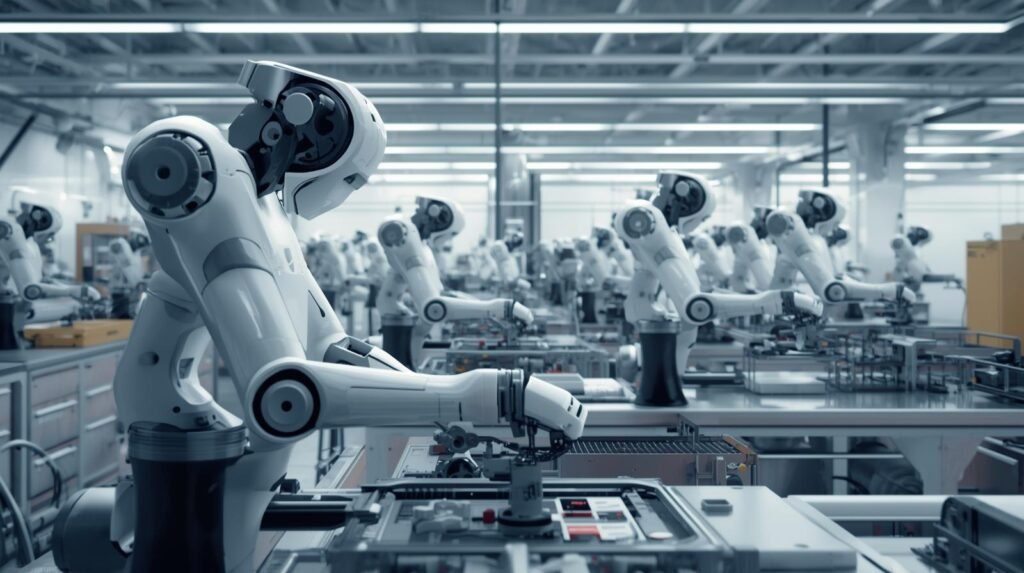
The Cobot Revolution is fundamentally transforming the way work is performed by bringing automation within reach of many businesses that require flexibility (i.e., not the ability to produce massive quantities) but do not require the volume capabilities of a production line. Examples of Cobots in Industry include: Electronics, Food and Beverage, Metalworking, Packaging, Logistics, and Niche Manufacturing. These industries have variable products or too low a volume to justify the use of large-scale automation systems.
As previously stated, it should be evident why Cobots are relevant to Small Business Owners. Cobots allow small-business teams to achieve the same level of productivity as larger, more advanced organizations (with full automation) by using a collaborative approach to perform functions at the workstation.
Cobots for Small Businesses can collaborate with people working at the workstation to perform functions including: Pick-and-Place, Machine Tending, Light Assembly, Palletizing, and Basic Inspection. As Cobots for Small Businesses are used in this manner, human team members will remain responsible for critical decision-making during Setup Changes, Quality Checks, and Exception Handling, while the Cobots handle consistent, repetitive motions.
Automating difficult tasks helps to alleviate labor shortages. The unappealing and physically demanding jobs at most small businesses make it difficult to hire. With Cobots for Small Businesses, small businesses can automate difficult tasks so employees can focus on high-value work such as customizing products, communicating with customers, troubleshooting issues, and Process Improvement. Cobots in industry generally don’t replace workers; instead, they allow production to continue uninterrupted.
An additional advantage to using Cobots in Industry is improved standardization. Cobots for Small Businesses provide consistent performance, and therefore, eliminate shift-to-shift variation and lower defect and rework rates. Consistency in production provides a competitive advantage by enabling faster, higher-quality delivery. Additionally, customers expect reliability and traceability of the manufacturing process — two areas that Cobots in Industry support.
Cobots in Industry are financially beneficial since Cobots for Small Businesses can be implemented in stages. A Cobot is usually used to perform a specific, defined task. After demonstrating a positive ROI through improvements in throughput, reduction in scrap, and reduction in delays, Cobots for Small Businesses can then be moved to the next bottleneck. Thus, the Cobot’s cost will be spread out over several years.
Therefore, Cobots in Industry are changing how all industries operate, and Cobots for Small Businesses are a prime example of practical automation that enables businesses to scale their production capabilities while maintaining human control.
Small Business Cobot Use Cases + Adoption Stats

Key Stat: Over 50% of cobot users are small and medium-sized businesses (SMEs)
Insight: Cobots are no longer just for large factories-they’re built for small operations.
Source:
- International Federation of Robotics (IFR)
https://ifr.org - Statista Robotics Data
https://www.statista.com
Cost-Effective Automation: Cobots offer affordable automation without high upfront costs
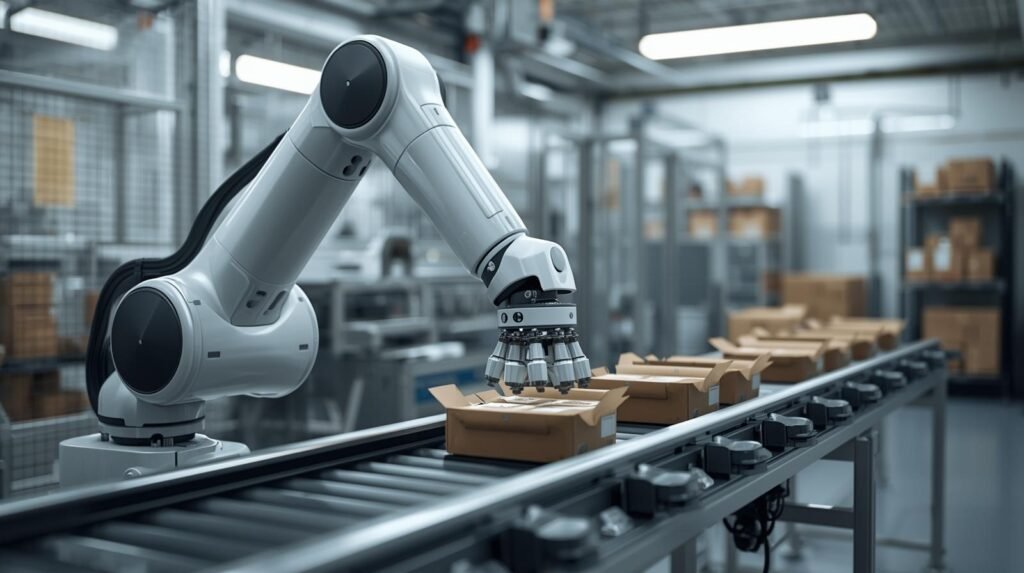
The trend toward cost-effective automation with Cobots for Small Businesses is growing at an exponential rate; however, they are also being used in small- to medium-sized business environments in addition to factories. Cost-effective automation for small- to medium-sized businesses allows them to increase production volume without making large capital investments or experiencing long periods of downtime during implementation.
It also reduces the need to develop custom designs that are costly to build and implement. Cobots for Small Businesses provide a practical, phased automation solution. They allow small- to medium-sized businesses to phase in automation, only automating when results justify additional investment.
One of the greatest benefits of cost-effective Cobot automation for Small Businesses is the fact that they can begin with small-scale automation projects. For example, the first step would be to automate a simple, repetitive task, such as packaging, labeling, pick-and-place, machine tending, or light assembly. Once one task is automated, small to medium-sized businesses can evaluate the immediate financial impact of the automation.
When small to medium-sized businesses take a phased approach to cost-effective automation, the risk of investing in an automation system is minimized. Instead of making a business-wide decision based upon a complete redesign of an operation, businesses can implement automation solutions incrementally. As a result, the total cost of an automation project will be significantly reduced.
Another advantage of cost-effective automation is the flexibility you retain throughout your automation investment. Cobots for Small Businesses can be moved around the shop as product lines change—from a packaging application in one quarter to a machine-tending application in the next. Since the cobot can move within your workflow constraints rather than sit idle on an obsolete task, this redeployment creates a more resilient, Cost-Effective Automation solution.
The cost savings from Quality Improvements add to the Cost-Effective Automation argument. The consistent motion and repeated placement provided by Cobots for Small Businesses eliminate costly errors, reduce scrap and rework, and save employee time and labor. As employees continue to monitor quality and address issues as they arise, the steady flow of production from Cobots for Small Businesses will help them meet customer expectations and align processes accordingly. Therefore, using a human to control the cobot keeps the Cost-Effective Automation flexible rather than rigid.
To get the most out of your Cost-Effective Automation implementation, select a reliable process, establish well-defined metrics (cycle time, defects, downtime), and provide your operators with training on monitoring and safely operating the cobot. By establishing a defined pilot program, you will find that Cobots for Small Businesses will deliver cost-effective automation solutions that increase both your throughput and quality at a low upfront cost.
How Much Does a Collaborative Robot Cost? A Practical Budgeting Guide
There is no way to avoid this question: What does a Collaborative Robot cost? The base price for a high-quality entry-level Cobot Arm from a reputable manufacturer typically ranges from $25,000 to $45,000. That represents the heart of the technology — the intelligent, safe, flexible, and programmable arm that provides the foundation for automating your process.
The price point of $25,000 to $45,000 for a high-quality entry-level Cobot makes this technology available to far more entities than large corporations. Nevertheless, there are additional expenses involved in purchasing a Cobot. To accomplish anything with a Cobot, you need to attach a “hand” referred to as an End Effector (i.e., a gripper, suction cup, etc.) to the arm. Depending on the specifics of your application, you may also require a stand or fixture to support the arm in position.
The estimated total investment for most simple applications will range from $35,000 to $60,000. This includes the cost of the robotic arm, as well as the costs of everything else required for a fully operational system.
This is what we call the “all-in” cost. It is the most accurate way to estimate your project’s cost in its early stages.
The cost appears very high at first glance. However, from a business perspective, you can see that for many small businesses, the cost of purchasing the necessary equipment is comparable to the full-loaded cost of having an employee for a year. An employee is going to leave or take a vacation. A Cobot is a capital asset you own. It works continuously (24/7). It takes no breaks. It performs each task consistently, with the same level of quality and reliability every time. It never calls in sick. Viewing your purchase through these two perspectives will help you answer the next question: Is it worth it?
Cobot Cost Breakdown Table

Insight: Cobots are significantly cheaper than traditional automation systems.
Source:
- Universal Robots Pricing Guide
https://www.universal-robots.com - Robotiq Cost Analysis
https://robotiq.com
Is It Worth It? How to Quickly Calculate Your Cobot’s Payback Period
The Payback Period and, therefore, the question of whether you can say that the “Is It Worth It?” question is answered with a yes, is dependent entirely upon how well you can measure your Return on Investment (ROI) as a business owner. A great way to illustrate this is by simply calculating the Payback Period, which is the time it takes for your company to pay back the entire cost of the cobot system (including all costs) through reduced labor expenses (i.e., the money you save).
This is quite easy. Simply calculate the total labor cost for the specific task(s) the cobot performs in a given year and divide that number by the total cost of the cobot system. For example, if the total cost of the cobot system was $45,000, and the total labor cost per year for the task(s) being performed by the cobot was $30,000, then your Payback Period would be 1.5 years ($45,000 / $30,000), or 18 months. At that point, the cobot is generating pure profits for your business.
But this basic calculation doesn’t tell the whole picture. The actual Return on Investment (ROI) and therefore the actual benefit of a cobot is much more than simply the money saved by not paying for the labor you were using.
The true ROI will also include an increase in profit because of an increase in product volume (because a cobot can run continuously without fatigue or variation in production rate) and the amount of scrap materials you produce will be lessened (because a cobot can help reduce the number of errors made by humans) and potentially other costs you have now reduced (such as overtime).
Therefore, if you consider all of the potential benefits of a cobot and all of the increased revenue and cost savings, the financial case for buying a cobot gets significantly stronger.
Many small manufacturing companies, as well as those who are currently running at very low volumes, get their investment back (payback) on a cobot within 1-2 years, which makes it one of the quickest and best investments you can make today..
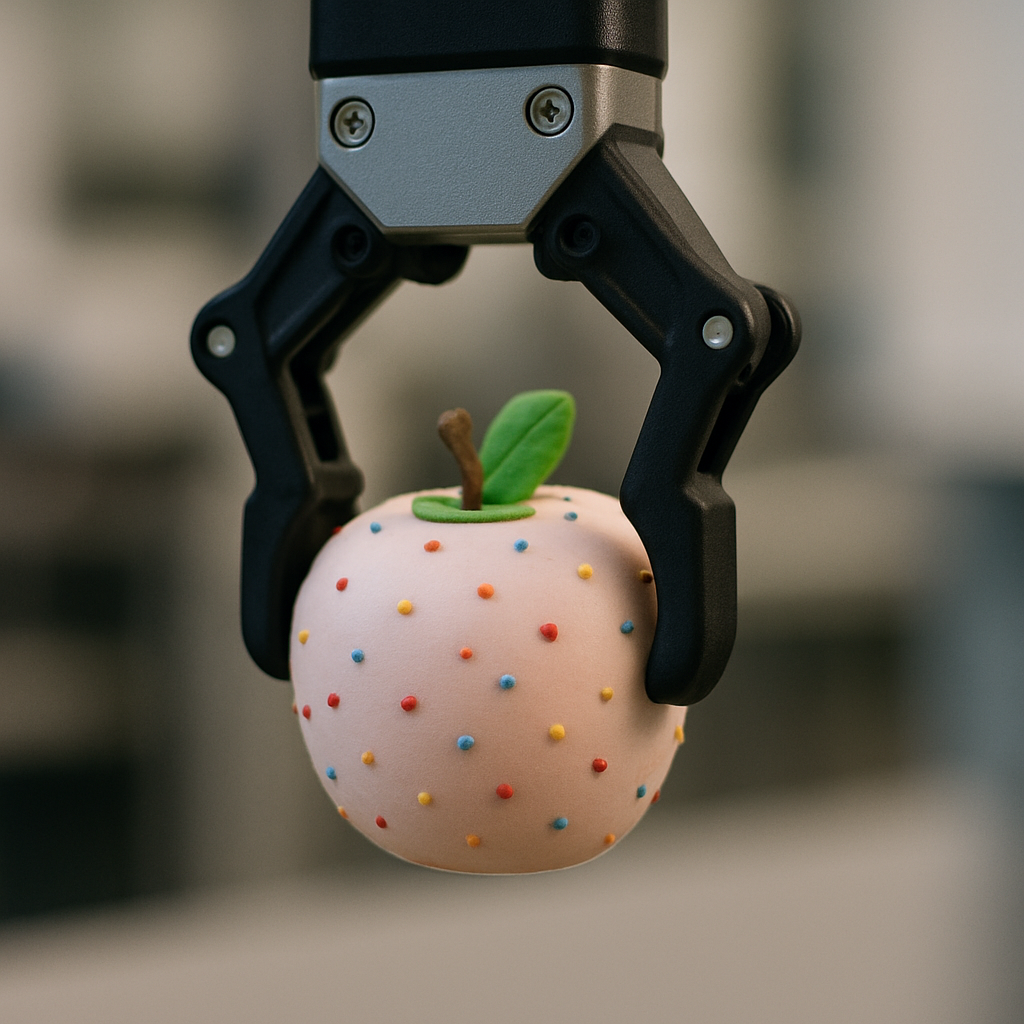
Payback Period Calculation Example
Quick Formula: Payback Period = Total Cost / Annual Savings
Source:
- Deloitte Automation ROI Report
https://www2.deloitte.com - IFR ROI Insights
https://ifr.org
‘Easy to Program’ Isn’t a Gimmick: How You Can ‘Teach’ a Cobot in an Afternoon
What comes to mind when someone thinks about “programming robots” is coding away at a blank computer screen. Programming for cobots, however, does not follow the same process. Most cobots use hand guiding to program them. This involves pressing a button to release the robot arm’s brake, then manually guiding it along the desired path. Essentially, you are teaching the cobot what to do by physically moving the arm to show it how to pick up an item, transport it, and put it down.
To further assist the cobot during the programming process, a simple handheld control device is used – a teach pendant (a ruggedized version of an iPad). A teach pendant is user-friendly and allows the programmer to save specific points, such as when the robot is hovering over a box. By tapping a button, the programmer saves the point. Not only can the programmer save points, but they can also program the cobot to perform simple tasks, such as closing a gripper and pausing for a couple of seconds.
Using a manual demonstration of a motion and a visually oriented “tap-and-go” interface, the cobot is easy to program. Therefore, it is ideal for those who may not have prior programming experience.
Programming these cobots offers an opportunity to significantly reduce implementation time for small manufacturing facilities and workshops. In some cases, traditional automation systems take months to fully implement. Cobots can be easily incorporated into a wide variety of applications within hours. For example, in less than one day, a basic cobot can be implemented to load parts into a shipping box. It would enable you to start making money from your new equipment quickly and generate a profit for your company. This results in a quick return on investment (ROI), providing you with a strong ROI in a very short time.
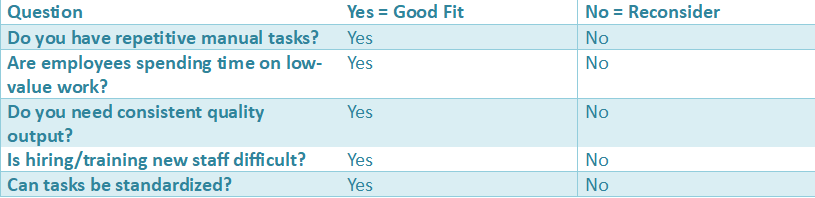
Is Your Business a Good Fit for a Cobot? A 5-Point Checklist
To assist you in determining if a Collaborative Robot (Cobot) is correct for your business needs, please answer the following five questions:
1. Do you have relatively simple, repetitive tasks your employees don’t enjoy doing?
2. Are you currently facing labor shortages or extreme employee turnover in specific positions?
3. Does the manual error from boring, repetitive work cost you money and create losses and/or waste as a result of the mistakes made by employees?
4. Would you benefit greatly from increased production levels, but you do not have sufficient floor space available to accommodate additional equipment?
5. Are your skilled employees being utilized at less skilled levels of operation?
If you answered yes to two or more of the questions above, you have clearly identified opportunities to implement a Cobot that will add value to your organization.
While the next logical action would be to start researching the many different models, prices, etc. of Cobots, that is far too easy. Instead, select one of those jobs and develop a detailed, step-by-step document outlining the procedure of completing the task. Specifically, how long will it take to complete the job, and what are the individual steps required to do so? That one page of documentation represents the first tangible actions you will take to implement a Cobot. It provides a clear direction toward turning a vague idea into a viable, action-oriented plan.
“Is a Cobot Right for You?” Decision Checklist Table
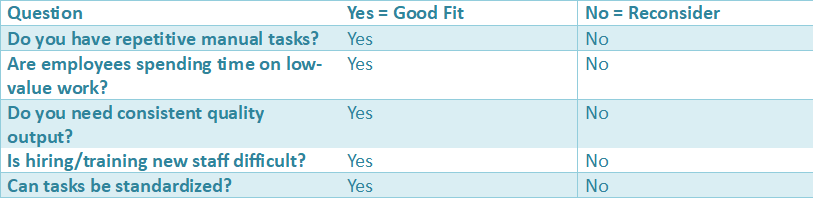
Insight: If you answer “Yes” to 3 or more, a cobot is likely a strong fit.
Source:
- SME.org Smart Manufacturing Insights
https://www.sme.org - Universal Robots SME Guide
https://www.universal-robots.com
Conclusion
Small businesses can be competitive in an environment characterized by speed, consistency, and flexibility when they use cobots to handle dangerous and repetitive tasks; therefore, their personnel can focus on the quality, problem-solving, and decision-making aspects of each task. The most important advantage for small business owners from using cobots is the ability to decide how to do the job. The increased production rate and lower error rate achieved by using cobots do not require sacrificing the adaptability customers have come to expect from small businesses.
In addition to allowing companies to decide how to do the job, cobots enable them to continue automating at a gradual rate. Companies can begin by introducing a cobot to perform a single task and compare its results against predetermined performance standards. Based upon the results of the first task, the company can then determine whether to expand the use of cobots. Cobots are also easy to redeploy; therefore, after investing in a cobot, the company can continue to derive value from the investment regardless of changes in its product line or customer demand. Because of this, automation can keep pace with bottlenecks on the manufacturing floor without redesigning the entire floor.
In conclusion, cobots are practical and effective because they can increase productivity, safety, and consistency, and are within the constraints of most small businesses (i.e., space, staff, budget); therefore, implement a focused pilot project, include those individuals involved in the work, and scale based upon the results. When properly implemented, cobots should provide a sustained competitive advantage for small businesses and allow them to grow without losing what made them successful.
FAQs
- What is a cobot, and how is it different from a traditional industrial robot?
A collaborative robot, also referred to as a “cobot”, is engineered to operate alongside humans and therefore has many safety mechanisms built into its design. This allows cobots to have lower guarding requirements than traditional robots. Industrial robots are generally better suited to handling heavy payloads and run faster than cobots; however, they are more difficult to integrate into a facility because they require large cages around the robot and more complex integration with existing systems and processes. - What are the best first tasks for cobots in small businesses (with high ROI)?
Repetitive, time-consuming, and stable tasks are good starting points for a cobot: Pick and Place, Packaging, Labeling, Machine Tending, Kitting, and Visual/Measurement Inspections. In general, the first “win” will be the process that creates the most bottlenecks and/or rework. - How much do cobots typically cost, and how quickly can a small business see ROI?
The cost of a cobot depends upon payload, reach, tools (end effectors/grippers), and integration into the specific application. While many small businesses measure Return On Investment (ROI) using labor-hour savings, throughput increases, and scrap reductions, these benefits can take anywhere from a few months to several years to realize, depending on how frequently the cobot operates and how well the specific task was defined. - Are cobots safe to use around employees, and what training is required?
While cobots can be very safe, safety is not an automatic feature. Many setups will still require a Risk Assessment and may require speed limiting, force limiting, sensors, and/or light guarding. Training will include Safe Operation, Basic Programming or Task Setup, and What to Do When the Cobots Stop Running or When Errors Occur. - How hard is it to integrate a cobot into an existing workflow (and can it be redeployed later)?
Many cobots can be easily integrated into an application when the task is consistent and input parameters are clearly defined (e.g., parts placed in a consistent tray and consistently oriented). However, relocating a cobot can be just as successful as integrating one, provided that a new task definition, End-Of-Arm Tooling changes, and a new Safety Review are in place.