





































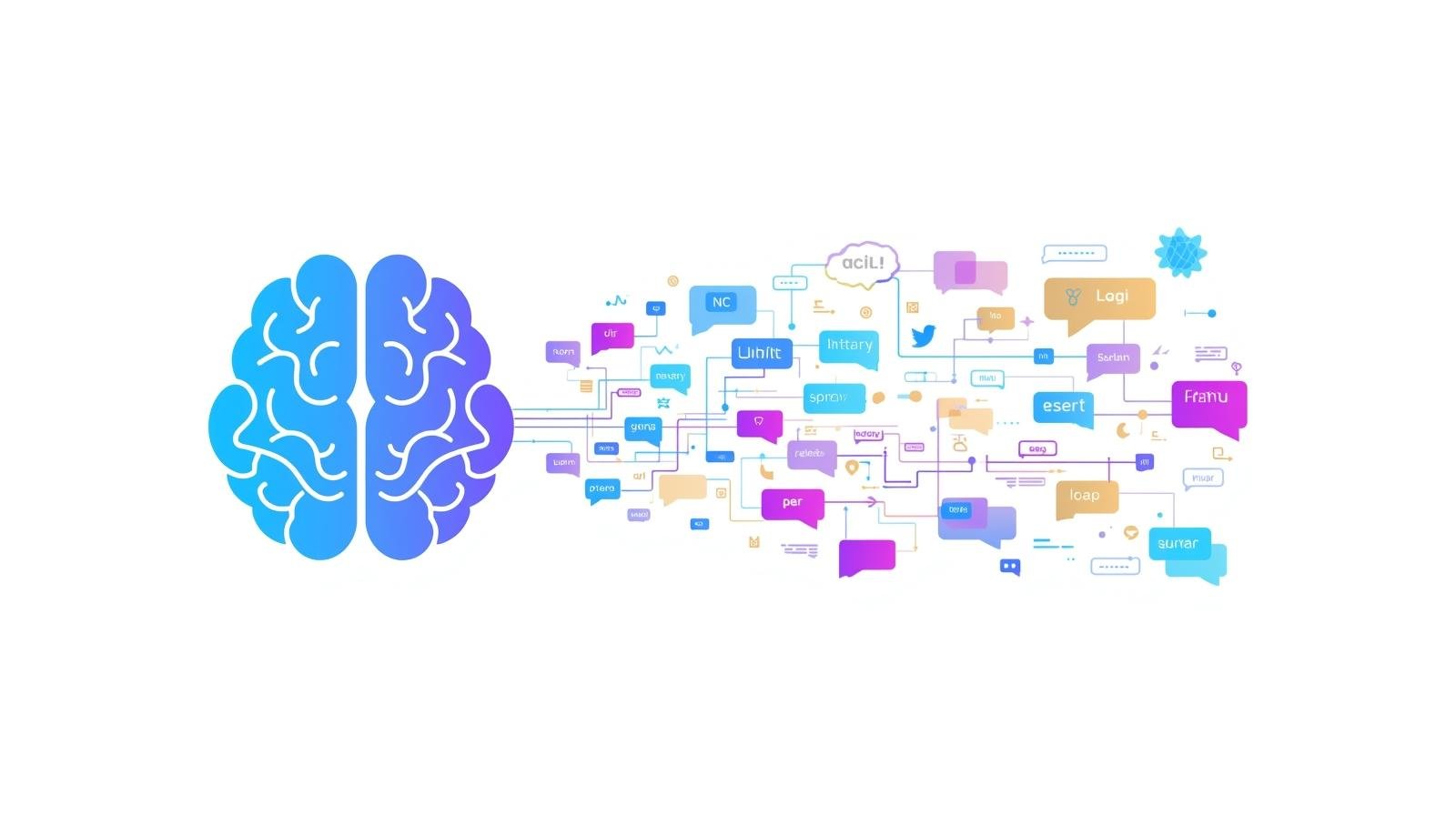
Understanding AI Language Models
Today, understanding how AI Language Models work is crucial for this digital age. AI Language Models were created to process and generate human-like text based on user input. As such, AI Language Models use large amounts of data combined with advanced algorithms to provide responses to user prompts that are both coherent and relevant to the context in which the prompt was asked.

The ability of AI Language Models to utilize our own forms and patterns of communication has enabled them to generate natural responses; thus, they have numerous applications, including but not limited to chatbots, content generation, and language translation. The need to comprehend and understand AI Language Models will continue to grow as we begin to utilize their capabilities to develop Artificial Intelligence.
AI language models were developed to simulate human language by being capable of both understanding and producing natural-language text. AI language models learn to identify and recognize patterns in text. These patterns enable AI language models to respond to questions, summarize documents, write email drafts, translate between languages, and aid users with ideas during brainstorming.
An artificial intelligence (AI) language model uses the basic premise of predicting the next word (or token) in a sequence of words based on the context of preceding words. AI language models are trained on billions of examples and adjust their internal parameters to maximize prediction accuracy. Most modern AI language models use a transformer architecture. Transformer architecture allows for an AI language model to focus on the most relevant part(s) of the input (prompt), and maintain coherence throughout a larger passage.
AI language models are used in a wide variety of applications, including customer support services, research assistants, content creation, code completion, and educational tools. AI language models can speed up the time-consuming task of writing, generate outlines, and present complex concepts in an understandable way, which may not be possible through human-only communication.
However, like all computer-based models, AI language models lack factual knowledge; they produce text that appears factual. Therefore, AI language models can generate text that confidently states incorrect information, especially when a prompt is unclear, when the subject requires knowledge that must be kept current, and/or when the subject is very technical and narrowly scoped.
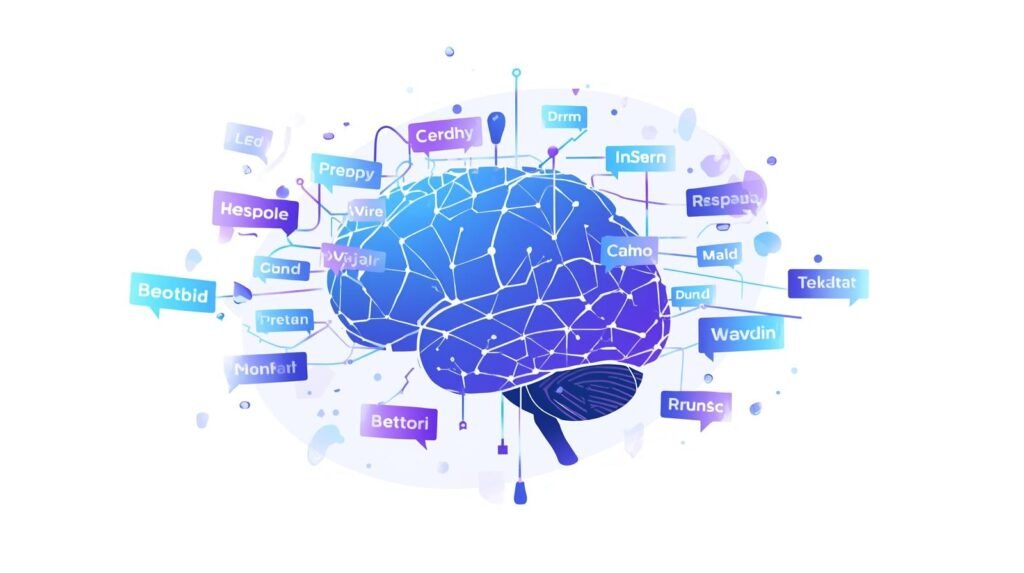
#NLP: Powerful Ways of Effectively Teaching Machines to Truly Understand Us
Good outcomes result from good prompts: provide a clearly stated objective, enough background information to support the prompt, specific limitations (i.e., length, tone, audience), and relevant examples when possible. When working with important tasks that utilize an AI language model, verify the model’s assertions with reliable sources; request supporting references or explain the process by which the model reached its conclusion when necessary; and evaluate the model’s outputs for unusual conditions or “edge cases”.
The model may also help you to ask for other alternatives, identify the premises upon which the model is founded, or indicate areas of uncertainty. Moreover, there are additional considerations for the responsible use of AI language models. These include: protecting sensitive information; recognizing the potential for biased content; abiding by copyright law; and maintaining user confidentiality.
With proper oversight, AI language models can become useful tools that augment productivity while allowing humans to continue making decisions about whether the generated information is valid, has ethical implications, and ultimately, what should be done.
What Are AI Language Models?
AI Language Models – AI Language Models are advanced software systems that process human language for both reading and writing; they interpret what was said to them when they read and generate a response to something humans say to them when they write. They were developed through machine learning, which is trained on large amounts of text data so they can recognize patterns in language and use those pattern recognitions to understand context and generate coherent responses to human input.
Their functions include, but are not limited to, answering questions, providing explanations/answers, holding conversations with users, and generating written content across many different formats and styles. In effect, these AI Language models serve as a tool to close the communication gap between humans and machines and allow individuals to communicate with technology in a more natural and intuitive way than before.
How Do They Work?
AI language models are complex systems designed to process written input and produce text that appears related to the input and is coherent and contextually appropriate. The systems are trained on vast amounts of text data (including books, articles, and web pages) to discover patterns in how we write, i.e., grammar, vocabulary, and relationships among word and phrase combinations.
Ultimately, these patterns enable the AI model to predict the next word in an input string and answer the user’s questions; this enables the model to converse with the user, summarize information, and describe concepts. In addition, these AI Language models are trained through many iterative cycles, during each of which the model’s performance is assessed and improved to best mimic how a human would generate text. Overall, the model is intended to interpret and generate language that reflects a type of understanding exhibited by humans; therefore, it allows for a natural means of interacting with users.
The Importance of AI Language Models in Today’s Technology
The growing number of new technologies and their increasing importance have created a greater need for AI Language Models (L.M.).
Because L.M.s can understand, generate, and manipulate human language in a way that is both intelligent and easy to use, they are being used in a wide variety of areas. Examples of these areas include the virtual assistants, translation tools, and chatbots that are now so common. With the aid of vast amounts of data, L.M. can identify patterns in human language, thereby increasing humans’ ability to communicate with machines. As a result, we can locate information and communicate with each other much more easily than before.
However, L.M. does not stop at just improving our daily lives. They also improve productivity and accessibility across many different disciplines. For example, in the area of customer service, companies have begun utilizing chatbots driven by language AI Language models to answer customers’ questions quickly, therefore creating a faster and better customer service experience. Furthermore, in education, L.M. assists students by providing personalized tutoring and feedback based on individual learning styles and needs.
Since these AI Language models will continue to grow and develop, it is reasonable to assume that there will be no end to their uses and that they will create many new technologies that will alter the ways we interact with technology and with each other in the coming years.
How AI Language Models Process Text (Concept Flow)

Example: AI language models like GPT analyze billions of text patterns to generate natural responses.
Source: Stanford Human-Centered AI Institute
https://hai.stanford.edu
No-Code AI Language Models
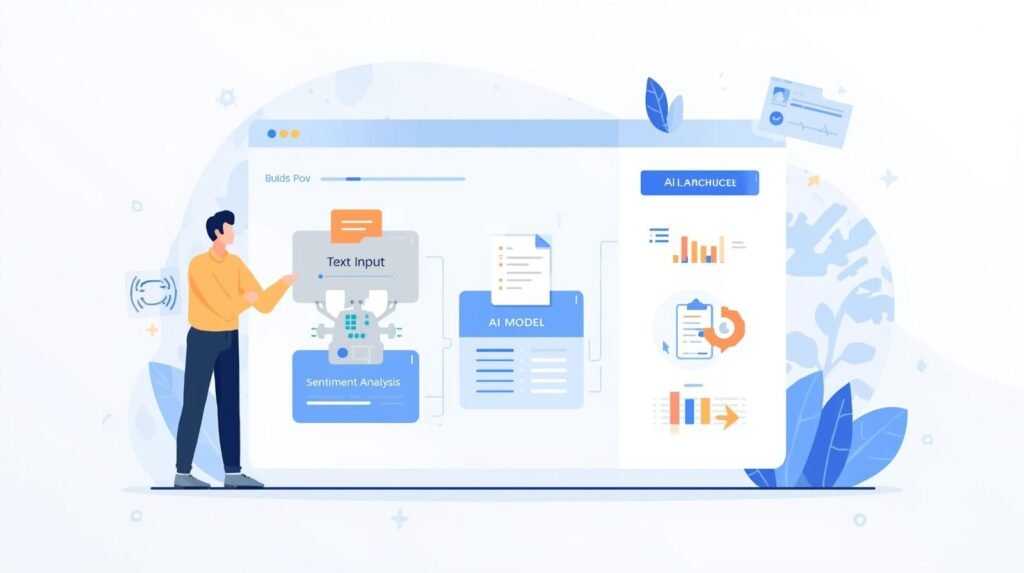
In addition to the technical community, No-Code AI Language Models enable Non-Technical Individuals to utilize Artificial Intelligence in ways they would have never thought possible. No-Code AI Language Models were designed to enable a larger segment of the population to use artificial intelligence than was previously possible.
No-Code Platforms offer user-friendly interfaces and intuitive functionality, enabling non-technical individuals to build, customize, and deploy their own AI Solutions as needed. No-Code Platforms empower a broad base of users, such as Entrepreneurs looking to enhance their service offerings and Educators seeking to integrate AI into their curriculum.
Typically, Apps are created using no-code application builders. The most common type of builder offers a simple template builder and a drag-and-drop interface, allowing users to create applications that leverage Natural Language Processing (NLP). Users of no-code application builders do not need to know how to write code in order to generate text, analyze data, and interact with conversational AI.
Many no-code application builders also allow users to access and integrate with multiple data sources, which adds relevant and useful information to their applications. Using these tools will allow businesses to automate and maximize efficiency across multiple areas of their operations, increase customer engagement and productivity, and eliminate the time-consuming process of learning to code.
#What Is Computer Vision: How AI Smartly Sees the World
The widespread adoption of no-code AI language models by companies across all industry sectors has led to growing interest in AI. As such, there is an increasing trend away from companies and business leaders being solely focused on creating their own AI solutions and toward an increased focus on using existing AI solutions.
The ability of users to rapidly prototype and test new concepts through tools that enable rapid prototyping is expected to increase innovation in the applications and solutions developed within the user’s field. Furthermore, as more users gain access to advanced AI capabilities, the expectation is that new collaborative creative opportunities will emerge and new possibilities for users to explore ideas and develop projects previously considered infeasible due to the difficulty or time required to complete them.
What Are No-Code AI Language Models?
AI language models allow end-users to create and/or implement applications/tools utilizing artificial intelligence with no prior programming knowledge/technical experience, and to describe what they require from a solution, with that solution created and implemented for them via an easily accessible user interface.
These solutions also utilize templates and “drag & drop” abilities to make creating a solution easier; while providing access to natural language processing, data analysis, etc., for all users; allowing many more people (including those who are not technically inclined), to take advantage of the capabilities of AI and be able to incorporate AI into their projects/businesses.
Benefits of No-Code Solutions
No-code solutions have enabled companies and individuals to build their own applications and automate tasks. One significant advantage of no-code solutions is that they allow you to create and customize software without having any programming knowledge. Non-technical employees can now be involved in projects and collaborate across departments to develop innovative ideas using no-code solutions.
Compared with traditional coding, most no-code solutions enable rapid application development. The traditional method of coding often takes a long time to produce the desired results and usually requires numerous iterations to achieve them. Conversely, no-code solutions allow you to build an application quickly using a visual interface and prebuilt components, greatly reducing the time required to complete the project.
There are two main advantages of rapid application development. First, no-code solutions save you both time and money by eliminating the cost of hiring a professional developer to create your applications. Second, one of the benefits of no-code solutions is that they are simple to edit or add features to when your business needs change. In today’s fast-paced business environment, flexibility is essential to success.
No-code technology allows non-technical employees to modify an application or create a new one at any time, without relying on IT staff. This allows companies to react to changing market needs and internal demands much more quickly than they could in the past.
Most no-code platforms also include basic functionalities such as security, integration, and scalability, so end-users can follow industry best practices when developing their own applications, even without programming experience. This could allow the IT department to focus on more strategic goals, which in turn will improve the company’s overall operational performance through better operational management.
In general, the no-code application development process offers several benefits, including (but not limited to) easier access to application creation for non-technical users, a faster development cycle, faster implementation of changes to an existing application, and improved security and integration capabilities. Because of these benefits, no-code application development is a good option for any company looking to build a new, innovative application that improves its business processes.
Popular No-Code AI Tools
There has been significant growth in no-code AI tools in recent years, and this is reflected in the number of people now using them. With no-code AI tools, users with little or no coding knowledge can use AI for various tasks, including developing complex AI Language models, automating processes, and generating insights through easy-to-use interfaces. Access to no-code AI tools has allowed the integration of AI-driven solutions into both business and personal workflows.
The majority of no-code AI tools offer a wide range of features to address different needs and purposes. Many platforms are primarily machine-learning-based, allowing end users to develop, train, and deploy their own AI Language models using drag-and-drop functionality, with no coding required. Similarly, many AI-based platforms are centered on natural language processing (NLP) and enable users to perform NLP tasks, such as text analysis, content creation, and chatbot development, all tailored tothe user’s preferences.
There are several AI-based, no-code tools which provide users image- and/or video-analysis capabilities. The potential for no-code platforms to be used across industries (e.g., advertising, healthcare, and security) could drive innovation and efficiency. Most of the platforms currently being developed share one common goal: to give users a simple way to use AI technology.
As the demand for AI continues to grow, no-code AI tools will continue to evolve, expanding their feature sets and integration options. As a result, the no-code platform is likely to become a leading component in the future of AI due to its ability to enable users with varying levels of experience and/or educational backgrounds to utilize advanced technologies.
The no-code platform will also enable people of all backgrounds to experiment, create, and explore new ways to perform tasks and processes that will revolutionize industries and enhance productivity. If you want to learn more about AI, I recommend starting with some of the no-code tools available today.
Popular No-Code AI Tools for Building Chatbots

Example: Businesses use no-code chatbot platforms to automate FAQ responses and lead generation.
Source: Gartner AI Automation Report.
https://www.gartner.com
Building an AI Chatbot Without Coding
There are many platforms to create an AI chatbot without programming — low-code and/or no-code platforms that allow you to develop chatbots using a graphical user interface (GUI). Low- or no-code platforms enable users to design the flow of conversations in their chatbot, add customizations (e.g., responses), and add other features via drag-and-drop. First, select a no-code chatbot platform; then follow the simple instructions to set it up, and your new chatbot is ready for use.
Why Build an AI Chatbot?
An artificial intelligence (AI) chatbot could be useful for both consumers and organizations. One major advantage of creating an AI chatbot is that it will help you deliver a better customer service experience by quickly and consistently answering a high volume of customer questions. Many consumers are seeking answers quickly; therefore, using an AI chatbot allows your organization to respond to your customers’ inquiries 24 hours per day, meeting their needs whenever they arise.
Another positive aspect of using an AI chatbot is that it enables the automation of operations, thereby reducing employees’ workload. By automating routine operations, such as responding to frequently asked questions (FAQs) and scheduling customer appointments, employees can focus on more complex tasks. By implementing an AI chatbot, you can increase your organization’s overall efficiency and productivity.
In addition, users are likely to engage with an AI chatbot because it creates a personalized experience based on their past usage and the site’s preferences. Thus, the AI chatbot will have created a new level of conversation tailored to each user’s specific needs and preferences. Developing an AI chatbot may also help a company build stronger business-to-consumer relationships through a more personalized conversational approach, leading to greater customer satisfaction and improved retention.
Finally, developing an AI chatbot can provide a company with valuable knowledge about what its customers want and like to buy. Companies can then use information from customers who interact with the AI chatbot to make changes to their products and/or services. Continuous customer feedback allows a company to evolve and adapt, providing a competitive advantage in the market and enabling it to develop products and services that meet changing customer needs.
Steps to Build an AI Chatbot Using a Drag-and-Drop Builder
Although developing an AI chatbot and building it can both be challenging in their own right, a drag-and-drop builder makes the entire development process much less challenging and more fun. The steps outlined above are how to develop and build your very own AI chatbot using one of the many drag-and-drop builders available today.
First, choose a drag-and-drop chatbot builder that fits your needs. There are many builders to choose from, so take some time to research each builder’s options to find the one with the best features in customization, integration, and customer support. After you’ve chosen a builder, sign up for an account if needed. Signing up for an account, may require basic registration data (for example, your email), and the setting up of a password.
After signing up for an account with a builder, you’ll be ready to start building your chatbot. Drag-and-drop builders usually offer an easy-to-follow layout for creating conversation paths to create your chatbot. Most likely, the builder will let you use pre-made templates to guide you through the initial setup or create a chatbot on your own.
As you begin creating your conversation path, consider what questions your users will ask and what responses you want your chatbot to provide. Using the drag-and-drop function, arrange all the different parts (such as greeting message, question, answer) in a way that will be most logical to your users.
You have finished designing the flow of the first step. You can customize the look of your chatbot. Most builders let you choose a color scheme, font style, and size, and images that fit your brand. Make sure the chatbot looks good and works well, so users can use it easily.
After you finish designing the chatbot, you need to conduct extensive testing to ensure everything is working properly. Most builders allow you to test the chatbot by showing you what it will look like in a live setting.
Testing the chatbot will show you any logical problems in it, whether it is giving good answers to users’ questions, and whether it is guiding users to where they want to go in the conversation. Also, while testing, identify where users might get stuck in the conversation and adjust the flow as needed to provide the best possible user experience.
Finally, once you are done testing and there are no issues found with the chatbot, you can start using your AI chatbot. Find out what your options are for publishing/deploying your chatbot on the platforms you plan on using (i.e., your website and social media). After you publish the chatbot, continue evaluating its effectiveness and make any necessary adjustments or updates based on user input and interactions. By continually evaluating and iterating these steps, you will create an effective and efficient AI chatbot.
Examples of User-Friendly Drag-and-Drop AI Chatbot Builders
With many of the “drag-and-drop” style user-friendly AI chatbot creator programs available today, there is no doubt that creating your own chatbot has never been as easy.
Drag-and-drop provides users with the ability to create a custom chatbot using building blocks (components) for chatbots and to map out the conversation flow for the chatbot they are developing by placing those chatbot building blocks in the appropriate sequence for the chatbot’s conversation flow by merely clicking on the block and dragging and dropping it to its desired location.
A majority of the products now also include a variety of templates that allow users to avoid starting from scratch when creating a chatbot. Therefore, this process of creating a chatbot is faster and simpler than before.
#How Image Recognition Works: From Pixels to Intelligent AI Decisions
Some well-established solutions are:
Chatfuel is well known for its ease of use, allowing users with no technical knowledge or prior coding experience to build chatbots on Facebook Messenger.
ManyChat offers the same ease of use for developing automated responses, flows, etc., but is focused on marketing & customer communication. It also allows easy integration with many other applications via a simple click-and-drag interface and includes analytics to help you make data-driven decisions about how well your chatbot is performing.
There are many additional user-friendly tools similar to those listed previously that enable organizations to build well-designed, engaging chatbots without extensive coding. The use of these tools will improve the efficiency of your organization’s internal customer communications and provide a better customer experience.
There are additional tools, beyond those described previously, that make it easy for non-technical staff to build and deploy chatbots. These tools, combined with those listed above, will enable you to communicate more effectively with your customers by automating routine tasks and delivering better overall experiences.
Simple Workflow for Building an AI Chatbot Without Coding

Example: A small business can deploy a chatbot in under one hour using no-code platforms.
Source: HubSpot AI Chatbot Guide
https://blog.hubspot.com
Utilizing AI Text Generators Without Coding
The first thing you need to understand about using an AI Text Generator (without having to write code) is that there are several “no-code” required text generator applications available online. All you have to do is put in your desired text or prompt and choose your template(s). The AI handles the rest by generating your desired content. Most of these applications also let you personalize how your content is generated and offer pre-made templates. Just try a few to find out which one will help you the most as you work on your next project.
What is an AI Text Generator?
A text generator is simply a program that uses artificial intelligence algorithms to generate written content. These programs are trained on large databases of pre-existing text, which they use to develop their own writing styles and characteristics, producing text that resembles human writing.
One of the main functions of a text generator is to generate content such as articles, essays, short stories, or poetry. However, a text generator’s use extends beyond these examples. Through advanced machine learning techniques, text generators can identify complex language structures and syntactic patterns and apply them to a specific subject area, enabling them to produce understandable content related to the subject at hand.
Text generated by AI technology can be used for many of the same purposes as human-generated text, including creating educational materials, website content, and social media content. Perhaps one of the largest goals of developing an AI-based text generator is to allow users to quickly and efficiently generate high-quality written content.
How to Use AI Text Generators Effectively
With all the opportunities artificial intelligence (AI) presents for generating text in so many forms of writing (i.e., students using AI to generate essays, content creators using AI to generate articles/blog entries; businesses using AI to generate email communications), if you can learn how to utilize these AI text generators successfully, they will enable you to produce more, and more efficiently. Below are some guidelines and ideas on maximizing the use of this new tool for your writing needs.
First, you should establish exactly what you want to achieve through your writing before you start to utilize an AI text generator. To do this, you will have to determine the type of text you want to generate (for example, to inform, to persuade, to entertain), as well as the intended use of the text.
The more clearly you articulate your writing objectives prior to utilizing an AI text generator, the more effective the prompts you will enter into the AI text generator will be. This, in turn, will allow the AI to generate more accurate and relevant information. Ultimately, by establishing your writing objectives clearly, you will direct the AI to produce information that aligns with them.
The use of various types of prompts is another factor to consider when using an AI text generator. AI text generators will create responses based on the prompt provided to them. Therefore, creating a well-crafted prompt is beneficial in eliciting the desired response from the AI. As an example, if you were generating an article, you would want to include the topic and/or background context to assist the AI in developing a clear idea of what types of information to include in the article.
You could also ask the AI to develop the article in a specific style or tone to match your required voice. Ultimately, the more detail and clarity you input into your prompts, the better the AI’s output.
In addition to crafting and providing the necessary prompts, the review and editing of the developed content are also included. AI can generate text quickly; however, it is not always perfect and therefore may not capture the nuances and context of a human writer. Careful review of the generated content will enable you to refine it, add personal touches, and verify its accuracy. Viewing the generated content as a draft rather than a final product will help you further enhance the quality and effectiveness of the content.
By continually expanding your knowledge of the possibilities and limitations of an AI text generator, you will continue to improve your effectiveness in using the tool each day. The different AI tools available have unique characteristics, including respective advantages and disadvantages.
In addition to being knowledgeable regarding the capabilities of each of the tools, learning about how they function will also allow you to optimize the capabilities of each one. Staying informed about advancements in artificial intelligence (AI) can also give you a better understanding of new techniques and uses for generated text, helping you stay up to date on this rapidly advancing technology.
If you follow the recommendations outlined above, you will unlock the complete capability of AI Text Generators to assist with all of your writing projects, creating an easier and faster method to complete your written content. Once you begin to feel comfortable with the use of AI to create text, you will discover methods of utilizing the tool to enhance your writing skills and creativity as a writer.
Advantages of AI Text Generators for Non-Technical Users
The benefits of using an AI-based content generator are numerous for those without a technical background. The most obvious advantage of using an AI-based content generator is the ability to quickly produce high-quality written material. Whether it be creating an email, writing a report, or posting on social media, an AI-based generator can provide content suggestions, improve upon your clarity of thought, and even write a draft from scratch – all while reducing your need to spend hours writing the same information.
These AI text generators can also enhance the quality of an individual’s written communication by employing a range of writing styles, formats, and tones tailored to the document’s audience or purpose. Therefore, as long as a person is willing to use an AI tool, they can produce high-quality documents comparable to those produced by professionals with years of training in writing techniques.
Finally, many AI text generators have user-friendly interfaces that enable users of all technical levels to create content quickly and efficiently. This allows individuals to produce content quickly and confidently, so they can focus on their primary responsibilities rather than spend hours figuring out how to write properly. The advantages listed above make AI text generators highly useful for improving written communication.
Global Adoption of AI Language Models

Source: Statista AI Adoption Report
https://www.statista.com/topics/3104/artificial-intelligence-ai/
The Role of No-Code AI Automation
A user’s ability to create and implement their own AI solution using no-code AI automation, without writing a single line of code, will enable both individuals and companies to greatly reduce the time spent on repetitive tasks, thereby enhancing operational efficiency and reducing total cost of ownership.
The ease of use of no-code AI enables users to automatically populate forms with data, interact with customers, generate reports, and much more. No-code AI is also providing many more individuals with access to this highly advanced technology, creating new opportunities for innovation and empowering many users to make business decisions rather than being bogged down by low-level technical details. The movement toward no-code AI automation will significantly transform how businesses operate and provide automation capabilities to everyone.
What is No-Code AI Automation?
The No-Code AI Automation is an emerging technology that allows individual and business users to develop and deploy AI-based processes and workflows without writing code. Therefore, non-technical users will be able to leverage AI applications and tools to automate repetitive tasks, analyze data, and increase their productivity.
Using a Graphical User Interface (GUI) with drag-and-drop functionality, users can rapidly build automation processes that range in complexity from simple, one-step tasks like scheduling an appointment or sending an email to multi-step processes that include data analysis, deployment of machine learning and AI Language models, etc.
No-Code AI Automation has the potential to enable a larger portion of the population to access and use AI capabilities, as it allows those without technical programming knowledge to streamline processes, reduce development time, and innovate.
Practical Applications of No-Code AI Automation
Software and systems referred to as no-code AI automation are designed to enable anyone to build AI/ML technology without writing code. There is a strong possibility that no-code AI automation can greatly enhance production capabilities across numerous industries through streamlined processes, improved data management, and enhanced customer interactions. No-code platforms enable users to create custom workflows, automate repetitive tasks, leverage machine learning and analytics, and build their own AI Language models.
Many types of businesses use no-code AI automation. For instance, marketing teams can use this software to automatically send emails to both current customers and prospects based on their behavior, or to personalize content based on previous interactions, thereby increasing customer engagement and conversion rates. In addition, customer service departments have recently begun using chatbots to handle repetitive customer questions, thereby allowing representatives to focus on more complex issues.
In addition, Human Resources departments may begin using this type of software to automate candidate screening, thereby speeding up the hiring process and improving the candidate experience. The no-code AI automation model enables companies to be more creative and operate more efficiently than they otherwise could.
Benefits of Automation for Businesses
Automated systems and processes have been increasingly important for companies over recent years and offer numerous advantages. Businesses may be able to improve the efficiency of their operations by using automated systems or processes; therefore, use of automation will likely help to reduce time and effort needed to complete tasks (to redirect to other uses) and enable employees to think at higher levels which are both more strategic and creative than repetitive tasks which in turn will provide both better employee satisfaction and increased overall productivity.
Additionally, automation can decrease the likelihood of human error and increase the overall accuracy of various tasks. Automation can also reduce manual entry errors compared to other methods. For example, in industries such as finance and manufacturing that depend on precision, the automation of routine tasks is becoming increasingly necessary to ensure consistent output quality and meet quality standards. Overall, businesses should be able to lower their operating costs and increase profit margins by improving efficiency and accuracy.
Companies use computer-based automation to generate higher-quality data and enable quicker evaluations of collected data. Automated systems enable a company to evaluate large volumes of “real-time” data that would have taken much longer to process using manual data collection and evaluation.
As such, automated systems allow businesses to collect data in ways that enable them to analyze it more effectively, make better-informed decisions about product and service development, identify market trends, and understand what their consumers are looking for. Companies will be able to create products and services that meet their customers’ continually evolving needs by better understanding these elements, creating an opportunity to become more competitive in their respective markets.
Automated systems are also used to scale operations as companies continue to grow. In general, when a company expands, it faces increased demand for its products or services. Automated systems help manage these growing demands by streamlining operations and enabling faster responses to customer inquiries and requests. Companies can create automated processes that can be easily changed or expanded in the future without investing in new employees or acquiring new resources.
Ultimately, the goal of utilizing automated systems is to provide a business with the flexibility and responsiveness needed to grow and succeed in today’s fast-paced market.
Business Benefits of AI Automation

Example: Companies implementing AI automation report up to 40% increases in productivity.
Source: McKinsey Global Institute – AI and Automation
https://www.mckinsey.com/capabilities/quantumblack/our-insights
Conclusion
Beginning with the automation of business operational processes is how the organization will scale. The business may experience problems due to high customer demand for its product(s) or service(s) as it grows. Automation will enable the business to scale by streamlining operational processes and delivering faster response times to meet customer demands. In addition, a business can implement automated systems that grow and adapt quickly at minimal expense in additional personnel or other business resources. Therefore, the business will be able to maintain its agility and responsiveness throughout the expansion process in a changing environment.