


















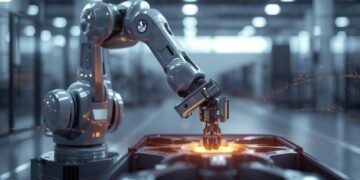
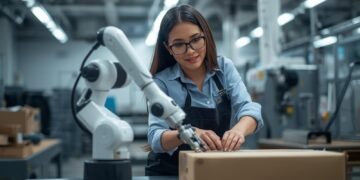
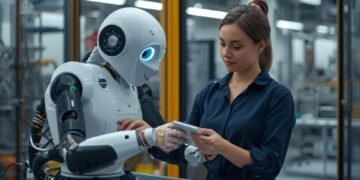
















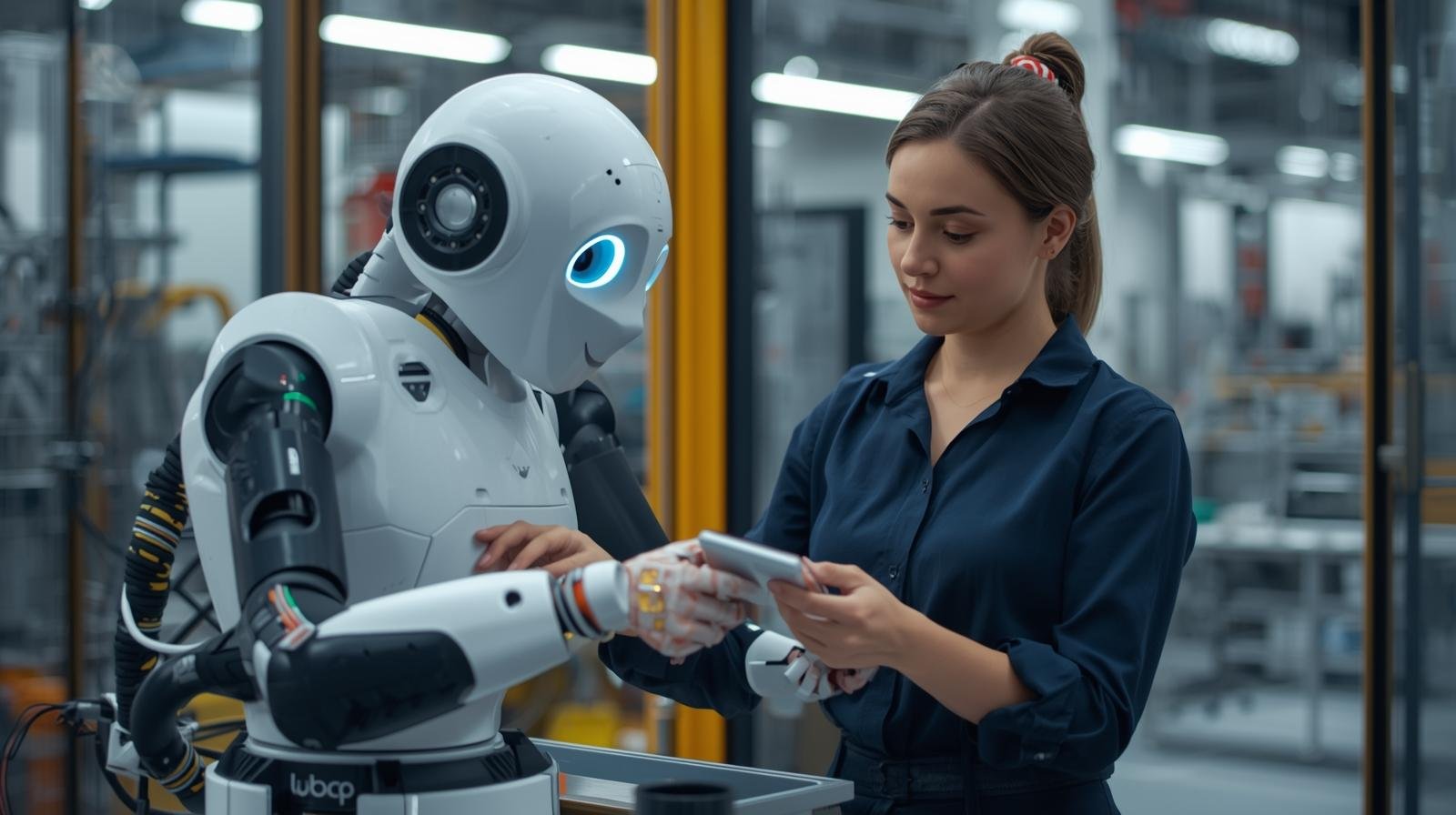
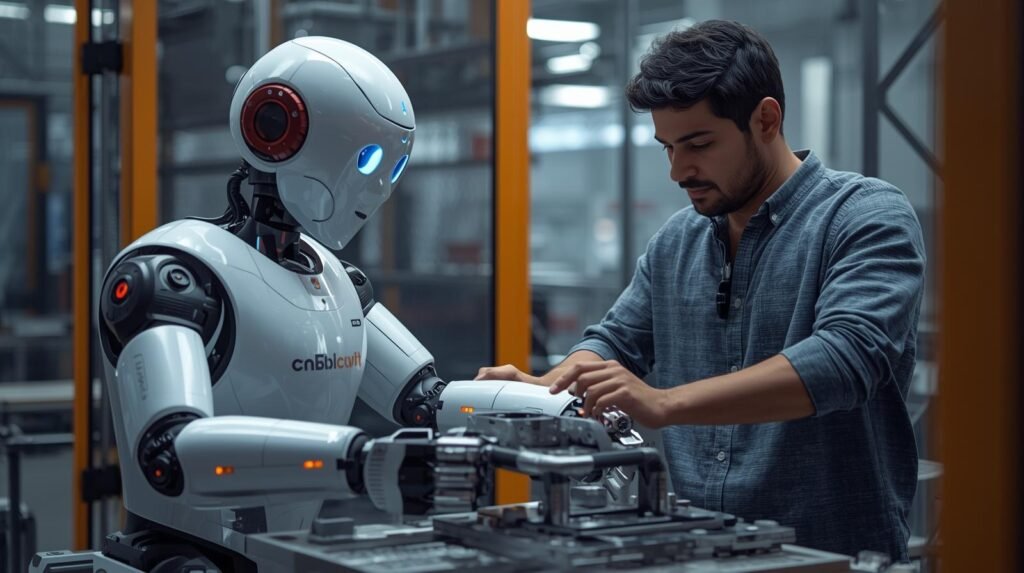
In all likelihood, you envision an industrial robot. As a result, in your mind, you probably think of an enormous, powerful robotic arm that can move about quickly to perform work on heavy parts and is shielded by a massive cage designed to protect a human being. In this sense, automation has been integrated into manufacturing environments over the years. These systems have produced high productivity and effectiveness, but their size has created a significant barrier to approaching the area near them, where injury might occur.

Wouldn’t it be wonderful if there were a machine that could serve as a safe, useful partner to a human worker? This is what we call a Collaborative Robot (Cobot) — a robot designed to safely collaborate with humans. Cobs are usually lighter than traditional robots and equipped with sophisticated sensors that allow them to quickly detect when something is about to unexpectedly come into contact with the robot (e.g., a human hand/arm).
In most people’s minds, I would say a cobot is likely envisioned as a tireless, super-powered assistant. Cobots excel at performing the boring, repetitive, or physically taxing portions of a job while freeing their human partner to perform those jobs that require agility, creative thinking, and problem-solving. The ability of a cobot to easily learn and adapt to new tasks is what allows it to become a truly collaborative partner, not just a one-time-use appliance like a robot vacuum cleaner.
Summary
To begin with, cobots (collaborative robots) are designed to work alongside humans; therefore, they are not limited to zones without people. As a result, they provide the consistency and precision associated with an automated system in a common area by providing a number of safety-based features, including controlled velocity/force, contact sensing, and stop sensing. In addition, cobots enable workers to be more productive, while their human coworkers retain the ability to make final quality judgments and address exceptions.
Cobots have been extensively used in manufacturing and logistics settings for various tasks, including assembly aid, packaging, machine tending, and inspection. The flexibility of cobots to adapt to varying environments is one of the biggest benefits of using them versus traditional industrial robots. Additionally, many cobots require less programming and can be easily redeployed as needed. They are well-suited to environments with a wide variety of products and/or processes (i.e., high-mix).
A key step in successfully implementing a cobot is identifying the most appropriate task(s) to automate, completing a risk assessment, and designing the workstation to promote safe human-robot collaboration with proper tools and training for operators.
Overall, cobots enable teams to reduce repetitive motion, stabilize production output, and enhance product quality without eliminating human interaction. Ultimately, when combining human decision making with robotic repetition, the results are “friendly” “partners” that contribute to creating safer, more productive and more flexible work environments.
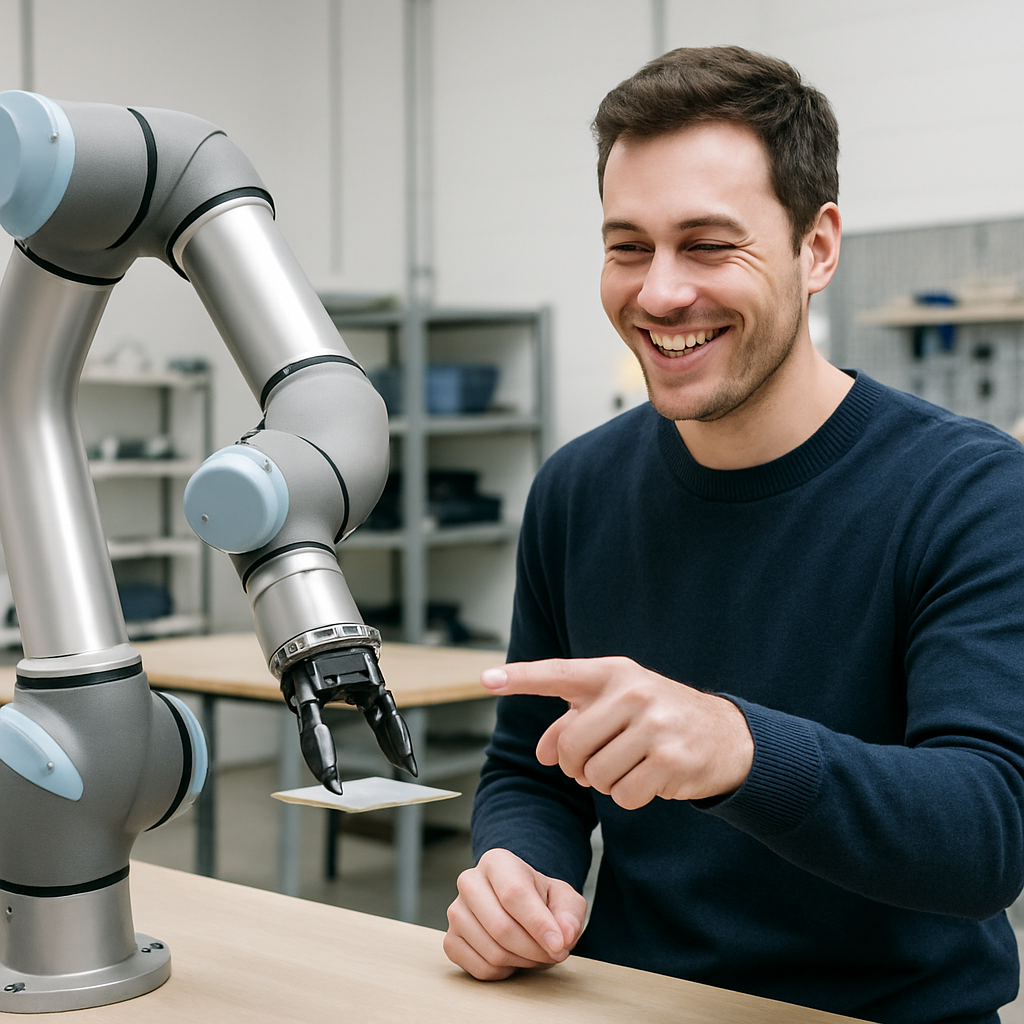
Collaborative Robots: Robots designed to safely work side by side with humans
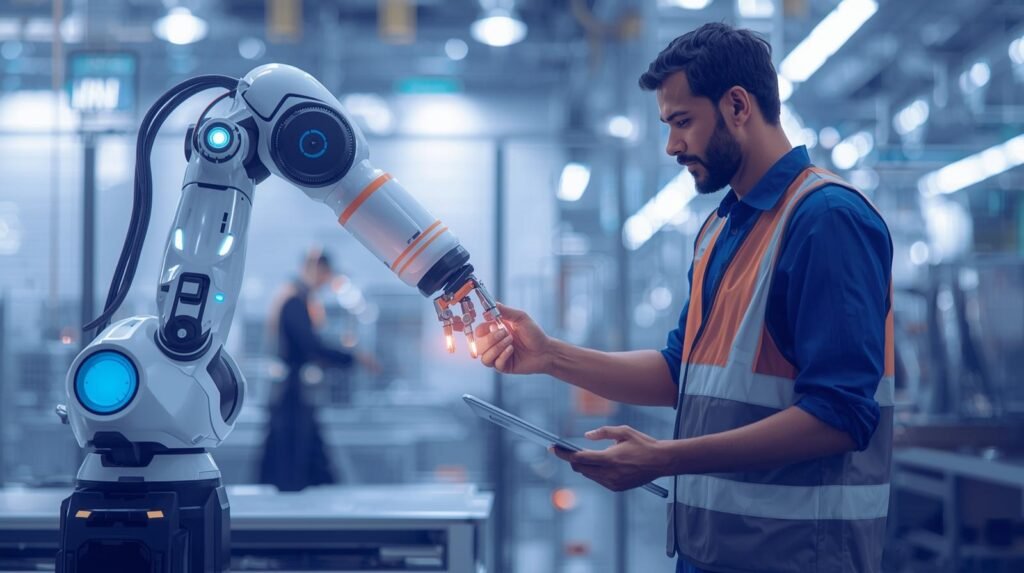
Collaborative robots are designed to allow both the robot and the human to coexist in the same workspace. This allows collaborative robots to be lighter than traditional industrial automation solutions that are often enclosed to keep workers away from dangerous equipment. Designed as an extension of the worker’s hand, collaborative robots provide precision, motion, and speed, while the human provides judgment, dexterity, and problem-solving abilities.
Unlike many industrial robots, collaborative robots have limited force, speed, and awareness and can be easily programmed to stop, slow down, or pause operation when a human is nearby. Since collaborative robots will operate in shared spaces, they are designed to be safe. They feature rounder edges and less power than industrial robots, and have built-in sensors to prevent accidents.
Most collaborative robots feature safety-rated components such as force/torque monitoring, speed/separation checks, and emergency stop functions. In the event of a collision or unexpected contact with a human, collaborative robots will detect it and react accordingly, minimizing the risk of injury and/or damage to products. Collaborative robots use smart programming, visual inspection systems, and comprehensive risk assessments to create a plan for every job, tool, and environment.
#Cobots for Small Businesses: Powerful & Practical Why It Matters
The Collaborative Robot functions optimally when it has appropriate end effectors, defined work processes, and skilled workers. The most common applications of collaborative robots on a production floor include machine tending, light assembly, screw driving, labeling, inspection, and packaging. These are all repetitive tasks that result in employee fatigue. However, human intervention is still required to provide contextual review. Collaborative Robots may also be used in a warehouse setting to assist with kitting, pick-and-place, and scanning workflows, enabling warehouse personnel to respond more effectively to increased demand.
In addition, Collaborative Robots have been utilized in laboratory settings to handle samples and load routine instruments, eliminating technician errors and freeing technicians from low-value tasks, such as manually loading instruments, so they can focus on high-value analytical tasks. Collaborative Robots, or Cobots, are being adopted by smaller organizations due to their ability to be quickly installed, easily reconfigured, and to operate flexibly compared to traditional automated cells.
To effectively implement Collaborative Robots, an organization must identify the appropriate application, confirm the robot’s safe use, and calculate Return on Investment (ROI) based on improvements in throughput and quality, and reductions in rework. As Collaborative Robots continue to develop greater sensing abilities, programming flexibility, and compatibility with current systems, they will serve as increasingly dependable team members who increase productivity while maintaining human decision-making authority in areas requiring contextual knowledge and compassion.
Human-Robot Interaction: Cobots are designed to interact safely and intuitively with human workers
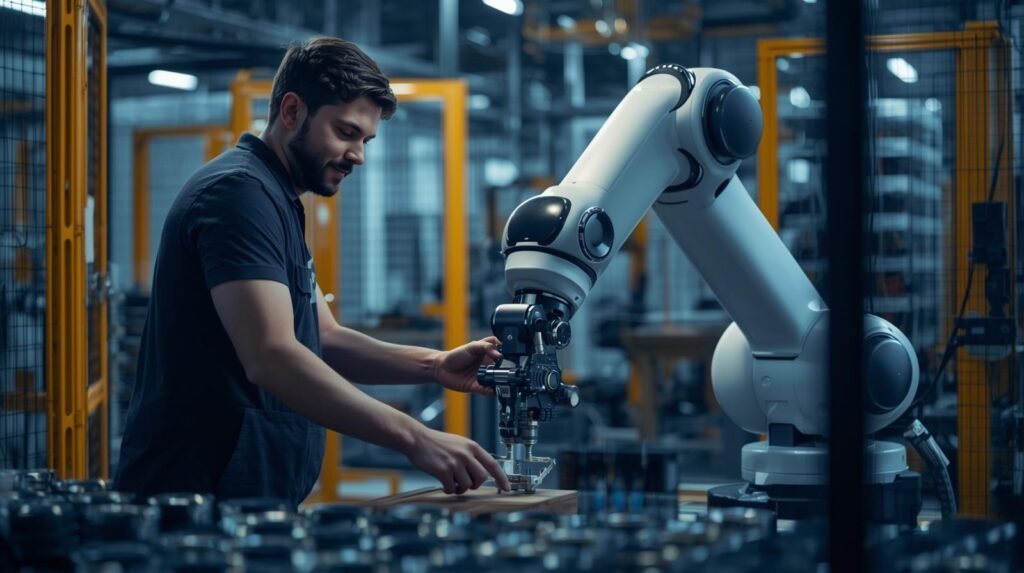
Human-Robot Interaction is a key factor in creating an environment where humans and robots collaborate. Cobots are designed with both safety and intuitive interaction for workers to allow a transition from “stay away from the robot” to “use the robot as an asset.” good Human-Robot Interaction makes all of the robot’s movements, signals, and actions predictable and easily understood by all users during their tasks, reducing confusion and building confidence on the shop floor.
An important element of Human-Robot Interaction is communication. Collaborative Robots provide visual cues (status lights, screen prompts, path indicators) and basic physical cues to help operators guide the robot in performing tasks without needing programming or code. Cobots also provide guidance on hand motions, quickly reteach specific points, and offer simple task selection options to help new users build confidence with cobots more quickly.
Additionally, Human-Robot Interaction involves how smoothly the team effort transitions into operation and out of operation, the speed at which the cobot operates when working close to people, and how purposeful the cobot’s movements are when they occur at a pace that mirrors the natural flow of human labor.
Safety and usability converge in Human-Robot Interaction through the development of systems that leverage real-world flow processes. In addition to typical features such as force limiting, emergency stops and sensors used to detect and prevent harm from occurring by way of unwanted contact between people and robots, another important factor in providing intuitive collaboration between cobots and humans lies with the design of the work cells; specifically how clearly defined are shared workspace areas, which end-effectors have been chosen and how straightforwardly are procedures explained.
Beginning with the most successful implementations of Human-Robot Interaction systems, there are likely to be fewer hours of “babysitting” an automated workstation from an employee’s perspective, and therefore more hours for decision-making, including monitoring product quality, managing product variation, and enhancing the process. Cobotics can enable humans to focus on high-value-added activities, such as quality judgment.
Human-Robot Interaction continues to evolve over time based upon user feedback and iterative modification. When teams encounter difficulty or delays due to confusion about how to interact with the robot, team members begin adjusting parameters of robot operation, such as speed, approach path, and prompting. Teams also continue to develop new training programs for the end-users to emphasize clarity. Successful implementations of cobotics occur when employees view the systems as trustworthy, collaborative partners in the workplace – responsive, open, and respectful of each employee’s personal space – that facilitate safe, comfortable, and continuous collaboration during each work shift.
Cobot Safety: Cobot safety features allow humans and robots to share the same workspace
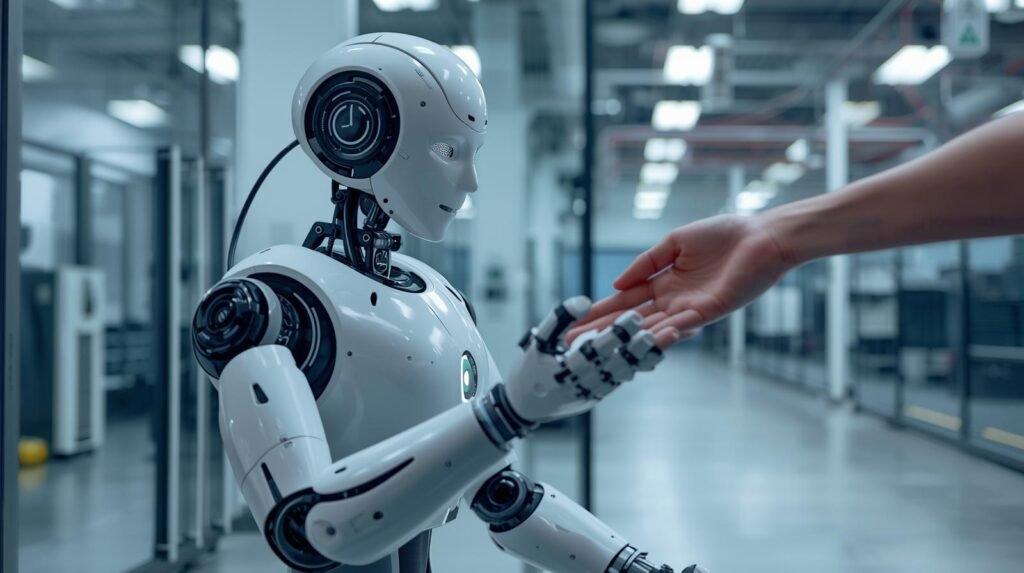
Robots designed as cobots enable workers to be near, or even touch, a machine during production. Cobot Safety is working to increase productivity by using design, sensing technology, and operating rules to control and minimize the risks involved when humans and machines share the same workspace. Many work cells have transitioned from traditional methods of isolating robots with fencing to using “smart” technologies that enable both productivity and safety at the point where the worker is performing their task and the robot is completing its.
#How Image Recognition Works: From Pixels to Intelligent AI Decisions
A key part of Cobot Safety is establishing the highest possible physical forces and speeds that a robot could encounter in close proximity to a person. There are multiple ways to do this, such as by using a “power-and-force limited” system. In this type of system, when a robot unexpectedly comes into contact with a person, the robot will immediately stop. Another way is to monitor the robot’s speed and separation from a person.
As a robot approaches a person, its speed decreases. The third way is through a “safety rated monitored stop.” A worker enters a specific designated zone. Once the worker is within that designated zone, the robot will pause all motion. It will continue to move once a safe condition has been established.
Through these processes, a Cobot can perform repetitive tasks while allowing a worker to be present within a predetermined safety buffer or envelope.
Tooling and Layout are also important aspects of a safe Cobot. Although an inherently safe robotic arm is safer than others, there are still potential hazards associated with sharp-edged end effectors, pinch points, and unstable parts. Many manufacturers choose to utilize Cobots with rounded-grip grippers, guard their tools, stabilize their parts, and place their fixtures in positions that eliminate hazards.
In addition to validating a safety system, teams also utilize risk assessments as an integral component of the safety design process. Assessments are made on the part based on its geometric characteristics, required speeds, contact points where the robot may come into contact with other objects, and the types of movement and paths of operators. Once assessed, teams can then determine appropriate safety limits and functions. Ultimately, this creates a safety system that can be measured in terms of safety rather than simply being an “assertion” of safety.
A fourth area, from a human-centered perspective, that can improve safety in Cobot environments is the use of visual indicators to represent the cobot’s task state (e.g., speed, stopping) and the provision of easily accessible emergency stop mechanisms. Training and defining procedures for passing tasks between operators further enhance the safety in these environments. The safer deployments of collaborative robots will recognize them as team members, operating in established and proven conditions.
Cobot Applications: Cobots are widely used for assembly, packaging, and inspection tasks
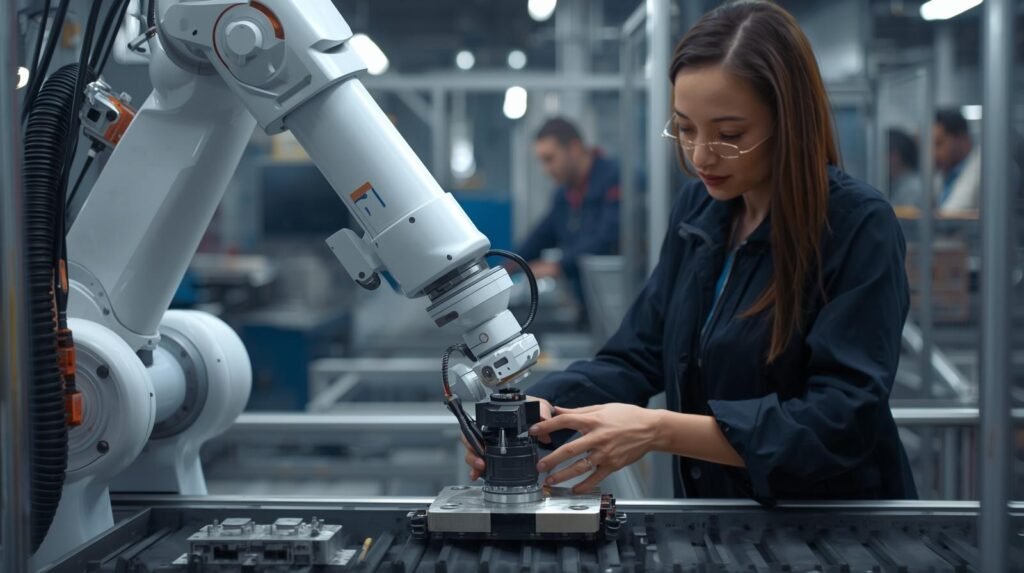
The use of cobot applications has enabled manufacturers and warehouses to change how they manage repetitive work by fostering collaboration between flexible automation and human oversight. This is because cobots are designed to coexist with humans in their workspace. Therefore, as long as some changes are made to their design, many cobot applications can be added directly to their current production lines. In addition, practical automation is now available to improve process reliability; however, it also enables employees to continue working on high-level tasks, such as problem-solving and changeovers, which robots currently cannot perform.
In assembly, the most common cobot applications include: screwdriving, press-fitting, dispensing, connecting parts with connectors, and completing lighter subassemblies. Cobots are perfect for applications that require repetitive work with varying products because they can be easily trained and redeployed from station to station. Many cobot applications leverage the robot’s ability to repeat its motion, using a combination of fixtures and sensors to determine whether the robot is in the correct position, apply the correct torque, and verify that the required part is present. By combining humans and cobots, employees can focus on aligning multiple components and performing final checks, while the cobot handles repetitive, tiring motions.
Packaging is another area where Cobot Applications generate rapid returns on investment. Packaging tasks that Cobots can perform include picking and placing items within containers; applying labels to packages; folding boxes; and completing other end-of-line packaging tasks. When frequent product changes and/or increased production volumes require rapid scalability of production operations, Cobot Applications will provide benefits. By handling the most repetitive aspects of packaging tasks, Cobots will help maintain a stable throughput and reduce the risk of repetitive-motion injuries while allowing humans to handle exceptions such as damaged packaging, order discrepancies, or custom inserts.
When it comes to inspection and testing, Cobot Applications usually involve holding a camera to capture images, moving objects through measuring points (mechanically or optically), reading bar codes, and placing objects under sensors. Cobots’ ability to consistently maintain viewpoints and cycle timing will enhance the reliability of defect detection and traceability.
In addition, many Cobot Applications use vision and/or force feedback systems to allow Cobots to accommodate minor variances while maintaining strict quality standards. Overall, Cobots will become very viable solutions for assembly, packaging, and inspection tasks in numerous industries due to their skills in: (1) dependable throughput, (2) quick change-overs, and (3) collaborative work environments.
Industrial Cobots: Industrial cobots boost productivity without replacing human workers
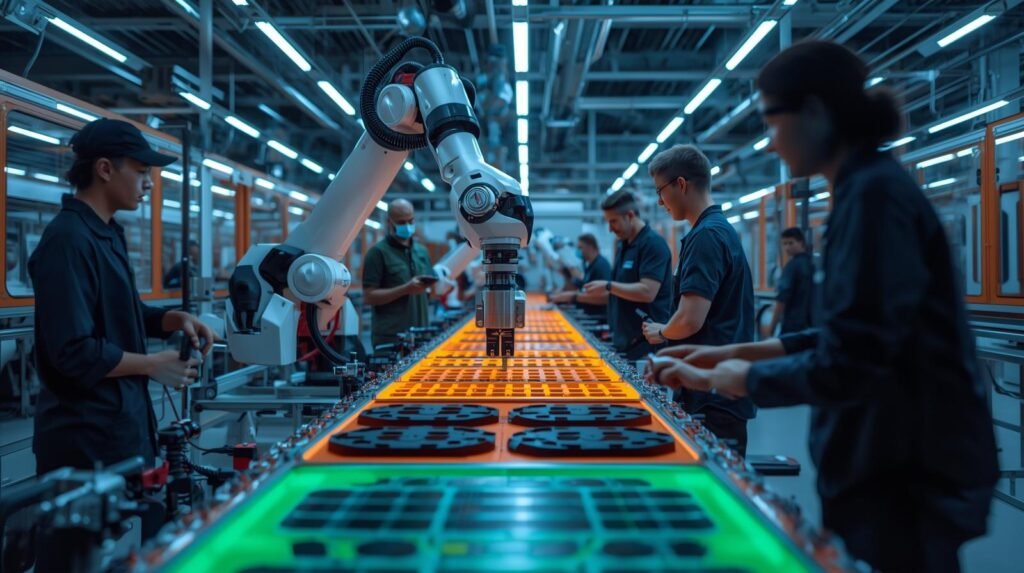
Industrial cobots allow for increased production while keeping humans involved in the process. Unlike industrial robots, which can replace an entire line of robots, Industrial Cobots will typically handle the repetitive, precise, and ergonomic portions of a task. This way, humans can focus on tasks requiring human judgment, i.e., problem-solving, making quality-based decisions, and replacing tools or materials. Therefore, Industrial Cobots are seen as productivity-improving for manufacturing efficiency, but not as a replacement for employees.
Common applications of Industrial Cobots in factories include machine tending, screw driving, material dispensing, small-part assembly using presses (light press fitting), and assisting with packaging after final inspection. A major advantage of Industrial Cobots is their ability to be reprogrammed and moved to other workstations much more quickly and easily than fixed-station automation equipment.
Therefore, Industrial Cobots offer many benefits in high-mix production environments with frequent changes to products, batches, or priorities. In addition, when demand surges, Industrial Cobots can help a team meet it by enabling consistent cycle times and eliminating bottlenecks, especially for tasks that contribute to worker fatigue over time.
Humans are very adaptable. However, humans tend to make slight errors with each repetition. The result is that Industrial Cobots consistently execute the same motions, reducing rework and scrap.
Industrial Cobots also do not replace the need for worker input when performing tasks that require human interpretation (for example, whether an item is a cosmetic flaw or fragile). Similarly, tasks that may present an unknown variable (e.g., what does a particular product look like?) will still require some degree of human input. Therefore, workflows using Industrial Cobots will typically have workers completing adaptive tasks while the cobot handles the “dull” work.
In addition to enhancing safety and reducing environmental impact, Industrial Cobots can help reduce employee fatigue from heavy lifting, reaching into tight spaces, and repetitive motion. As a result, Industrial Cobots can be implemented incrementally – automating one function at a time – allowing you to continue producing while you implement additional production capacity.
Ultimately, Industrial Cobots can aid in increasing productivity by improving a team’s capacity to produce, increasing the consistency of that production, and enhancing human resources’ ability to utilize their talents.
Cobots vs. Industrial Robots: Cobots differ from traditional robots in prioritizing flexibility and safety.

The distinctions between Cobots and Industrial Robots provide a solid foundation for comparison when determining which form of automation best meets your shop-floor workflow needs. For decades, traditional forms of automation have focused on speed, reach, and repeatability as key elements of industrial robots; however, these robots are often contained within fenced cells or other protective enclosures to prevent humans from coming into contact with them and thus minimize the risk of injury.
Collaborative robots (cobots), as discussed in Cobots vs Industrial Robots, differ from this approach by focusing on controlled motion, sensor technology, and “safe-by-design” interaction. These attributes enable cobots to operate at relatively close distances to their human counterparts while ensuring safe human-machine interaction.
Furthermore, the discussion of Cobots vs. Industrial Robots addresses how safety is established and maintained in each system. In many cases, safety is achieved through physical barriers (e.g., fencing, light curtains) and/or by completely separating the human worker from the robot. As indicated above, physical barriers and separation between the human worker and the robot are used to accommodate the high-speed, large-payload capabilities of many industrial robots.
In contrast, safety is established in cobot-based systems through design attributes such as force limiting, monitored stop capability, and reduced speeds near the worker. All three attributes listed above are core to the philosophy of collaborative robotics and, therefore, critical to establishing a safe working relationship between the human worker and the automation in a shared workspace.
The differences between cobots and industrial robots have never been clearer than in terms of flexibility and the time required to make changes. Robots will continue to thrive in high-volume production environments where processes have been perfected and cells optimized for maximum output. Cobots (collaborative systems) can generally be moved from station to station and can be configured for a new product line more easily. This is an example of how cobots vs. industrial robots represent a major difference in how long-term integration is achieved versus short-term incremental improvement.
Ultimately, whether to choose cobots or industrial robots will depend upon the characteristics of the job at hand: payload, cycle time, precision, operating environment, and process variability. If you need very rapid cycle times, extreme reaches, or large payloads, traditional industrial robots are probably your best option. On the other hand, if you need to easily relocate, share tasks with operators, and/or be closer to your operators, a collaborative solution may offer the greatest overall value. The comparison between cobots and industrial robots is less about competing and more about selecting the appropriate automation tool to complete the necessary work.
Cobots vs. Industrial Robots: What’s the Real Difference?
Industrial Robots and Collaborative Robots (Cobots) differ greatly in their design and development. Industrial robots were designed to provide maximum performance and productivity (speed), but this focus on speed can create hazardous environments; therefore, they must be isolated in safety cages.
There is clearly a trade-off between high-performance capabilities and operational flexibility in collaboration with humans.
- Industrial Robots: Designed to operate at high speeds and are normally installed in cages for safety. Programming traditional industrial robots requires a trained professional (an engineer).
- Collaborative Robots (Cobots): Cobots are designed to ensure the safety of both the robot and nearby personnel. Cobots may be operated without a cage to work alongside or directly with people. Additionally, anyone can teach/train a cobot.
The most fundamental shift in how you instruct a robot is also one of the most basic: programming robots with code. Programming robots for use in manufacturing environments can be a long and arduous task that requires engineers to write code (programming) that tells the robot exactly what to do. On the flip side, training cobots typically takes very little time or effort. Most often, you simply take the cobot’s arm and hold it while you move it along the path you want the robot to follow. The cobot then uses this path to perform future jobs that require it. Training a cobot is essentially as simple as training a human apprentice.
Cobot vs Industrial Robot Comparison Table
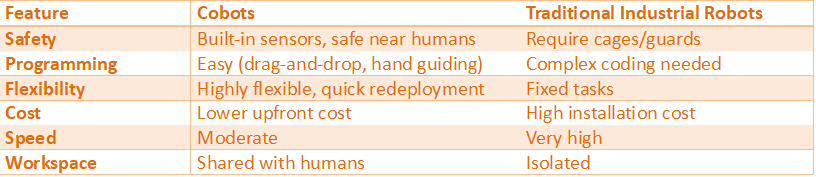
Key Insight: Cobots trade speed for flexibility and safety.
Source:
- Internation Federation of Robotics (IFR)
https://ifr.org - Universal Robots Reports
https://www.universal-robots.com
How Can You Safely Work Next to a Powerful Robot Arm?
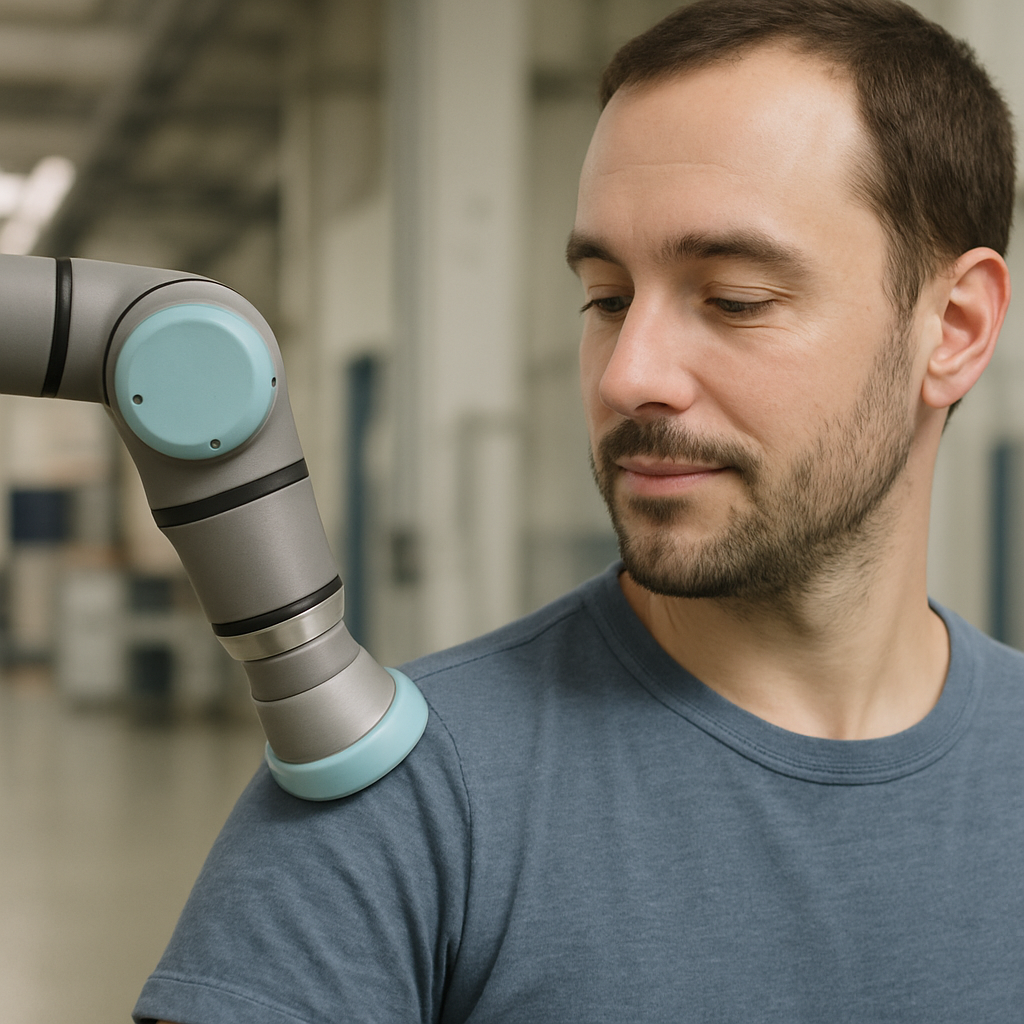
When considering the idea of a robotic arm working “side-by-side” with a worker, one of the most basic questions is: What keeps it from unintentionally hurting the worker? For decades, industrial robots have been separated from workers to avoid safety issues. That’s why they’ve built cobots from scratch to work safely alongside humans.
The answer is a type of sensor called a force-limiting sensor. Force-limiting sensors are located at each joint of a cobot, giving the cobot a kind of “feel.” As the cobot operates, the sensors continuously monitor for unexpected forces or friction. If the sensor detects an unexpected force or friction (for example, a misplaced part or a person reaching out to touch the cobot), the cobot immediately stops operating.
For example, think about elevators. When you reach out and put your hand in front of the doors as they close, the doors do not just keep going to try to get through your hand. Instead, the doors open again after detecting an obstruction. Cobots use the exact same logic. When the cobot hits something (a barrier), the cobot freezes all movement in less than a second to protect the potential victim.
Because of this inherent awareness, cobots can be designed to work in the same space as humans without the large, heavy enclosures that protect workers from industrial robots. Therefore, instead of creating physical barriers between humans and robots, cobots create a collaborative work environment where people and machines work together in the same area.
What Kind of Jobs Do Cobots Actually Do?
The cobot’s job is not to build cars or perform brain surgery with its niceness. What does this friendly robot do? Generally, the answer is found in one of many dull, boring, and time-consuming tasks that would be too difficult or frustrating for a single worker to complete. Cobots work well for repetitive, consistent tasks that don’t require creative thinking or problem-solving.
One example is the “pick and place” function. A cobot arm is located on a conveyor belt. It picks up the finished item (e.g., a bottle of sauce or a smartphone) and places it in its package. The process repeats itself. The human worker has no distractions or fatigue from the robot, so they can check the product for quality or start preparing the next batch of items.
Cobots can assist humans in other ways as well. While the robot is just placing products, cobots can be used as assistants. When a cobot is used for “machine tending,” it can load raw materials into a machine and unload completed parts. This is a monotonous task that is potentially hazardous to workers. In collaborative assembly, the cobot serves as a third hand for a human worker, holding a heavy or hard-to-hold part steady while the human completes the more detailed task of adding screws or connecting wiring, thereby reducing the amount of physical labor required.
All three functions demonstrate the same principle. The cobot completes the dull, repetitive, and physically challenging portion of the task. The human worker completes the skillful, critical, and flexible portion.
Real-World Cobot Applications
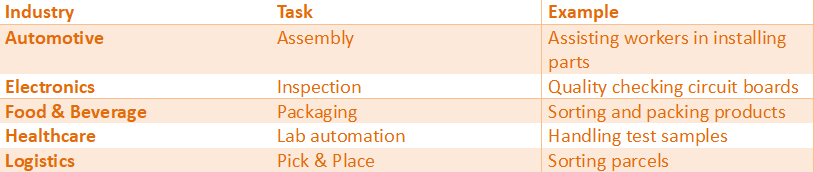
Example Highlight: BMW uses cobots to assist workers on assembly lines, improving efficiency and reducing strain.
Source:
- IFR Case Studies
https://ifr.org - BMW Manufacturing Insights
https://www.bmwgroup.com
Why Would a Small Business Invest in a Cobot?
Speed is just one of the benefits of cobots. Protection of people is another. Think about a job requiring you to twist an arm to tighten something and pick up a 20-pound box every minute for 8 hours. Repeated motion like this can lead to significant strain on your body and potential injury. When you assign a job that requires repetitive physical motion to a cobot, you can dramatically reduce workplace accidents and keep your most valuable assets healthy and happy while they work.
This level of consistency has a dramatic effect on the quality of the final product. Regardless of skill level, no employee can perform a task with the same level of accuracy as a machine. There is always some degree of variation in how much glue they apply and the pressure used to tighten a screw. A cobot, however, performs tasks with robotic precision and uses the exact same amount of glue (and/or tightens the screws) to the same degree each time it attempts the task. This leads to fewer mistakes, less wasted materials, and a better finished product for consumers.
These advantages provide a reason for investing in cobots, especially for small businesses. Cobots help local shops and small factories compete with larger companies by creating a safer work environment and producing higher-quality products.
ROI & Business Benefits of Cobots

Example: A small manufacturing unit reduced labor costs by 30% after deploying cobots
Source:
- Deloitte Robotics Report
https://www2.deloitte.com - Universal Robots ROI Studies
https://www.universal-robots.com
How Do You “Teach” a Cobot What to Do?
Developing a cobot’s programming is often perceived by robot programmers as very complex and as being visually represented on a large computer screen with many lines of code. However, when you compare developing a cobot’s programming to how it actually works, it may seem to be less complex than expected due to its physicality and intuitiveness.
Most cobots do not require any keystrokes for development and use a method called “hand-guided.” The method involves the operator pressing a button to release the cobot’s arm, allowing it to move around as they perform the task. After the operator has manually guided the cobot through the motions required to complete the task, the cobot will remember the motion, much like a student learning to draw a shape by tracing it with their hand while a teacher traces it with theirs.
Once the operator has demonstrated the physical path the cobot should follow to complete the given task, each step required to accomplish it will be displayed on a simple touchscreen tablet. The interface for programming a cobot is very similar to using a smartphone app.
The cobot’s programming can be developed using a combination of simple graphic icons representing actions that include “Move To Location”, “Pick-Up Object”, and “Wait For X Amount Of Time”. Changing individual steps in a program is easy; all the operator needs to do is tap a button. So, with no programming knowledge required, the operator can modify the program or instruct the cobot to perform a new task.
This ease-of-use is what makes cobots so revolutionary. Cobots enable experts to take automation out of the lab and put it directly in their own hands. With this technology, experts can take advantage of machine capabilities to automate repetitive tasks without needing an engineering background.
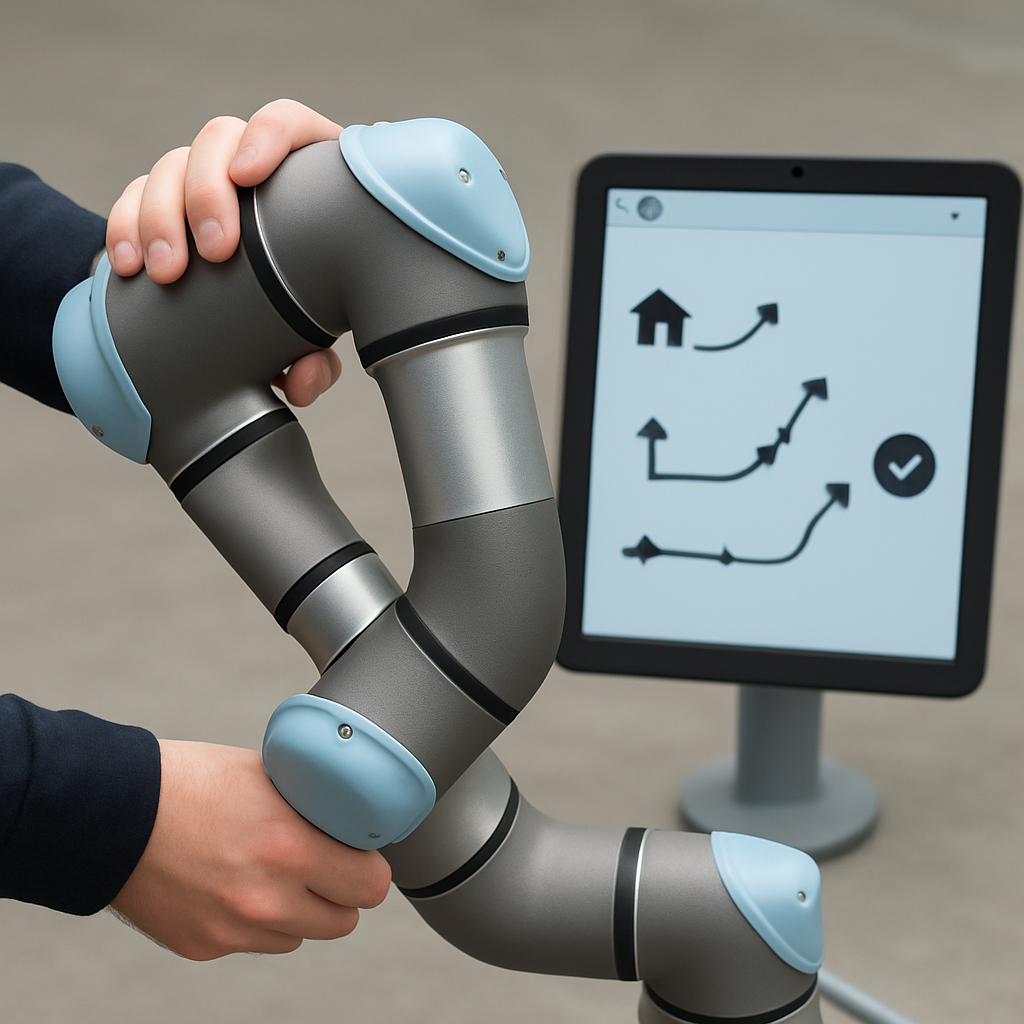
How Cobots Are “Taught”

Example: A worker can grab the robot arm, move it through steps, and the cobot memorizes the task.
Source:
- Universal Robots Academy
https://academy.universal-robots.com - ABB Robotics Training
https://new.abb.com/products/robotics
What Is the “Hand” at the End of a Cobot’s Arm?
The most significant limitation in a cobot’s functionality is its inability to operate autonomously. A cobot cannot function without an end effector. An end effector is an arm-mounted tool that enables the cobot to physically interact with a part. The simplest form of an end effector is a gripper. A gripper is essentially an artificial finger. It is used to grasp parts, boxes, and bottles.
Vacuum cups are an alternative to grippers when working with fragile or slippery surfaces. Vacuum cups hold the object against the gripping surface, providing a secure grip. Screwdrivers, sanders, and glue applicators are examples of end effectors that can be mounted to a cobot. These tools enable a cobot to perform tasks that require physical interaction with a part.
One benefit of End-Effectors (EOAT) is their ease of replacement. Much like a power drill bit can be easily swapped to perform different tasks, the EOAT can be easily swapped to enable the cobot to perform multiple tasks. For example, a cobot can be used to stack boxes at 9 am and assist with building a product by 1 pm. This is possible because the cobot can switch from an EOAT designed to stack boxes to an EOAT designed to assist with building products.
Are Cobots Really the Future of Work?
Cobots are changing how we see robots in the workplace—from being a replacement for workers to being collaborators who help workers accomplish difficult or boring tasks. With the use of cobots, workers will be able to increase productivity and spend time on high-level creative thinking instead of being bogged down by repetitive, mundane, and tiring work that cobots can accomplish.
Instead of asking “Was a robot stealing a worker’s job?” the most accurate way to ask that question now would be “Was a cobot making my job better?”—which is precisely why more and more companies are viewing cobots as a smart business decision, because they are investing in their employees’ quality of life and future. The future of the workplace does not need to be a story of humans vs. machines. This is the start of a long-term partnership with humans and cobots working together as a team to create a collaborative workplace. When cobots handle the routine, monotonous parts of a job, humans will be able to excel at what they do best—create, think critically, and innovate.
Global Cobot Market Growth Statistics

Key Insight: Cobots are one of the fastest-growing segments in robotics.
Source:
- MarketsandMarkets
https://www.marketsandmarkets.com - Statista
https://www.statista.com
Conclusion
Cobots are changing how we think about automation. They’re taking automation away from replacing human work (at least) and instead moving towards integrating humans and machines to work together in close proximity. The design of cobots has focused on developing safe, easy-to-use equipment that can be deployed wherever needed. This enables humans and machines to work side by side, dividing the workload based on what each does best.
For example, humans can perform tasks such as judging, being flexible, and providing quality assurance, particularly when the products manufactured are made from different types of materials and/or when the production priorities vary. Cobots can consistently and dependably perform repetitive, precise, and physically demanding motions on an assembly line.
If cobots are used properly, and if there is sufficient due diligence taken in evaluating the risks of using cobots, selecting the proper tools to use with the cobots, and training operators to use the cobots safely and effectively, cobots have the potential to increase throughput, decrease error rates, reduce the amount of ergonomic strain experienced by employees, and they can do this while being compatible with existing workflows of an organization, all without having to make significant changes to their physical facility.
As sensing, programming, and integration capabilities improve in cobot technology, “helpful” and “powerful” robots will become commonplace in manufacturing, warehousing, and laboratory environments. For many organizations, cobots represent the most practical means to achieve scalable productivity — through people, not in replacement of people.
FAQs
- What is a cobot?
A cobot (short for collaborative robot) is an automation technology capable of operating in close proximity to people. The cobot can be found working alongside people in a variety of settings, including workspaces. This technology assists with high-precision, repetitive tasks. - How are cobots different from traditional industrial robots?
Industrial robots have historically been faster and capable of carrying heavier payloads than cobots. As a result, they have traditionally required enclosures or fences to protect workers from hazards associated with these machines. Cobots were designed with safety as a priority, ease of deployment, and the ability to share space with workers. - Are cobots safe to work with?
If a cobot is properly evaluated and set up, it can be a safe addition to your workplace. Cobots provide safety through built-in limits (e.g., speed and force), sensors, emergency-stop capabilities, and a job-specific hazard/risk assessment of the workstation and its design. - What are common cobot applications?
There are many ways cobots are used in today’s workforce. They are commonly used for machine tending, light assembly (e.g., screwdriving), packaging, pick-and-place, labeling, and inspection/quality checking. - Will cobots replace human workers?
Many organizations use cobots to assist workers by performing repetitive and/or physically demanding operations, allowing them to focus their time and energy on quality decisions and addressing issues that arise during production.















Comments 2