



















Welcome to the era of “data is the new oil”. Just as raw crude oil has no value unless refined, raw data has no value unless it can be analyzed and converted into useful information (insights). That’s when a data scientist comes into play. If you enjoy playing with numbers, identifying trends, and working on tough business problems, then a career in data science may be right up your alley.
Aspiring professionals, individuals looking to transition into the tech world, or managers who want to learn about what makes this job so difficult, welcome! This ultimate guide to data scientists’ roles & responsibilities will walk you through day-to-day activities, how to get promoted, and all the required skills.

Data Scientist: A data scientist turns raw data into meaningful insights that drive smarter decisions.

Welcome to the era of “data is the new oil”. Just as raw crude oil has no value unless refined, raw data has no value unless it can be analyzed and converted into useful information (insights). That’s when a data scientist comes into play. If you enjoy playing with numbers, identifying trends, and working on tough business problems, then a career in data science may be right up your alley.
Aspiring professionals, individuals looking to transition into the tech world, or managers who want to learn about what makes this job so difficult, welcome! This ultimate guide to data scientists’ roles & responsibilities will walk you through day-to-day activities, how to get promoted, and all the required skills.
- A data scientist takes large amounts of unorganized raw data and turns it into insightful information that helps businesses make informed, intelligent decisions.
- Data scientists examine complex data to find patterns and solve real-world problems.
- Data scientists use their knowledge of statistics, computer programming (coding), and artificial intelligence (AI) to analyze data and develop data-driven solutions.
- Data scientists take the data they are given and transform it into valuable business insights and opportunities for business growth.
- Data Scientists use the data, algorithms, and models they developed to predict future events and optimize outcomes.
To achieve success as a professional, it’s important to develop habits and an emphasis on the basics. Develop your skills in SQL and Python. Learn about probability and experimentation. Use simple visuals to tell stories. Create a portfolio that represents all aspects of end-to-end work, including problem description, data preparation, model development, and decision support. Obtain feedback from peers and/or a code review. Stay aware of the importance of ethics, privacy, and bias.
By being aware of how to apply data scientist roles (beyond just modeling) and by understanding the goals and constraints associated with products/decisions, the insights you provide will be more aligned with business decisions.
When technical ability is coupled with strong communication and a curious mind, your analysis becomes a reliable input for better strategic decision-making.
As far as daily activities go, the job involves both exploration and production. A typical day may include profiling new tables, designing metrics, running quick notebooks to validate assumptions, and packaging the best practices for the “winning” process into a reusable pipeline.
The collaboration with other team members is consistent. Collaboration includes working with analysts, engineers, and subject-matter experts to define success criteria and data-quality controls. Good documentation and version control help ensure results are repeatable. As you continue on this path, you can elect to pursue areas such as machine learning, experimentation, natural language processing (NLP), or analytics leadership while maintaining a practical, decision-first mentality.
Complete Guide to AI Engineer Roles and Responsibilities: Essential Skills for a Successful Career
Example
At a Grocery Store Chain, A Data Scientist observed Weekly Stock Outages for Fresh Berries. She combined sales information, weather patterns, and shipping records, after which she developed an easy-to-apply forecasting tool that showed likely increases in demand prior to holidays. The Data Scientist tested her new forecasting model in three different store locations. Following testing, the Data Scientist created a One-Page Summary showing reductions in Empty Shelves at Stores and in Waste.
Based on the success of using a forecast model, the Company’s Reorder Points were automated. In addition, if there was a change in supplier lead time, an Alert would be generated. Two Months later, the availability of Berries increased by 12%, and Spoilage decreased by 8%. This demonstrates how a Data Scientist can convert Disorganized Data into Profitable Decisions. Additionally, as a result of her efforts, Managers were trained to Trust Probabilities rather than Gut Instincts.
Data Science Job Description: Learn the complete data science job description, including daily tasks, tools, and responsibilities.

The Data Scientist job description should clearly explain how the position will translate data into decision-making through analysis, modeling, and communication. The most common expectation across all departments is that the candidate can demonstrate both technical expertise and business acumen and provide a mix of work spanning exploratory and experimental activities, as well as production support.
When looking at an open position for a Data Scientist, the Data Scientist Job Description needs to identify the domain (marketing, product, financial, healthcare) where they will be working, the level of maturity of the company’s data platform, and what success will look like for the Data Scientist in their first 30 – 90 days.
A typical day for a Data Scientist may involve using SQL to pull data, cleaning and transforming the dataset(s), and exploring patterns/trends in the data to help answer stakeholder questions. Typical tools used in this position include Python (pandas, scikit-learn), Jupyter Notebooks, Git, and visualization software such as Tableau or Power BI. Many positions use cloud-based solutions (AWS, GCP, AZURE), big data storage solutions (Snowflake, BigQuery), and workflow management tools (Airflow).
It is also important for a strong Data Scientist Job Description to emphasize collaboration with other members of the department (data engineers and analysts) to ensure the quality of the data being analyzed and the smooth running of analytical processes.
Core Data Scientist Responsibilities normally entail the development of predictive or descriptive models; running A/B Tests to compare different versions of an application (or web page) or service; and developing metrics which inform and/or help drive Product and Business Decisions. Communicating Results — explaining one’s assumptions, uncertainty, and trade-offs to enable decision-makers to make confident decisions — is another core responsibility of the Data Scientist.
In larger/more mature organizations, responsibilities may include Deploying Models, Monitoring Performance Drift, and Improving Automation.
Qualifications usually require Strong Statistics, Programming, Problem-Solving Skills, as well as the ability to translate Ambiguous Questions into Measurable Hypotheses. Growing in this position requires End-to-End Projects (defining a problem, collecting and assembling data, developing a Model or analysis, and presenting a Recommendation). A well-written Data Scientist Job Description will give Candidates a clear understanding of what they are being asked to do through their responsibilities, while providing Employers a means to Hire For Real Impact.
Example
Data science job description example: “You’ll be working closely with marketing to increase renewal rates. The main responsibilities of this role are as follows: you will query Snowflake using SQL, build predictive models using Python, and present your results to non-technical leadership. You will also build features that come from web events, subscriptions, and customer service tickets. In addition, you will write automated tests to validate your data and use A/B testing to determine lift.
Statistics, Machine Learning basics, Git, and Clear Writing are all required. Nice to have experience with Airflow, dbt, or Causal Inference. Success within the first 90 days of this position is defined by delivering a Churn Dashboard, deploying a Baseline Model, and documenting Monitoring for Drift. Work collaboratively with Engineers to deploy updates and ensure Privacy Compliance at All Times.
Decoding the Data Science Job Description
A “standard” job description for a Data Science role is really about extracting answers from messy, unstructured data and using them to help organizations make better decisions. The role of a Data Scientist is also part Mathematician (analytical), Part Computer Scientist (building models and tools), and Part Business Strategist (understanding how to use information to drive decision-making).
The exact details of what you’ll be doing as a Data Scientist will vary greatly based on the size of your company or the type of business you’re working with, but your overall objective will always remain the same. You need to hypothesize, build experiments/code, and develop/deploy models that resolve problems in the world.
Data Analyst vs Scientist: Clearing the Confusion
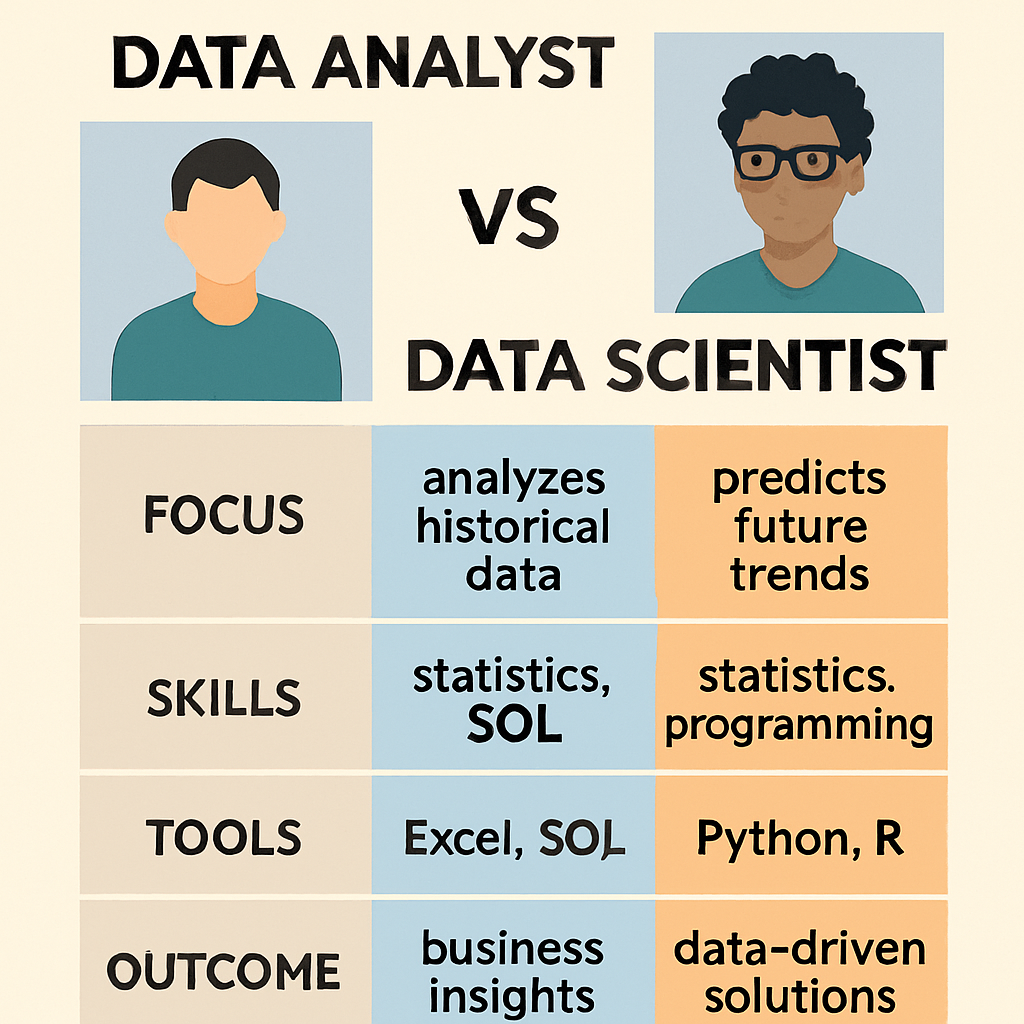
Before diving deeper, it is vital to distinguish between two frequently confused roles: data analyst vs scientist.
• Data Analyst – The primary focus of a data analyst is on past data. A data analyst will typically examine past data and identify trends and patterns. Analysts use SQL for database queries and create dashboards using Tableau or Power BI.
• Data Scientist – A data scientist is primarily focused on predicting future outcomes. A data scientist uses advanced statistical techniques and machine learning to develop models that predict the likelihood of future events. In addition to examining historical data, a data scientist’s ultimate objective is to build predictive models.
What Does a Data Scientist Do on a Daily Basis?
What does a Data Scientist do daily? Most people who have thought about pivoting into this area ask that very same question. However, the “Hollywood” view of typing away at your computer and building sentient AI is much further from reality. A Data Scientist’s daily job duties can be both collaborative and diverse.
A typical day might look like this:
- Daily Stand-up Meetings (Morning): Meeting with Product and Engineering Teams to review progress toward daily objectives and identify obstacles that could be hindering our ability to reach those objectives.
- Data Wrangling: Spent large amounts of time crafting SQL code to collect relevant data. Then I spent even more time ensuring the quality of the collected data through data cleansing techniques and by creating features from existing columns to prepare my data for modeling.
- Model Development: Exploratory Data Analysis (EDA) and Predictive Modeling in an attempt to find underlying trends or prove new hypotheses.
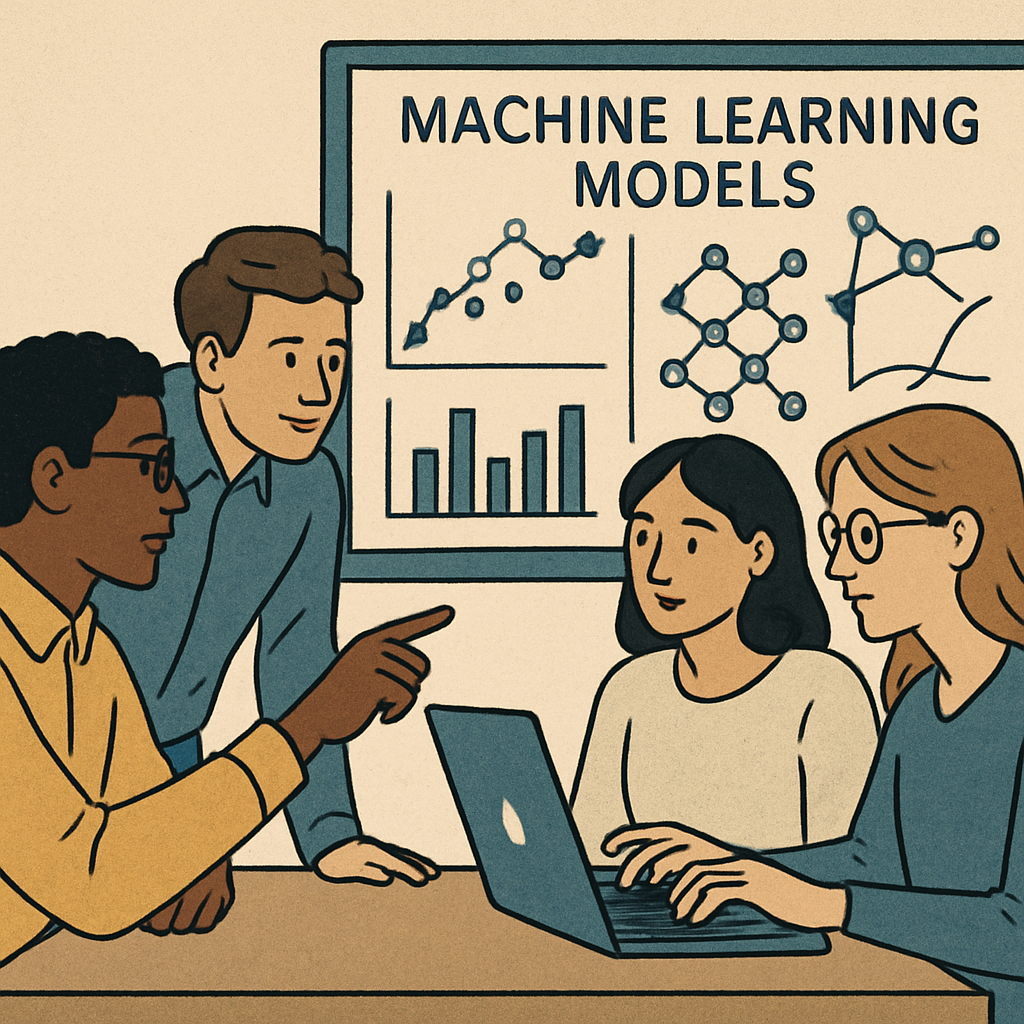
- Collaborative Work With Other Departments: Collaborated with Data Engineers and Product Managers to determine how we would be able to scale the newly developed Machine Learning Model and get it integrated into our primary application.
Synthesis & Presentation: Taking complex insights gathered during modeling and presenting them visually so that they are easy for Non-Tech Stakeholders to understand
Daily Tasks Breakdown
| Task | Time(%) | Example |
|---|---|---|
| Data Cleaning | 30% | Removing missing values |
| Data Analysis | 25% | Identifying trends |
| Model Building | 20% | Training ML models |
| Visualization | 15% | Creating dashboards |
| Communication | 10% | Presenting insights |
Source: Kaggle Survey Insights
https://www.kaggle.com
Core Responsibilities Unpacked
To truly succeed in this field, you must master the fundamental data scientist duties. These extend far beyond just writing code.
- Data Cleaning and Feature Engineering:
Most datasets are imperfect. Even data scientists estimate that as much as 70 percent of their time can be spent simply locating, cleaning, and preparing data for analysis. Adhering to strict data-cleaning and feature-engineering best practices is important when developing algorithms. As the saying goes, if you put garbage in, you’ll receive garbage back. - Exploring Your Data through Exploration and Prediction
After your data has been cleaned, the fun begins. By exploring your data and making predictions, you begin to uncover hidden patterns. For example, you may have a clustering model that groups customers based on their purchase history. Alternatively, you may develop a neural network to predict where a stock price will go in the near future. - Cross-Functional Collaboration
A great deal of what you do as a data scientist happens outside of your own area of expertise. You work closely with data engineers and product managers. The data engineers are building the pipeline that delivers the data you’ll use to create your model; the product manager helps identify how the model can solve the business problems your company is trying to address. - Championing Ethical AI
Another responsibility of modern data scientists is understanding the ethics of data collection and how algorithms may have built-in biases. While this doesn’t mean there’s no value in training models on large amounts of data (which can create better predictive models), if those models are trained on biased historical data, that same bias will appear in their predictions. Thus, it is the duty of all data scientists to continually check their models for fairness and ensure they’re not creating discriminatory models based on race, gender, age, or other demographics.
Example
During a hospital readmission project, Data Scientist responsibilities started with defining the target: readmission within 30 days, excluding planned returns. Next came data quality checks for diagnosis codes, missing discharge notes, and timestamps.
The scientist built a baseline logistic regression model, compared it with gradient boosting, and documented performance by age group to identify bias. Another of the Data Scientist’s responsibilities was interpretability: he created a clinician-friendly chart explaining the top risk drivers. Finally, he partnered with IT to deploy the score nightly and set alerts when calibration drifted, keeping the model safe and useful. He wrote runbooks so nurses could respond.
Data Scientist Job Roles and Responsibilities: Get a detailed breakdown of data scientist job roles and responsibilities in real-world projects.

In all Data Science Project Work, Data Scientist Job Roles and Responsibilities cover the entire process of transforming a business issue into a quantifiable outcome. Most projects begin at the scoping level by holding stakeholder meetings, specifying what will be improved, establishing how success will be measured, and stipulating limits such as timeframes, data availability, and acceptable risk. The first step in any project is considered part of the Data Scientist Job Roles and Responsibilities, as it determines whether the work has the potential to create a positive impact.
The next major portion of most Data Science Projects involves data work, which can also take up the majority of the time. Major responsibilities that comprise core Data Scientist Responsibilities include finding appropriate data sources (e.g., data warehouses, product logs, customer relationship management (CRM) systems, or third-party data), writing SQL to retrieve datasets from those sources, cleaning and validating records, and creating reliable feature sets.
In many mature organizations, this stage of a project often involves collaborating with data engineering roles to build data pipelines and ensure consistent definitions across multiple dashboards and models.
Example: In a fintech startup, Data Scientist roles split across a small squad. One person owned data ingestion, mapping transaction feeds into clean tables. Another focused on experimentation, designing A/B tests for a new budgeting feature and estimating sample sizes. A third handled modeling, training a churn classifier and building explainable features for support agents. The lead coordinated stakeholders, set success metrics, and reviewed code to keep pipelines reproducible. Together, these Data Scientist roles ensured the product team had fast insights, reliable dashboards, and deployable models, while engineers received clear specs for monitoring drift and retraining schedules in production every quarter.
Exploratory data analysis and determining a suitable approach (statistical or machine learning) are part of a Data Scientist’s responsibilities. The Data Scientist trains and adjusts his model based on the results of these statistical or machine learning methods and evaluates his performance using the most relevant metric.
He will also check for bias, overfitting (“leakage”) in his model as well as whether the results are interpretable (especially if they influence customer behavior, prices, etc.) — all the while providing an estimate of uncertainty associated with the output. When working in teams where experimentation is key, the Data Scientist will assist with developing A/B testing plans, determining sample size requirements, and interpreting the test results with confidence intervals.
The delivery phase of your project represents the time at which the work you have completed becomes useful. As such, it is part of what Data Scientist job roles and responsibilities entail; as Data Scientist responsibilities for providing clarity into their findings using everyday language, creating simple decision-based tools to assist in making decisions, and providing documentation about how they reached their conclusions so that other individuals will be able to take care of maintaining the solutions created.
In addition to the above-stated Data Scientist responsibilities, another responsibility is supporting deployment (transferring from Data Scientist to an engineer or placing a packaged model) and tracking changes to the data pattern. Collaboration is ongoing throughout each stage of this process — working with product, engineering, analytics, and leadership to ensure alignment between the solution provided and the constraints faced by all parties involved. When successful, the Data Scientist role combines technical detail with practical decision-making. This ensures that the final outcome improves rather than simply generating additional reporting.
Top AI Jobs in the USA: Careers, Salaries, and Future Opportunities
Example
Data Scientists at a fintech startup worked as a small team of three. The first role was responsible for data ingestion, or putting raw transaction feed information into a clean format (tables) that could be used by other Data Scientists. The second role is experimentation, which included designing AB testing methodologies for the newly released “budgeting” feature and determining how many samples were needed to ensure statistically significant results.
The third role involved modeling, including developing an algorithm to identify users likely to cancel their subscriptions (“churn”) and creating explainable features for use by customer service representatives.
The fourth role is the lead or program manager for all of the Data Science activities within the organization, he/she coordinates various stakeholders such as; the engineering teams and/or developers, the product development teams, sets measurable goals/success criteria for each project/data analysis/feature release etc. and reviews the code written by his/her team members to provide the ability to reproduce the pipeline(s).
Data scientist duties: Understand the key responsibilities involved in analyzing and interpreting complex data.

Data Scientist duties include providing actionable business decisions by transforming large amounts of disorganized, unclean, or confusing information into usable, reliable insights. To accomplish this, Data Scientist duties include clearly identifying the questions to be answered (i.e., what is the purpose of the project?; what decision(s) do we need support for?, what desired outcomes should result from our analysis?) as well as determining which data sets will provide the answers. A strong Data Scientist will also define success measures and transform ambiguous requests into testable hypotheses.
Data Scientists primarily collect, process, and prepare data for a project. This process includes developing SQL code to collect data from databases, linking tables (joins) to identify trends, determining how to handle missing values, identifying outliers, and validating the overall quality of the data. Even if the model created by a Data Scientist performs well, it will perform poorly if the data used was incomplete, inaccurate, biased, or otherwise unreliable.
In addition to documentation that allows other Data Scientists to review and reproduce your findings, using tools such as notebooks and version control, and clearly defining all data, helps Data Scientists document their methods and procedures in detail.
After that comes the modeling and evaluation of a model. Tasks typical for the above steps include Exploratory Data Analysis, Feature Engineering, Building Statistical or Machine Learning Models (Classification, Regression, Clustering, Forecasting), Selecting Appropriate Methods for Your Model(s) to Run Well, Tuning Performance Metrics as Necessary, and Evaluating Results Using the Right Evaluation Metrics.
In addition to the responsibilities mentioned previously, the additional Data Scientist Responsibilities in this area are Testing Robustness and Fairness of Your Model(s), Assessing Interpretability of Your Model(s), Identifying Leakage in Your Model(s), etc.
Technical skills are used in conjunction with business judgment to complete a data scientist’s job: clean your data well, think about your analysis, present your results clearly, and continually improve the process. This way, data work will be measured as performance (not simply pretty graphs).
To do this, you’ll need to use technical skills. Data Scientists summarize their research with visualizations; they explain uncertainty by saying things like “this model worked most of the time,” and suggest what should be done next. Data Scientist duties can be summarized as working on engineering teams to get models into production, implementing monitoring so that if the business changes, then you know to go back to the data, and making decisions based on the data at hand.
Example
The duties of a Data Scientist on this application to track how much energy consumers used involved creating a daily pipeline to ingest smart meter data (the actual amount of electricity used) and merge it with tariff schedules (the rate they are charged per unit). The Data Scientist then examined her results for unusual behavior, found that a firmware upgrade had caused duplicate records to be reported for many users, fixed this problem, and segregated user accounts based on their individual electricity-use behavior. Next, she built a model that suggested times of day when users could save money by using less electricity.
In addition to developing her analytic skills, part of a Data Scientist’s duties on this project was to explain limitations; e.g., if a home uses solar power to generate some or all of its own electricity, her predictive models would be less accurate.
Therefore, she recommended adding functionality so that she can collect data from these inverters (which convert DC electricity generated by the photovoltaic cells back to AC electricity usable in the house); in addition to writing very clear documentation regarding the operation of the models she developed, she created an operational dashboard that support staff can review each day when reviewing the previous days’ data; and trained them to understand how to interpret the models’ output in terms of making specific recommendations to end-users — thus converting the analytics into tangible cost reductions.
The Required Arsenal: Technical Skills vs Soft Skills for Data Science
For all that, you will need to have a variety of tools at your disposal. While the argument as to whether technical or soft skills are better for data scientists continues, top-level professionals know that you can’t succeed with just one.
The Technical Foundation
The basic hard data scientist skills are necessary. You must be proficient in speaking the language of Data and Algorithms.
- Programming: A candidate needs to be proficient with various programming languages and machine learning frameworks; the most prominent are Python and R, along with Pandas, Scikit-Learn, TensorFlow, and PyTorch.
- Mathematics and Statistics: The ability to analyze algorithms is dependent upon an individual’s mathematical background, including probability, linear algebra, and calculus.
- Database Management: To extract data from a database (relational or non-relational), proficiency in SQL and/or NoSQL databases will be necessary.
The “Soft” Differentiators
What separates a good coder from a great Data Scientist? Soft skills.
Business Acumen: (You have to connect what you’ve learned from the Data with a Business Strategy). The best model ever built will be of no use unless it can help create a real business solution.
Communication: (You are a Storyteller). Your ability to communicate mathematically derived information in an understandable format for the C.E.O. or Mktg Dir., is likely your most important skill.
Technical vs Soft Skills
| Technical Skills | Soft Skills |
|---|---|
| Python, R | Communication |
| Machine Learning | Problem-solving |
| SQL & Databases | Critical thinking |
| Data Visualization | Storytelling |
| Statistics | Collaboration |
Source: LinkedIn Workforce Report
https://www.linkedin.com
Data scientist skills: Master essential data scientist skills like Python, machine learning, and data analysis.

Mastering the skills of a Data Scientist entails creating a toolkit for making actual decisions, rather than merely building predictive models. This includes programming, which is the most commonly used skill among professionals working with data; specifically, Python is the primary choice, with libraries such as pandas and NumPy for data manipulation, scikit-learn for model development, and notebooks for exploratory analysis.
As well, a strong set of Data Scientist Skills will include proficiency in SQL, as much data resides in a warehouse, and you will be required to quickly and accurately obtain the correct data, join or combine data sets, and ensure your data is accurate.
A second key area of a Data Scientist’s skill set is machine learning. It is essential to understand how to choose algorithms (e.g., regression, classification, clustering, time series) for different problem types, tune them to improve performance, and evaluate their performance using appropriate statistical metrics. However, the greatest Data Scientist Skills extend beyond evaluating model accuracy.
For example, a Data Scientist may require feature engineering to create new variables based upon existing ones; cross-validation to ensure that results from one sample do not apply to all samples; techniques to provide interpretability to their models to facilitate decision-making by non-data science stakeholders; and an appreciation for the potential presence of bias or data leakage within their models.
Finally, even though Data Scientist roles involve many experiments with large amounts of data, basic statistics and experimentation play critical roles in many Data Science Roles — including hypothesis testing, confidence interval calculations, and A/B test designs.
Data Scientist skills such as exploratory data analysis, presentation of findings through visualization, and communication – including converting findings into recommendations – combine to provide the glue that ties all aspects of data science together. In addition, in Data Scientist roles, stakeholders may have no technical background and therefore will require explanations of trade-offs in simple terms. A number of tools exist to allow you to rapidly present an insight. These tools include Tableau, Power BI, or various Python visualization libraries.
Finally, it matters who works on your project and what happens after you complete your work. For example, using version control with Git, documenting your processes, having experience with a cloud platform (e.g., AWS/GCP/Azure), and being familiar with deploying models and monitoring them for “drift” can help ensure your work is easily reusable by others. Ultimately, one of the best ways to become a better Data Scientist is to build projects from start to finish—define a problem, collect data, analyze it, create a model based on that data, and then communicate the results.
Breaking & Progressive AI Regulation News in the United States
Data analyst vs. data scientist: Compare the roles to choose the right career path

The key to deciding between a data analyst and a data scientist begins with the type of problems you would like to solve. Data analysts are usually focused on answering questions about what has occurred (why something has happened) through reports, dashboards, KPI tracking, and ad hoc analysis, which can help inform day-to-day business decisions. Data scientists generally have two primary areas of interest: predicting what may occur in the future and providing recommendations on how to proceed next; they utilize statistical modeling, machine learning techniques, and analysis.
When comparing a data analyst vs. a data scientist, while both share some common tools, there is a clear distinction in depth. Analysts tend to rely on SQL, Excel spreadsheets, BI tools such as Tableau or Power BI, and simple statistics to analyze trends and cohorts. In contrast, data scientists not only use SQL but also add an additional layer of complexity by using Python or R for their data pipelines, feature engineering, and model development. Many organizations view one key difference between a data analyst and a data scientist as whether the end product is a report/dashboard or a model/decision-making system.
The scope of work and responsibilities also typically shift. As mentioned earlier, typical common Data Scientist Responsibilities include defining an unstructured problem, developing a predictive model(s), conducting experiments (and providing recommendations based on those experiments), and measuring the success of these efforts through appropriate metrics.
Additional Data Scientist Responsibilities often include supporting model deployment, tracking model performance over time, and identifying issues such as bias, lack of interpretability, and data leakage. While analysts will do some level of forecasting or experimentation, their production requirements are usually much lower than those of a Data Scientist.
Therefore, when determining which career path is right for you, ask yourself what type of activities you most enjoy. If you enjoy solving clearly defined business problems, interacting with stakeholders, and rapidly producing answers to business questions, then an analyst role might be a good fit. If you enjoy math, coding, and building systems that automate or enhance decision-making processes, then the field of data science would likely be a good fit. In reality, however, many careers have elements of both, so it’s always best to explore project opportunities in each area before deciding on one.
Data Analyst vs Data Scientist
| Aspect | Data Analyst | Data Scientist |
|---|---|---|
| Focus | Analyzes historical data | Predicts future trends |
| Skills | SQL, Excel, BI tools | Python, ML, Statistics |
| Tools | Excel, Tableau, Power BI | Python, R, TensorFlow |
| Output | Reports & dashboards | Predictive models |
| Goal | Business insights | Data-driven solutions |
Source: IBM Careers Guide
https://www.ibm.com/topics/data-science
Industry Spotlight: Data Scientist Roles in Finance vs Healthcare
Your specific duties will heavily depend on your sector. Let’s compare data scientist roles in finance vs healthcare to see how the landscape shifts.
- FINANCE: This area primarily involves risk management, automated trading algorithms, and fraud detection. For example, a data scientist working at a bank may be responsible for developing and implementing real-time machine learning systems capable of identifying suspicious credit card transactions in as little time as possible. Speed and accuracy of results will matter greatly in this environment, while regulatory oversight will act as a significant constraint.
- HEALTHCARE: In Healthcare, the consequences can literally be fatal. Therefore, a Data Scientist in this field could be working in genomics, developing models to predict which patients are likely to require hospital readmissions, and/or developing machine learning applications (using computer vision) capable of quickly detecting early tumor formations in medical images, such as X-ray images. Model interpretability is also extremely important because doctors need to understand the reasoning behind an AI’s recommendation before they are willing to use it.
Industry Use Case
| Industry | Use Case | Impact |
|---|---|---|
| Finance | Fraud detection | Reduces financial loss |
| Healthcare | Disease prediction | Saves lives |
| E-commerce | Recommendation systems | Boosts sales |
| Marketing | Customer segmentation | Improves targeting |
| Manufacturing | Predictive maintenance | Reduces downtime |
Source: McKinsey AI Report
https://www.mckinsey.com
Data scientist career: Explore a high-growth data scientist career and discover opportunities in today’s data-driven world.

A Data Scientist Career Path has been one of the fastest-growing career paths for professionals interested in applying their knowledge of Statistics, Data Science, and Experimental Methodology (Practical Experimentation) to solve Business Problems.
In addition, organizations across industries such as Technology, Finance, Healthcare, Retail, and Manufacturing utilize Data Scientists to enhance products/services, mitigate Risk, Personalize Experiences, and Optimize Operations. One reason the Data Scientist Career is extremely appealing is the vast range of work it offers. For example, a Data Scientist could be working on creating Demand Forecasts, Identifying Fraudulent Activity, Developing Strategies to Increase Customer Retention, and Building Recommendation Systems.
Typically in day-to-day activities in a Data Scientist Role, there are five primary steps; Problem Framing (i.e., turning a vague question into a clear set of metrics and testing the hypothesis); Data Work (i.e., extracting data via SQL, Validating/Cleaning the extracted data and Exploring Patterns within the data to better understand what contributes to certain Outcomes); Model Development (i.e., developing Statistical/Machine Learning Models utilizing Python), Model Evaluation (i.e., assessing how well the developed models perform) and Communicating Results (i.e., communicating results clearly enough for Stakeholders to take action).
Given the importance of communicating results effectively, strong Communication Skills are an essential component of a data scientist’s role, since even if a Model is well developed, if stakeholders do not know how to properly apply the Model’s results, the value derived from the Model will be greatly diminished.
Career development as a Data Scientist is quite versatile. At an early stage in your career, you develop core competencies in SQL, Python, statistics, and data visualization, and you demonstrate the ability to deliver value through end-to-end projects.
Later in your Data Scientist career, there are many options that allow you to focus on areas of expertise, including but not limited to NLP, Time Series Forecasting, Causal Inference, MLOps; alternatively, you may choose to transition into a mentorship role or lead cross-functionally. There are several ways to define a senior path for a Data Scientist; one is to establish best practices for experimentation, model monitoring, and Responsible AI.
To maximize your opportunities as a Data Scientist, consider building your career as a portfolio of outcomes. This means demonstrating how you identified the problem, improved the data used to solve it, selected the method(s), and produced measurable results. Ultimately, consistent demonstration of positive impacts from strong Data Science foundations, combined with effective collaboration, will provide both sustainability and rewards for Data Scientist roles.
The Data Scientist Career Progression Path
The data scientist career progression path is dynamic, offering multiple routes for advancement depending on whether you prefer to stay an individual contributor or move into management.
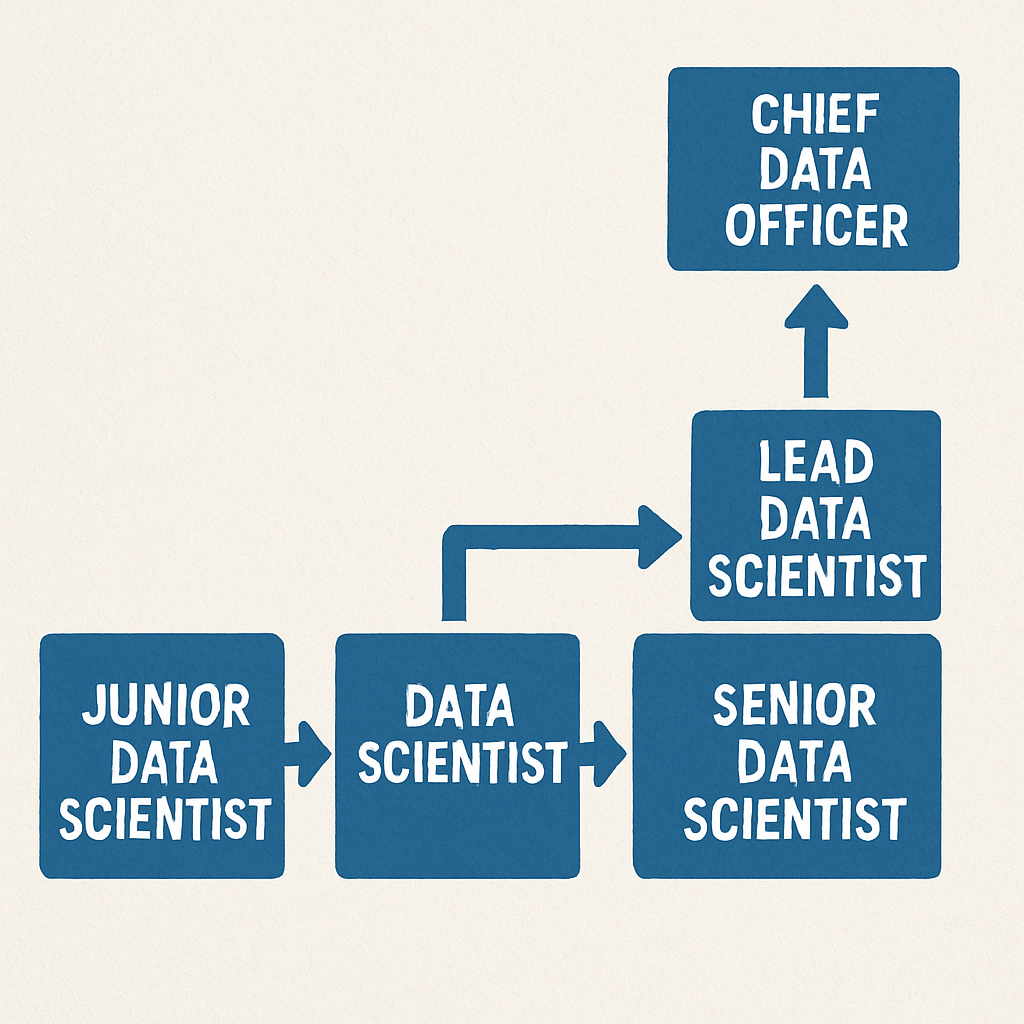
Junior Data Scientist
Entry-level roles focus heavily on execution. You will likely spend your time cleaning data, writing basic queries, and assisting senior members with model training.
Senior Data Scientist
As you move up, the differences between junior and senior data scientist roles become apparent. A junior asks, “How do I build this model?”, while a senior asks, “Should we build this model at all?”
The senior data scientist’s roles and responsibilities encompass:
- Architecting end-to-end machine learning pipelines.
- Mentoring junior data scientists and analysts.
- Leading meetings with C-suite executives to define the data strategy.
- Evaluating the long-term infrastructure needs alongside the engineering teams.
Lead Data Scientist / Chief Data Officer (CDO)
At the top of the ladder, the focus shifts entirely from coding to leadership, budget management, and enterprise-wide data governance.
Career Progression & Salary
| Role | Experience | Avg Salary (US) |
|---|---|---|
| Junior Data Scientist | 0-2 years | $80,000 |
| Data Scientist | 2-5 years | $110,000 |
| Senior Data Scientist | 5-8 years | $140,000 |
| Lead Data Scientist | 8+ years | $160,000+ |
| Chief Data Officier | 10+ years | $200,000+ |
Source: Glassdoor Salary Insights
https://www.glassdoor.com
Senior Data Scientist Roles and Responsibilities: Discover the advanced responsibilities and leadership roles of a senior data scientist.

Senior Data Scientists are responsible for much more than developing predictive models. The primary responsibility of a Senior Data Scientist is to provide strategic direction and lead high-impact initiatives that elevate their team’s technical capabilities. A senior data scientist will take vague business objectives and translate them into concrete problems by defining success metrics and creating detailed project plans.
In most cases, Senior Data Scientist Roles and Responsibilities also include determining which method(s) to use (e.g., experimentation, causal inference, machine learning, or forecasting), ensuring that the chosen solution is both reliable and explainable, and consistent with the organization’s constraints.
One of the most significant differences between senior and junior roles is the degree of ownership and influence. Most typical Data Scientist roles focus solely on completing an analysis, whereas senior roles require collaboration with other functions, including product development, engineering, and executive management.
As such, senior data scientists are often involved in reviewing assumptions made during an analysis, questioning poor metric selection, and assisting their colleagues in avoiding potential pitfalls associated with data bias, data leakage, and/or overfitting. Additionally, a significant portion of Senior Data Scientist Roles and Responsibilities involves mentoring others through peer-based code reviews, providing guidance on model evaluations, and offering recommendations on best practices for documenting and reproducing results.
Senior-level work will require a high degree of production-readiness. Senior Data Scientist roles and responsibilities typically include designing scalable pipelines, deploying models in collaboration with other teams, creating monitoring systems (e.g., for drift), and developing retraining or recalibration plans. Many Data Scientist roles represent the transition of “deliverables” from “analysis” to “a maintained system that continues to evolve with the business.”
Senior Data Scientist roles demonstrate leadership by effectively communicating trade-offs, explaining uncertainty, and helping stakeholders make informed decisions with appropriate confidence levels. Often, senior data scientists participate in the hiring process, create interview questions, support new hires in their role development, and help establish guidelines for experimentation, model governance, and responsible use of artificial intelligence. Ultimately, senior data scientist roles and responsibilities blend both technical expertise and practical leadership to produce measurable, consistent results.
Proving Your Worth: Measuring Business Value
One of the most challenging aspects of the job is justifying the time and computational cost of your work. Measuring the ROI of data science projects is a critical skill for career advancement.
How do you prove ROI?
- A/B Testing: Clearly demonstrating that an AI-driven recommendation engine increased sales by X% compared to the baseline.
- Cost Reduction: Showing how a predictive maintenance model saved a manufacturing plant thousands of dollars by preventing a machine breakdown.
- Efficiency Gains: Calculating the hours of manual human labor saved by automating a previously tedious data categorization process.
Breaking In: How to Become a Data Scientist With No Experience
Maybe you’re reading this and think it’s all well and good; however, I’m just in school and don’t know anything about technology. Fear not; there are many professionals within the field who switched from being biologists, economists, teachers, and artists.
Here is a strategic plan for becoming a data scientist with little or no experience:
1. Build a Foundation Through Education
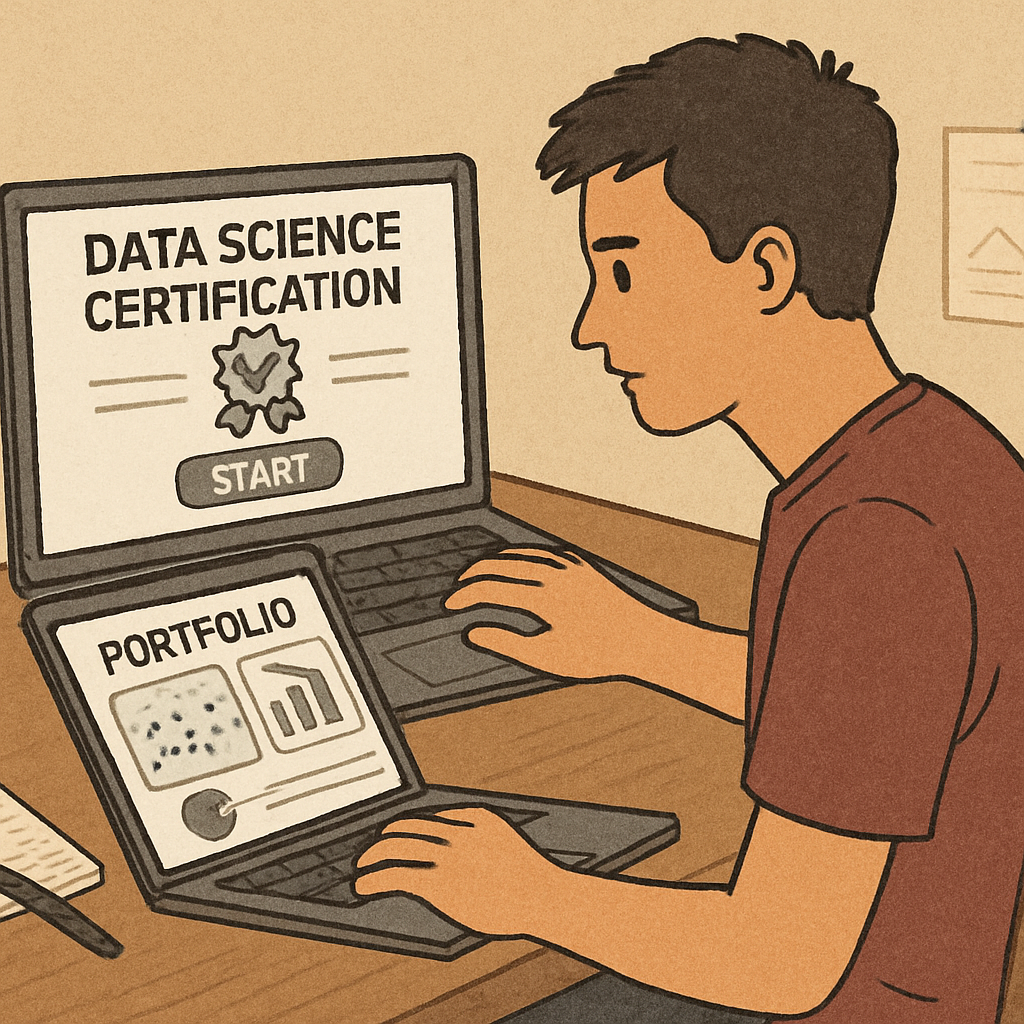
You may not be required to earn your Master’s Degree in Computer Science. Many boot camps and self-paced online education platforms are viewed favorably by today’s technology sector. In addition, many of these programs provide certifications that demonstrate an individual has learned the core elements needed to grow professionally as a data scientist.
2. Create Tangible Evidence of Your Skills
A resume tells, but a portfolio shows. Building a data science portfolio to showcase expertise is the single most important step for a beginner.
- Skip the Titanic dataset: Hiring managers have seen the basic beginner datasets a million times.
- Solve real problems: Scrape your own data, analyze a niche topic you are passionate about (like sports statistics, local real estate prices, or public health data), and build an end-to-end project.
- Host it publicly: Put your code on GitHub and write a detailed Medium article explaining your methodology and business conclusions.
3. Network and Contribute
Take part in communities such as those found at kaggle.com, join a variety of “hackathon” competitions, and take advantage of the local tech community by attending tech-based meetup groups. Community involvement can greatly enhance your learning while providing opportunities for referral to entry-level positions.
My Viewpoint
You may want this guide to portray the Data Scientist as the individual responsible for converting uncertainty into clear, actionable options through data, models, and communication, thereby converting risk into potential impact.
Rather than defining each responsibility individually, you would provide a singular goal (helping a team make better decisions faster using evidence the team trusts) to tie all roles (from junior to senior) together.
When viewed in this manner “responsibilities” will look similar to a repeating process: identify the choice/decision and what measure of success it needs to be measured by, assess the quality of the data used, pick the most straightforward option that provides value, evaluate the results with honesty, describe the trade-offs in simple terms, create a solution that is useful in the real-world (hand off, monitor and iterate).
The career progression then represents growing levels of responsibility: the early stage of their careers focuses on executing the basics and fundamentals; the mid-level adds independence and stakeholder management; the senior level adds leading others, systemic thinking, and governance.
Additionally, this viewpoint makes a very important distinction between technical ability and effectiveness within an organization: impact is generated by how well a company frames a problem, measures its solutions, and adopts them.
Effective data scientists build credibility — technically, statistically, and socially.
Conclusion: Embrace the Journey of Lifelong Learning
A Data Science Career is not simply a goal but a long-term commitment to continuous learning throughout your life. Tools, algorithms, best practices, etc., which are widely used today, will change dramatically by tomorrow.
To become an indispensable resource to all organizations, you should master your technical skills (such as your ability to program and manipulate datasets) and develop the necessary soft skills (communication, presentation, etc.) in addition to being able to convert complex algorithms into tangible business value through your understanding of the entire Data Science Job Description. Regardless of whether you are working with your first dataset or preparing for a senior leadership position, realize that your true value does not lie within the lines of code you produce, but instead within the clarity and vision you provide to an ever-increasing number of data-driven decision-making processes.
- What does a data scientist do day-to-day?
They clarify the business question, pull and clean data (often with SQL/Python), explore patterns, build and evaluate models or experiments, and present insights. In mature teams, they also help deploy solutions and monitor performance over time. - What are the core responsibilities of a data scientist?
Problem framing, data quality checks, analysis/modeling, measuring impact with the right metrics, and communicating results clearly. Many roles also include documentation, reproducibility, and collaboration with engineering and stakeholders. - How is a data scientist different from a data analyst?
Analysts usually focus on reporting, dashboards, and descriptive insights. Data scientists more often build predictive/decision models, run experiments, and create scalable data products—though there’s overlap depending on the company. - What skills and tools matter most for career success?
Strong SQL, Python, statistics, and clear communication are the baseline. Common tools include pandas/scikit-learn, notebooks, Git, BI tools, and cloud data platforms; higher levels benefit from experimentation design, model monitoring, and system thinking. - How do I move from junior to senior data scientist?
Grow from executing tasks to owning outcomes: define metrics, lead projects end to end, handle ambiguity, influence stakeholders, and mentor others. Senior roles emphasize reliability (deployment/monitoring), decision-making impact, and leadership across teams.

Garikapati Bullivenkaiah is a seasoned entrepreneur with a rich multidisciplinary academic foundation—including LL.B., LL.M., M.A., and M.B.A. degrees—that uniquely blend legal insight, managerial acumen, and sociocultural understanding. Driven by vision and integrity, he leads his own enterprise with a strategic mindset informed by rigorous legal training and advanced business education. His strong analytical skills, honed through legal and management disciplines, empower him to navigate complex challenges, mitigate risks, and foster growth in diverse sectors. Committed to delivering value, Garikapati’s entrepreneurial journey is characterized by innovative approaches, ethical leadership, and the ability to convert cross-domain knowledge into practical, client-focused solutions.