
















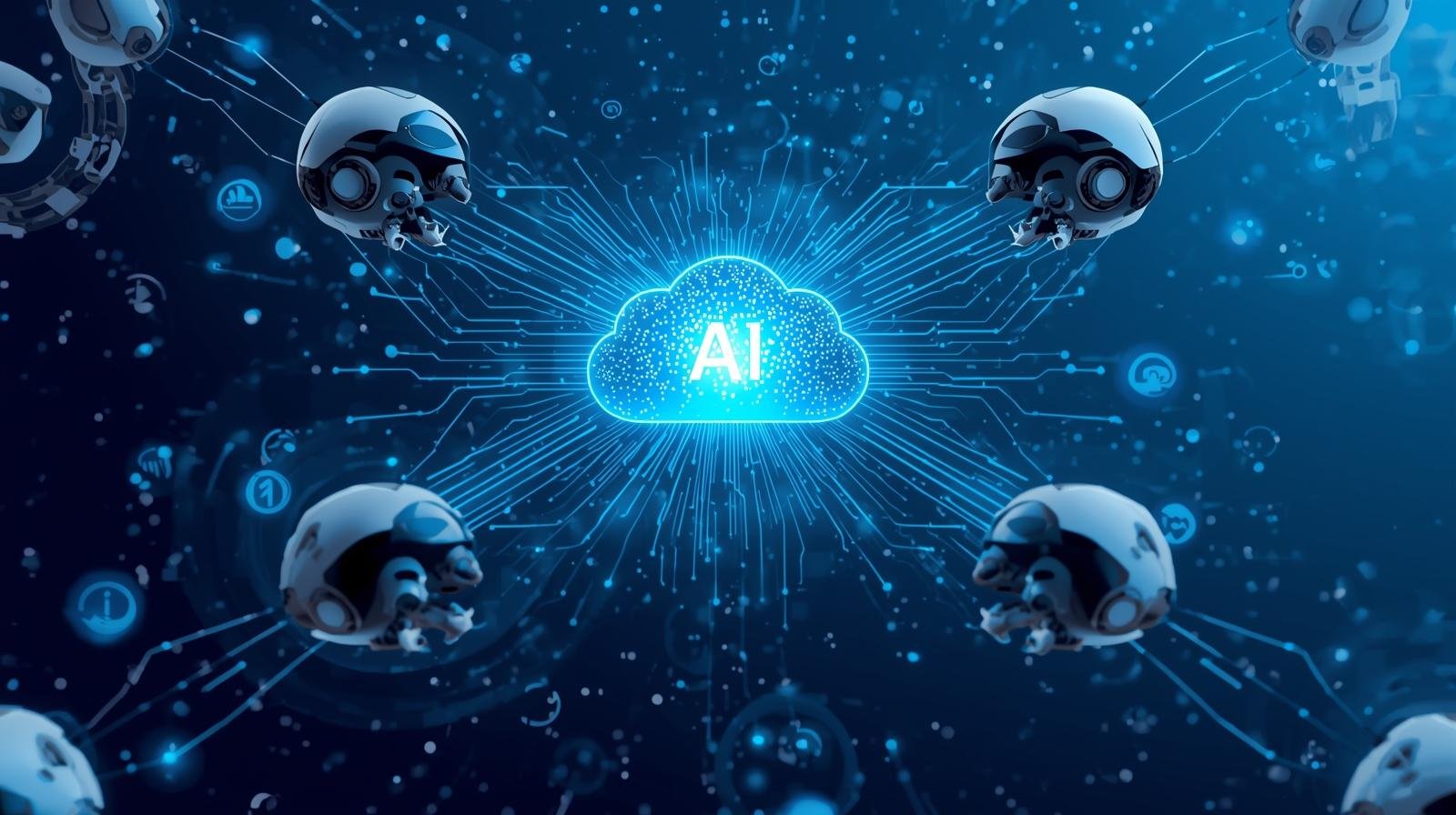
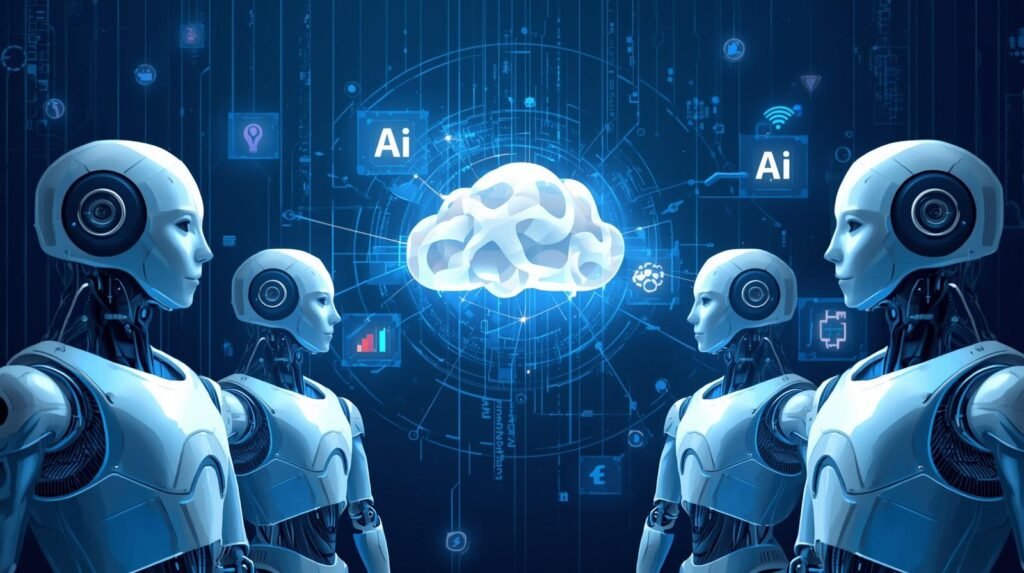
The Cloud AI uses Artificial Intelligence, which runs “in the cloud.” This means you can utilize powerful computing resources, storage, and fast processing for AI models by simply logging in to the models via the internet — you only pay for what you use, and you scale up/down based on your business’s needs.
Cloud AI enables businesses and organizations to develop applications that can identify images, understand spoken language, translate between languages, detect fraud, predict future demand, or summarize large amounts of content, all without purchasing expensive hardware. Cloud Service Providers provide pre-built services (e.g., Vision, Language, Recommendation API’s), along with managed environments to build and deploy custom machine learning models.
A typical Cloud AI workflow follows a fairly standard flow as follows:
* Collect the data you would like to utilize
* Store the collected data in a secure location
* Clean and label the collected data
* Train a model utilizing the cleaned, labeled data
* Test the trained model
* Deploy the tested model as an endpoint and have applications call the endpoint.
Distributed computing using the cloud enables a significant reduction of training time for large datasets and complex deep learning models. Cloud also greatly facilitates collaborative work on AI applications, bringing data scientists, engineers, and product development teams together in the same environment, with the same toolset and the same version.
There are also advantages to using cloud-based AI over on-site or local AI applications. For example, it is much easier to integrate into the organization’s current systems and applications.
For most organizations, cloud-based AI provides direct connections to their data warehouses, streaming tools, and/or other business applications. Therefore, the output from predictive analytics can be used immediately to identify fraud as soon as it occurs or to provide a customer with an updated inventory suggestion based on their previous purchases. In addition, organizations have access to various observability tools to measure model performance, model drift, and latency. Organizations can then use these metrics to determine whether retraining is required.
Cloud-based AI requires a company to create appropriate governance policies and procedures to protect the privacy of all customers using its cloud-based AI service. The company will have to implement measures that provide adequate security for all data processed by its AI, including (but not limited to) encryption, access controls, auditing, and logging.
In addition to implementing these safeguards, the company will need to develop policies and guidelines on how it collects and stores its customers’ private information. An organization also needs to consider responsible AI practices, which include (but are not limited to) testing for bias; involving humans in critical AI decision-making processes; and being transparent with customers about the limitations of their AI system.
#AI-Native Networks: The Essential Guide to Intelligent, Self-Driving Networks
Cloud-based AI also enables robots and IoT devices to act as if they have a “brain” in the cloud by integrating data and providing a centralized source, allowing them to offload complex computational tasks, learn from one another, and rapidly update their knowledge base.
Cloud-based AI also enables developers to deliver advanced AI capabilities to consumers at a significantly lower cost than traditional methods of developing AI-based products and services. This has allowed many small development groups to create successful products utilizing much more advanced capabilities than they were able to utilize before.
There are certainly robotic vacuum cleaners that can navigate a room. The two are intelligent and can function independently. Each vacuum cleaner learns your home’s floor plan, maps where your furniture is located (e.g., a table leg), and remembers the position of the dog’s bed. All of this information is stored on the individual vacuum cleaner’s computer and cannot be communicated to any other vacuum cleaner.
We could certainly design machines capable of processing incredible amounts of information. However, there are no super-brains that can be produced for every machine. That’s not due to the machine’s own intelligence but due to the limitations of making something like a “super-brain” feasible for machines.
The reason we don’t place a “brain” (a processor) inside a robot is that the robot needs to be self-contained in its processing capabilities. This is referred to as on-board processing, in which all calculations and decisions made by the robot are performed by a physical computer located within the robot. Just like how the tiny processor in your cell phone limits what you are able to do on your cell phone due to both power and heat generation constraints, so too does the on-board processor of a robot limit what that robot is able to do.
An AI brain is essentially a supercomputer. Because of the cost of developing and building them, their size, and the electrical energy required to run them, it would never be possible to put one of these AI brains inside a small delivery drone or in your household robot.
In that case, most standalone robots will be designed to perform repetitive, predictable tasks. If a robot encounters an unknown object (such as a new piece of furniture), it can become stuck. What if your vacuum cleaner could learn from every other vacuum cleaner on earth at any time? For instance, if another vacuum cleaner in another part of the country found the optimal route for navigating through a particularly hard-to-get-around shag rug, it would know how to navigate it without having to repeat all the mistakes it made.
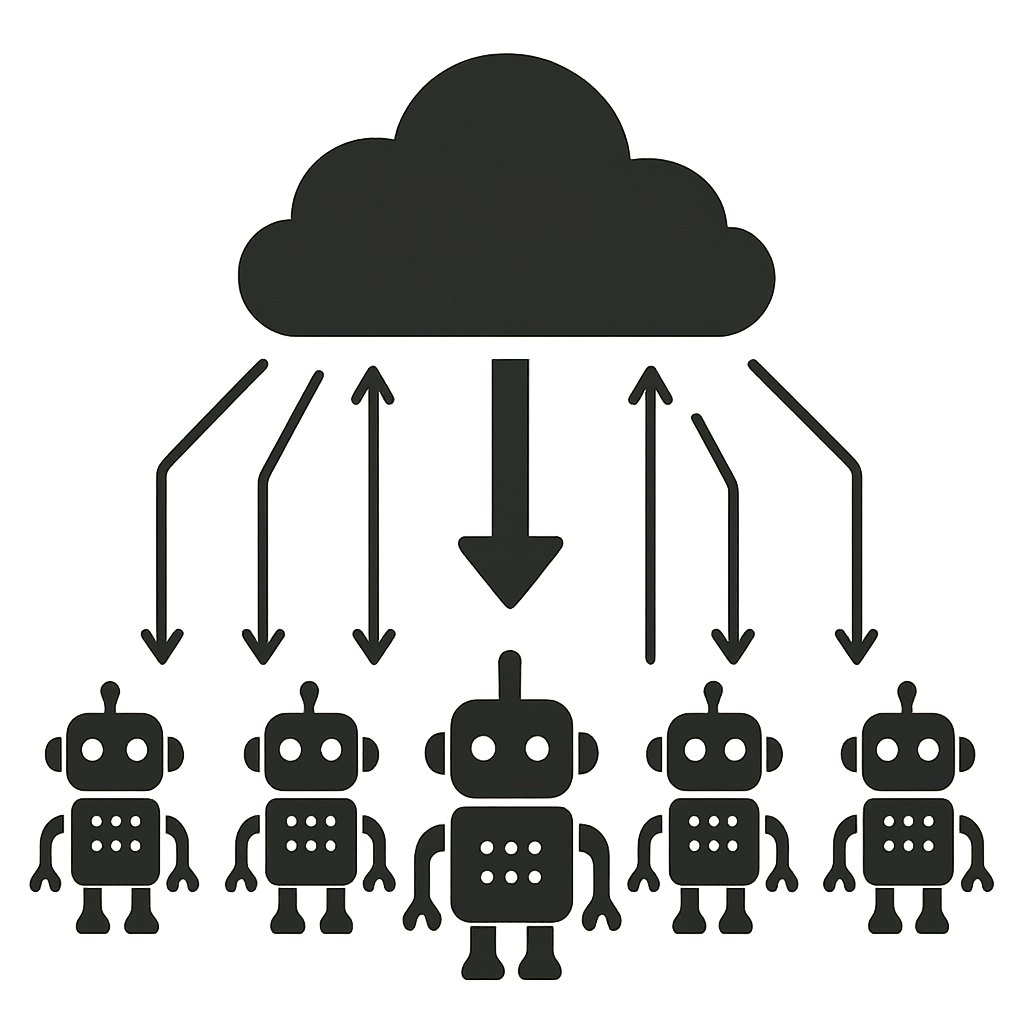
This isn’t science fiction; it is the core idea behind Intelligent Cloud AI. The idea here is that, instead of operating on its own, this system creates a large, distributed brain or “cloud”. This represents a significant leap in the way of robot learning. A single robot can create a team of many robots working together with a common goal of continually improving themselves.
Example Cloud AI
A retailer uses a cloud-hosted vision model to count shelf stock from phone photos and triggers restock alerts.
Cloud Robotics Market Growth and Adoption
| Metric | Value |
|---|---|
| Global cloud robotics market (2023) | $6.2 billion |
| Forecast market size (2030) | $32.1 billion |
| CAGR | 26% |
| Key industries | Logistics, Manufacturing, Healthcare, Agriculture |
Statistic: Cloud robotics is expected to grow rapidly due to AI advancements, edge computing, and 5G connectivity.
Source: MarketsandMarkets Report
https://www.marketsandmarkets.com/Market-Reports/cloud-robotics-market-198734864.html
Summary
“Intelligent Cloud AI: Using a Powerful Cloud Intelligence Brain to Make Modern Robots Smarter ” describes the method by which modern robots are made “smarter” by using cloud-based intelligence. Robots can now use their onboard processing to collect a subset of sensor information, map data, and rare event information (edge cases) that will then be sent to the cloud, where large-scale memory stores for all devices in the fleet exist and where more advanced artificial intelligence models can be developed based upon experience gained from numerous other robots.
The cloud can leverage the combined experience of multiple robots and perform larger-scale simulation exercises than any individual device. Also, the cloud can validate potential improvements to an existing artificial intelligence model much faster than any individual device.
Robots will still perform rapid reactions to local, safety-critical issues (emergency stop and obstacle avoidance), while the cloud performs higher-level functions, including developing models, creating global maps, performing long-horizon planning, and coordinating action among a group of robots.
Additionally, once an updated artificial intelligence model has been validated, it will be deployed back to the fleet in stages, with mechanisms to monitor its performance and, if needed, remove it due to adverse effects on overall system performance and stability.
This article also provides background on why this is important and why this technology represents value. The primary reason this represents value is that the ability to learn from one another allows all devices to improve at a rate greater than they would individually. This results in less hardware required per device.
Additionally, having a centralized location to develop new features for deployment across multiple sites increases consistency. It also points out that there needs to be appropriate oversight (governance) around security, privacy, and accountability for ensuring the trustworthiness of the “cloud brain.
What Is the ‘Cloud Brain’? It’s a Giant Digital Library for Robots
The solution to the physical restrictions on robotics is easily misunderstood as very complex; however, the solution is actually quite simple based on the fact that, instead of trying to create a more powerful artificial intelligence within every robot unit, there will be a more powerful artificial intelligence (or several) located outside of them, which will provide the intelligence through what is called a “cloud.”
When you refer to a “cloud,” do not imagine soft, white clouds floating above you. Instead, data centers around the world are large physical buildings or warehouses housing thousands of individual computers connected via the internet. Because of the enormous size of these networks, they form a global collective brain that robots can connect to and use as desired.
Imagine a huge library with an endless number of books on its shelves. Also, imagine that you have a million librarians working at this library. Each of these librarians has read every book in the library and can help you with any question as quickly as possible. Clouds serve two purposes for robots: they are both a virtually infinite store of information and a virtually infinite store of computational thinking power.
To assist in solving complex problems, a robot uses the internet to connect to a worldwide repository of thought and problem-solving capabilities in a data center, providing access to virtually unlimited intelligent problem-solving capabilities as needed. Cloud computing provides a robot with access to additional intelligent problem-solving capabilities without itself supporting those capabilities.
Cloud Intelligence: Centralized Intelligence That Enables Robots to Learn Collectively

The ability to utilize cloud intelligence allows for a collective “brain” in a warehouse (cloud-based). In contrast, local intelligence utilizes the processing capabilities of a single robot’s processor. When multiple robots are connected to the same “brain,” they can share knowledge of their experience, including visual information, successful movement patterns, and unsuccessful attempts. The cloud cleanses and categorizes the information from the robots, trains a new model based on it, and then makes that model available to the individual robots so they can use it.
As stated previously, cloud-based AI enables processing large amounts of unstructured data without the need for a “supercomputer” on each robot. With cloud-based intelligence, an entire warehouse fleet can reach the same conclusions about how to navigate the warehouse. Using the previous example, if a single robot determines that a specific type of floor marking causes wheel slip, all robots could be updated by the end of the day.
Cloud intelligence also provides training on new box types after only a handful of robots have encountered them, requiring only an update to the cloud, and all locations will receive the new policy. Cloud AI backends handle data storage, training, testing, and safe deployment of AI.
The collective learning environment created by Cloud AI also enables “experience replay,” as robots send edge-case scenarios, such as glare, dust, and crowds, to help cloud intelligence build a more comprehensive perception and planning model.
This results in faster learning curves and more predictable behaviors across devices. Cloud AI can also serve as a simulation environment, allowing robots to run millions of trials virtually before deployment in the real world. Once a better policy is identified, cloud intelligence deploys it, and each robot maintains its own local reflexes for immediate safety stops.
In addition to being able to react in real time, robots do not need an internet connection at every decision point. The robots run lightweight versions of the models on the device so they can respond quickly and, as needed, sync with the cloud using the available bandwidth. Updates can also be phased – first released to a few test devices, then to the entire robot fleet after testing.
This hybrid approach provides the speed of deploying the robot software (rapidly), the learning opportunity provided by collecting data from each individual robot, and also ensures the safety of each robot via human oversight in massive quantities – regardless of the location of the robot – and whether or not there is a stable WiFi connection to the robot – and/or the robot’s usage of resources (down time).
To ensure that the cloud intelligence on each robot is trusted, teams using this kind of cloud-based intelligence must have a solid governance model (including, but not limited to, encryption, access controls, and auditing) as well as clear policies for what types of sensor data are stored locally versus sent to the cloud.
In addition to those, teams must develop methods to monitor and track each robot’s cloud intelligence performance so that when an update negatively impacts functionality, they can roll it back quickly. When these needs are met, the set of previously autonomous robots becomes a coordinated learning network. Ultimately, Cloud Intelligence becomes a “Shared Brain” among all of the robots, allowing each robot to increase its intelligence with each new version.
Example for Cloud Intelligence
Cleaning robots in multiple airports upload obstacle maps; the cloud merges them overnight and pushes improved routes to every robot.
The “Collective Learning” Effect in Cloud Robotics
| Learning Stage | What Happens | Impact on Robot Network |
|---|---|---|
| Robot performs a task | Robot encounters a new environment | Generates training data |
| Data uploaded to the cloud | Data stored in a shared cloud model | Central AI improves the algorithm |
| Model retrained | Updated AI model created | Better navigation or decision making |
| Model deployed | Update pushed to all robots | Every robot learns instantly |
Example: If one warehouse robot learns a better path, the improvement can be distributed to thousands of robots worldwide.
Source: Google Cloud Robotics Research
https://cloud.google.com/robotics
AI in Cloud: Running Advanced Artificial Intelligence Directly on Cloud Platforms

Cloud-Based AI allows you to run complex AI applications (models) on Cloud Platforms that have both the Data and the Computing Power to process them. Running your AI application(s), Data, Storage, and Tools for Management all in one location allows for On-Demand access to GPU’s, managed tools, secure storage, etc., instead of having each device or Office Server be responsible for Heavy Processing.
Therefore, Cloud-Based AI is now becoming a Practical Way to Deploy Modern AI Capabilities because it provides an Easy and Rapid Path to Deployment.
Real-World Projects using AI in the Cloud encompass the Entire Lifecycle of AI, including Data Collection, Data Preparation, Model Training, and Deployment as Scalable Services. Additionally, AI in the Cloud provides a mechanism for Models to be exposed via API’s, allowing Apps to call these Models for Image Recognition, Speech-to-Text, Search, Recommendations, Forecasting, and Document Understanding. With Cloud AI, Organizations can scale from a small pilot to Millions of requests without needing to rebuild the System.
Additionally, AI in the Cloud is particularly valuable when dealing with Large Volumes of Data or Data that Changes Quickly. Streaming Pipelines can pull new events into Feature Stores, and Automated Workflows can Retrain Models on Schedule. AI in the Cloud can also Host Simulations and Testing Environments to Evaluate Accuracy and Reliability Before Users Apply Updates. Lastly, for Teams, Cloud AI Reduces the Operational Burden of Managing Infrastructure, Patching Servers, and Provisioning Capacity.
The rules that govern how things are managed and protected through secure practices will still exist. The AI running in the cloud will encrypt data (i.e., make it unreadable), implement role-based access control, maintain audit logs of all actions taken on the system, and enforce retention policies that define what information the AI is permitted to store. Teams must also monitor for model drift, latency, and failures, and plan to roll back changes if the model does not function as expected upon initial deployment. Through effective monitoring, AI in Cloud enables responsible deployment practices and provides the means for your systems to be maintainable.
In robotics or any other edge computing devices, AI in Cloud will serve as the primary “brain” for model training and model coordination. However, the most important safety function will always reside with the device itself. Devices at the edge of the network can send edge-case data to the cloud and then receive updated models from the cloud that can be applied directly to those same devices. Thus, AI in the cloud will enable new and innovative features across a greater number of products rapidly and easily, and there is no longer a requirement that each endpoint be a high-performance computing device.
Example for AI in the Cloud
A hospital runs a HIPAA-compliant triage model on managed GPUs, auto-prioritizing radiology studies and sending results to the PACS via API. Together, these show how centralized compute, shared learning, and cloud deployment turn separate devices and apps into continuously improving systems. It reduces hardware costs, accelerates updates, and ensures consistent performance across sites and teams.
A factory collects vibration data at the edge, then trains a failure-prediction model in the cloud and deploys lightweight inference back to machines. Intelligent Cloud Computing keeps costs down by right-sizing GPUs and shutting idle resources. Cloud AI Services add new capabilities quickly, while Cloud AI delivers custom models when needed across teams, regions, and compliance boundaries with audits.
Cloud-Based AI: AI Systems Operating Remotely Using Shared Cloud Resources
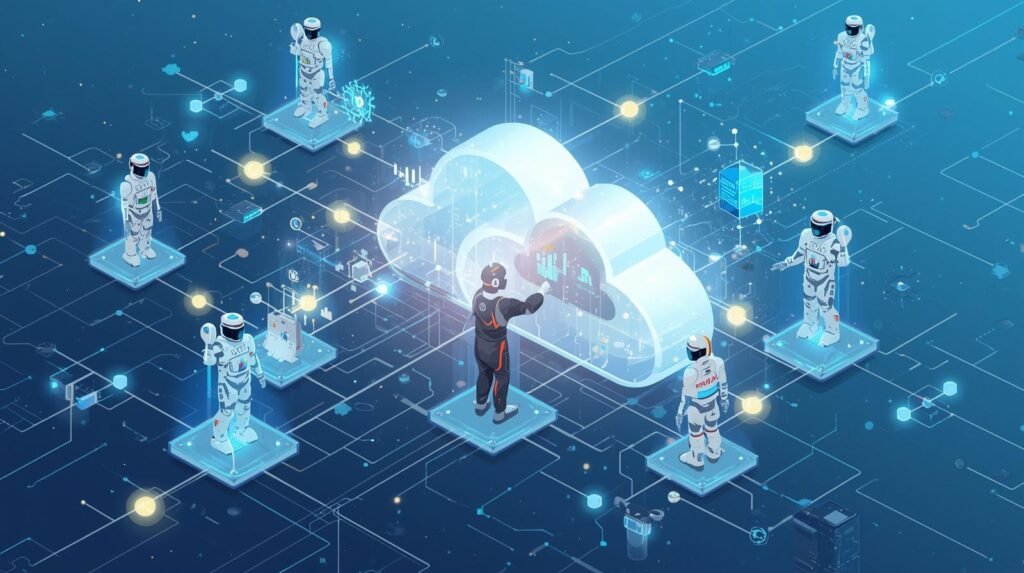
Cloud-based AI describes how AI systems are hosted and delivered from remote environments with support from cloud computing and storage resources and/or cloud-managed services, and does not rely entirely upon one (1) on-premises device. A major advantage of cloud-based AI is that organizations can leverage complex models and massive computational power to achieve business goals without purchasing, installing, or maintaining their own proprietary hardware. Typically, cloud-based AI systems are accessible through a cloud AI platform, which offers pre-built APIs and tools that allow users to create customized solutions.
A key advantage of cloud-based AI is its high scalability. When demand for processing increases (e.g., when an organization experiences a sudden influx of customer chat requests, image uploads, or sensor data), the system’s processing capacity can automatically scale up and down as demand returns to normal.
With cloud-based AI, organizations find it simpler to deploy applications across geographically dispersed locations by using the same model across all regions simultaneously and delivering the same update to each location. Many organizations have found that using cloud AI systems allows them to prototype new products more quickly and bring them to production more quickly.
Most cloud-based AI systems involve data ingestion (taking input), secure data storage, data preparation (cleaning and formatting), model training, testing, validation, and deployment. Applications using a cloud-based AI system call the model over a network and receive the result(s) nearly instantaneously. Cloud-based AI can also assist in continually improving an AI model’s performance by retaining results each time the model is called, monitoring for changes (drift), and retraining the model periodically based on new data. Engineering teams will benefit from using cloud AI, as it removes the burden of managing GPU, driver, and scaling policy issues.
Cloud-based AI refers to AI systems running in external locations that utilize cloud computing, cloud storage, and managed services, rather than relying entirely on a single on-site device. The biggest advantage of cloud-based AI is that companies can leverage advanced models and immense processing power without purchasing, installing, or maintaining their own private hardware. Cloud AI systems are typically delivered via cloud AI platforms that offer pre-built APIs and tooling, enabling users to create customized solutions.
One of the primary advantages of employing cloud-based AI is the ability to scale processing power on demand. If an organization is experiencing an influx of processing requests (e.g., increased customer interactions via chat, increased upload of images, etc.) the system will automatically increase its processing capabilities and return to normal usage levels when demand decreases. The global deployment of applications is also facilitated by cloud-based AI, as a single model can be deployed across multiple geographic regions simultaneously and receive the same updates. Organizations are increasingly using cloud AI platforms to rapidly build prototypes and get them into production sooner than they would if building and deploying on-premises.
The operation of most cloud-based AI systems includes data ingestion, secure data storage, data preparation, model training, model testing/validation, and model deployment. With a cloud-based AI system, the application calls the model over the network and receives results in near real time. Additionally, cloud AI provides opportunities for continuous improvement by tracking the results of every model invocation, monitoring for model drift, and periodically retraining models on new data. Cloud AI Systems provides Engineering Teams with relief from the burdens of managing GPUs, Drivers, and Scaling Policies.
Intelligent Cloud Computing: Computing Systems That Adapt, Learn, and Optimize Automatically

Intelligent Cloud Computing involves a dynamic, self-adapting, self-learning, and self-optimizing system for both hardware and software that responds to environmental changes. The use of Intelligent Cloud Computing relies on a combination of dynamic, flexible cloud infrastructure, automation, real-time monitoring, and machine learning to enable the platform to continuously optimize performance, cost, and reliability with minimal or no end-user interaction.
Cloud AI is a primary driver of Intelligent Cloud Computing technology. Cloud AI enables pattern identification, anticipation of future demand, and improved resource allocation.
Applications using Intelligent Cloud Computing can proactively increase capacity before an anticipated usage spike, rather than reacting to a slowdown. Additionally, Intelligent Cloud Computing enables platforms to distribute workloads across multiple geographic locations, select the fastest available communication path, and adjust caching behavior to minimize latency.
With cloud AI, Intelligent Cloud Computing platforms can use both historical trends and real-time data to predict usage levels and thus allocate compute resources to maintain consistently high response times. In addition to predictive analytics, Intelligent Cloud Computing can support self-healing processes. For example, if an application experiences degradation, the Intelligent Cloud Computing process will allow the platform to restart failing components, redirect traffic from them, or revert to a previous deployment of the application.
Intelligent Cloud Computing platforms can enhance security by continuously detecting threats using multiple methods. Logs, network signals, and identity-related events can be used by cloud AI to detect anomalies, isolate potential malicious activity, and suggest policy changes. In addition, Intelligent Cloud Computing supports the automatic implementation of policies for Least Privilege Access, Credential Rotation, and Configuration Drift Verification to prevent the impact of human error on security.
Intelligent Cloud Computing is the most important feature to reduce your costs. One major benefit of using Intelligent Cloud Computing is the ability to dynamically resize instances, reduce job costs, and eliminate unused resources. Another great feature of Cloud AI is that it lets you track how you are wasting money (e.g., provisioning extra clusters or not using the correct storage tier) and then fixes it for you. Using Intelligent Cloud Computing lets you choose which resource type to use for a job based on cost or performance (e.g., CPU, GPU).
Cloud AI greatly simplifies the pipeline for creating data & AI projects by automating the scheduling of training jobs, managing all experiment jobs, and monitoring all models after deployment. Additionally, Cloud AI will automatically retrain models if the data used to train them changes, and it includes guardrails and approval workflows to ensure safe updates. So, in total, Cloud AI provides an Adaptive “Autopilot” Layer in the Cloud that uses Cloud AI to continue learning from Telemetry, Optimize Operations, and Keep Systems Running Fast, securely, and efficiently.
Example for Intelligent Cloud Computing
A streaming app predicts peak traffic and auto-scales pods, caches, and bandwidth before latency rises.
Cloud AI Services: Scalable AI Tools Delivered Through Powerful Cloud Infrastructure
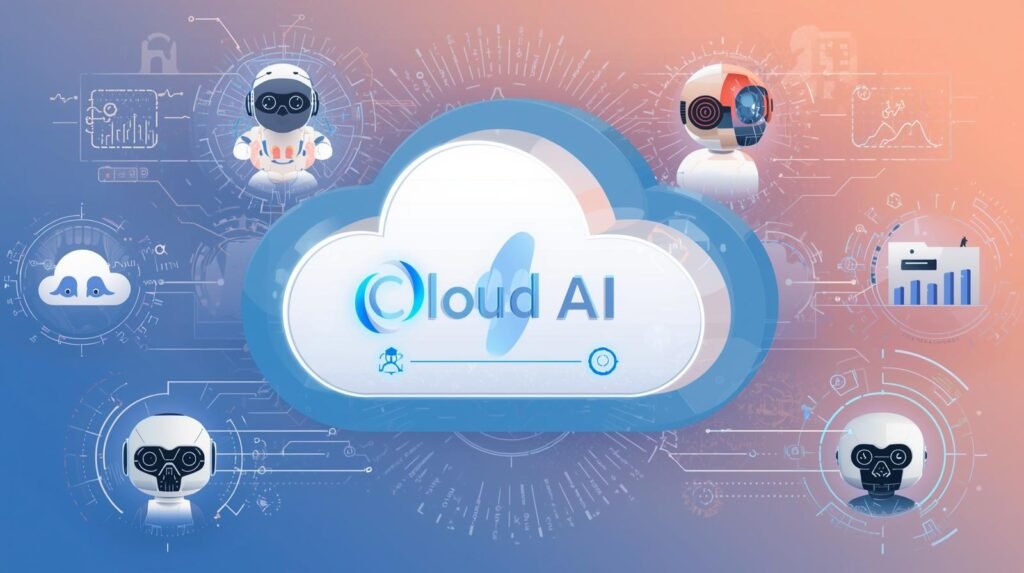
Cloud AI Services are scalable AI tools that leverage cloud-based systems, enabling organizations to develop intelligent solutions for their business needs. Organizations that utilize Cloud AI Services have access to numerous AI-powered features and capabilities, such as image recognition, voice recognition, language translation, document scanning and processing, recommendation engines, and predictive forecasting. All these features can be accessed with ease through an Application Programming Interface (API).
The elasticity of scaling is one of the greatest benefits of Cloud AI Services. This means that when an increase in traffic occurs, whether it is due to a seasonal fluctuation in usage (i.e., holiday shopping) or a large event (i.e., a new product launch), the Cloud AI Service will automatically scale up to handle the spike in requests and then scale back down when the demand decreases. Therefore, Cloud AI Services can be used for both small-scale pilots and high-traffic applications. In addition, since the cloud provider manages the provisioned specialized hardware, responsibility for its management and support falls to the provider, not the organization.
When using Cloud AI Services, data is generally collected, stored, secured, and processed; models are selected from existing libraries or customized; and results are delivered to the application in real time. If the available off-the-shelf model does not provide the required level of accuracy, Cloud AI can be used to customize and fine-tune it to better suit your organization’s needs. Once deployed, Cloud AI Services provide performance metrics (such as latency, error rate, and throughput) to help the development team ensure that the end-user experience remains consistent and reliable.
There is still an importance to governance. When using Cloud AI Services, you should have developed policies to control access, encrypt your data, audit all data interactions, and retain data. There may be more regulatory requirements depending on how you plan to use Cloud AI for high-risk applications or very sensitive information, such as a bias check, human review of results, etc., before you roll out any new application with a new model.
Versioning and staged deployments provided through Cloud AI Services allow teams to test and validate changes before deploying to production.
For robotics, IoT, and enterprise automation, Cloud AI Services can provide a “shared intelligence” layer for devices to send data (and edge cases) to cloud-based models that improve over time. Once models are validated, updates can be deployed to multiple endpoints. In this context, Cloud AI is the engine room that provides standardization, scalability, and ease of maintenance for AI capabilities across all your products and teams.
Example for Cloud AI Services
A call center plugs in speech-to-text and sentiment APIs to coach agents in real time, without training models.
How Robots Use Cloud AI Architecture (System Layers)
| Cloud AI Layer | Key Technology | Robot Function Enabled |
| Edge Gateway | Edge computing nodes | Filter and compress sensor data |
| Device Layer | Cameras, LiDAR, sensors | Collect real-world data |
| Cloud AI Platform | AI training, Large models | Analyze images, objects, and navigation |
| Knowledge Database | Shared learning models | Store robot experiences |
| Control API | Robot cloud services | send optimized actions back to robots |
Example: Autonomous robots upload sensor data to cloud platforms, where AI models analyze the environment and send back improved navigation decisions.
Source: IBM Cloud Robotics Architecture
https://www.ibm.com/cloud/learn/cloud-robotics
AI Cloud Integration: Seamless Integration of AI Models with Cloud Environments

There is still an importance to governance. When using Cloud AI Services, you should have developed policies to control access, encrypt your data, audit all data interactions, and retain data. There may be more regulatory requirements depending on how you plan to use Cloud AI for high-risk applications or very sensitive information, such as a bias check, human review of results, etc., before you roll out any new application with a new model.
Versioning and staged deployments provided through Cloud AI Services allow teams to test and validate changes before deploying to production.
For robotics, IoT, and enterprise automation, Cloud AI Services can provide a “shared intelligence” layer for devices to send data (and edge cases) to cloud-based models that improve over time. Once models are validated, updates can be deployed to multiple endpoints. In this context, Cloud AI is the engine room that provides standardization, scalability, and ease of maintenance for AI capabilities across all your products and teams.
AI Cloud integration must include security and governance right from the time of deployment. By using AI Cloud integration, the organization will implement the most secure environment possible by enforcing least-privilege access, encrypting all data in transit and at rest, maintaining audit logs, and defining a clear retention policy for both training and inference data.
The organization must allow for human oversight of model decision-making and bias analysis, and clearly document the model’s limitations if its decisions are likely to have a significant impact on the organization or its customer base. Using cloud AI in no way diminishes the organization’s obligation to establish and adhere to the aforementioned elements; however, it provides a much more robust framework for compliance.
In general, when properly implemented, AI Cloud integration gives an organization a reliable AI capability that is not a fragile add-on to its current technology infrastructure. The flexibility of Cloud AI allows organizations to connect their models to other business applications, safely upgrade them, and ensure their continued reliability in response to changes in traffic, data, and application requirements.
How a Robot ‘Talks’ to Its Cloud Brain in Three Simple Steps
Robots at street level communicate with computers remotely via information exchange. The two devices don’t have a conversation – rather, they quickly exchange data about the robot’s environment. This essentially illustrates how robots use cloud computing to navigate the real world.
The entire operation is based upon a simple three-stage cycle.
For example, if you’re on your way home with your delivery robot and it encounters a tree that has fallen across the road in front of it – instead of hitting the tree, or stopping to determine how to go around it — the robot will follow the three basic steps outlined below to create a solution.
Step 1. Identify the Issue (Data from Sensors) The robot collects information regarding the issue via sensors – camera systems as eyes, scanner systems as touch – to capture a digital picture of the obstruction and identify its size and position. The captured information constitutes raw data.
Step 2. Phone A Friend (Sending Data To The Cloud). Next, the robot sends the information package to the cloud supercomputer, the cloud brain, via the Internet. The Internet provides a high-speed path to send the robot’s “What should I do?” query to the cloud.
Step 3. Getting The Answer (Cloud Instructions). In less than one second, the cloud-based AI analyzes the digital image the robot has sent in and determines what the object is that the robot is looking at, based on the image of the downed tree, and responds to the robot with an easy-to-follow instruction: “stop, turn around, and try the next street.”
The robot doesn’t need to be familiar with trees; it simply follows the instructions received from the cloud. The cloud is performing the heavy lifting in the robot’s decision-making. This aspect of the technology is the most revolutionary in how the cloud processes the answer next.
The Real Magic: How One Robot’s Mistake Makes Every Robot Smarter
The solution to the downed tree does not just vanish. Instead of treating this as a one-time solution for a specific machine, the cloud AI will treat it as valuable knowledge and experience. At this point, the shared brain really starts to show off its intelligence by turning a collection of individual machines into a single, smart system. In essence, this is the difference between one person learning from a problem versus an entire category of problems being learned from by an entire species of machines instantaneously.
This is how this system works. It functions much like a “hive mind” versus a single intelligent machine. One machine’s experience has become the collective knowledge of all machines. With the central AI learning about the downed tree, it updated its complete model of reality with this new knowledge. So, if the next machine in the fleet encounters an identical object (in a completely different city, a week later), the shared brain knows the solution and can immediately tell the machine to go around the downed tree.
Therefore, we have created a system that is continuously learning on its own. Every delivery, obstacle, and unanticipated problem makes the network more efficient and reliable, without requiring a human to program each machine separately again. Each machine is a part of a larger, constantly learning team.
Where You Can See This ‘Hive Mind’ in Action Today
The “hive mind” is evolving through autonomous driving systems. Vehicles equipped for self-driving will use learning to improve their navigation and operation. For example, when one vehicle successfully traverses an unmarked, dangerous intersection, it transmits the information to a central cloud-based system, which assesses the data and relays the lesson learned to every vehicle that uses that intersection.
The same type of learning is occurring during your online shopping experience. Thousands of robots within a massive warehouse are working together. An artificial intelligence operating in the cloud is serving as a “traffic controller” in real time, adjusting each robot’s path to prevent collisions and congestion. Whenever a robot discovers a new route or method of travel, it shares that information with all robots in the warehouse, allowing them to benefit from a single robot’s discoveries.
Small, wheel-mounted delivery robots are beginning to appear on city streets. Due to their size, these robots lack sufficient onboard computing capacity to navigate their environment. As such, they operate connected to the internet cloud, providing access to all computing capabilities. These robots also share important knowledge (i.e., the safe and efficient crossing of a broken curb) with all other robots connected to the network.
Cloud vs. Local Brain: When Do Robots Need to Think for Themselves?
In other words, if an intelligent robot loses its internet connection, will it shut down? No, it will not. The same holds true with your own brain. Deep thinking is required for advanced problem-solving; however, you do not need to “think” or “reflect” to remove your hand from a hot stove. This is called a reflex, a rapid, automatic response hardwired into your body to protect you. Intelligent robots are essentially similar to humans.
Why does it seem like we need to design reflexes into our intelligent robots? Sometimes, time can literally be a killer. For instance, in the case of a self-driving vehicle, there may not be enough time for the onboard computer to send out a request to a remote data center and then wait for a response before a child darts into the street. Therefore, the onboard computer must quickly decide whether to activate the brakes. In those kinds of emergencies, the local “reflex” brain reacts faster than the more powerful cloud-based brain.
When the robot can process information rapidly and make quick decisions, this is referred to as edge computing —the processing happens at the “edge” of the network, rather than on a more distant cloud. Rather than a competition between the two brains, it’s a collaboration. The local “reflex” brain manages emergency responses, while the more powerful cloud brain processes the bigger picture, learns from experience, and helps make the entire system smarter over time.
Cloud Brain vs Local Brain Decision Model
| Scenario | Local Robot Brain | Cloud AI Brain |
|---|---|---|
| Obstacle detection | Immediate Local processing | Not required |
| Path Optimization | May use cached map | Cloud computes optimal route |
| Object recognition | Limited onboard AI | Cloud deep-learning model |
| Fleet coordination | Not possible locally | Cloud manges multiple robots |
| Learning new tasks | Limited | Cloud trains models using global data |
Insight: Robots often combine edge AI (local decisions) with cloud AI (global intelligence)
Source: NVIDIA Cloud Robotics Guide
https://developer.nvidia.com/robotics
How Super-Fast 5G Is the Fuel for Smarter Cloud Robots
To successfully implement a Cloud Brain Strategy, the relationship between the Robot and Cloud must be seamless. A slow or choppy internet connection is like having a serious video phone call with a terrible connection; constant freezing and lag make real-time communication nearly impossible. Since the robot must receive instructions instantly, this digital lag could easily determine whether a strategy is successful or unsuccessful.
This is where Fifth-Generation wireless technology (5G) will greatly enhance the robot’s ability to connect to the cloud. One of the major advantages of 5G is the dramatic decrease in communication “lag” when compared to prior generations of wireless technology. With 5G networks, the time it takes for a signal to go from the robot to the cloud and back is almost negligible. The speed of communication, from sending a letter to engaging in an instantaneous conversation, illustrates the responsiveness of a 5G network with extremely low latency.
The data transfer speeds of 5G networks enable an unprecedented range of new capabilities for users. For example, think of remote surgery, where a surgeon in one city uses a robotic arm to operate on a patient thousands of miles away. Every surgeon’s movement has to be sent to the robotic arm, and the robotic arm must execute each movement instantly. This is the exact same type of responsiveness that a 5G network with extremely low latency was developed to support.
Overall, a 5G network with reliable connectivity makes a “Cloud Brain” for mobile robots feasible. As long as there is a reliable connection, the robot itself can be a simple, lower-cost device and need only receive a continuous, stable signal to connect to a common, collective intelligence.
Real-World Examples of Cloud-Powered Robots
| Company | Robot System | Cloud AI Role |
|---|---|---|
| Amazon Robotics | Warehouse robots | Cloud coordinates navigation and logistics |
| Tesla | Autonomous vehicles | Cloud collects driving data to train AI |
| Boston Dynamics | Industrial robots | Cloud analytics improves robot performance |
| Alibaba | Delivery robots | Cloud routing and traffic analysis |
Example: Amazon warehouse robots operate using a centralized cloud system that optimizes routing across thousands of robots simultaneously.
Source: MIT Technology Review-Cloud Robotics
https://www.technologyreview.com
The Future Isn’t Owning a Robot—It’s Subscribing to One
A robot, however, is so much more than just a smart self-sustaining device; it has a virtual umbilical cord – that is, a link to a large, common, cloud-based “brain” that provides shared, collective intelligence to assist the robot’s decision-making.
Robots that communicate with each other through the cloud are producing a new type of user for advanced robots, using a model called Robotics-as-a-Service (RaaS), which works similarly to how you might subscribe to Spotify or Netflix. In both cases, there is no need to purchase every song or movie; instead, you can sign up for a subscription plan to access all available songs or movies.
Similarly, a small business that cannot afford a fleet of expensive delivery robots may simply “sign up” for the RaaS service. Because the robots operate in the cloud, they are automatically updated with the latest software and collectively share their experiences/knowledge from the entire network, providing instant effectiveness.
As such, the stand-alone robot era will give way to the era of connected intelligence. The next time you see a robot, instead of asking “what does it do?” ask yourself, “Is it thinking on its own, or is it part of something greater?” And now you have the opportunity to appreciate the significant difference.
My Thoughts
robots with local reflexes plus a shared cloud brain that learns for the whole fleet.
Open with a vivid scenario: one delivery robot slips on a new type of wet floor sealant. It doesn’t just recover—it uploads the event (sensor clip, wheel torque, surface estimate, recovery actions) to the cloud. Overnight, the cloud brain aggregates thousands of similar near-misses from other robots, runs simulation replays, updates the traction and path-planning models, and ships a verified micro-update. By morning, every robot in the city avoids that hazard—even ones that have never encountered it.
Structure the piece around four layers of the cloud brain:
- Fleet memory (shared experiences and edge cases)
- Skill factory (training, simulation, and evaluation pipelines)
- Decision studio (high-level planning, map fusion, task allocation)
- Safe rollout (canary updates, monitoring, rollback)
Highlight the key tradeoff: robots keep safety-critical actions on-device, while the cloud handles heavy learning and coordination. End with what makes it “intelligent”: continuous feedback loops, measurable improvement, and governance (privacy, security, and update safety).
Conclusion
Intelligent Cloud AI has already begun to transform how we use AI in robotics by creating an intelligent “Cloud Brain” for all connected robotic units, which leverages the cloud to learn much faster than individual units.
The “brain” of this type of system is powered by aggregating data from multiple devices, enabling the cloud to identify patterns, retrain models, and enhance navigation, perception, and decision-making capabilities across the entire fleet. While maintaining the reflexive responses required for immediate safety on each individual unit, all heavy computational burdens, simulation requirements, and coordination issues are handled remotely via the cloud.
This offers the greatest benefit: a common learning experience across an organization through collective knowledge sharing. One unit’s learning experiences become lessons learned by all units. This allows for accelerated development time, reduced resource usage per robotic unit, and enables organizations to deploy consistent updates across all locations. Additionally, Intelligent Cloud AI enables continuous improvement through performance monitoring, detection of environmental changes (drift), and model refreshment based upon those changes.
FAQs
1) What is “Intelligent Cloud AI” in robotics?
It’s a setup where robots use cloud computing to store shared data, train/improve AI models, and coordinate tasks across many robots, while still running key controls on the robot itself.
2) Do robots need the internet to function all the time?
No. Safety-critical actions (like stopping, avoiding obstacles, and basic navigation) are typically handled on-device. The cloud is mainly used for heavy training, updates, analytics, and fleet learning.
3) What does the “cloud brain” actually do?
It aggregates fleet data, builds better maps, runs simulations, retrains perception/planning models, and then distributes validated updates to robots through controlled rollouts.
4) What are the biggest benefits of a cloud brain?
Faster improvement from shared learning, lower hardware requirements per robot, easier scaling to large fleets, and consistent updates across locations.
5) What are the main risks and how are they managed?
Risks include exposure of sensitive information, security breaches, and the widespread spread of faulty updates. Mitigations include encryption, access controls, audit logs, data minimization, extensive testing, staged deployments, and rollback capability.

Garikapati Bullivenkaiah is a seasoned entrepreneur with a rich multidisciplinary academic foundation—including LL.B., LL.M., M.A., and M.B.A. degrees—that uniquely blend legal insight, managerial acumen, and sociocultural understanding. Driven by vision and integrity, he leads his own enterprise with a strategic mindset informed by rigorous legal training and advanced business education. His strong analytical skills, honed through legal and management disciplines, empower him to navigate complex challenges, mitigate risks, and foster growth in diverse sectors. Committed to delivering value, Garikapati’s entrepreneurial journey is characterized by innovative approaches, ethical leadership, and the ability to convert cross-domain knowledge into practical, client-focused solutions.