















Imagine you’re standing in front of an endless conveyor belt for 8 hours, looking for a single misplaced stitch on a pair of jeans out of a thousand. That’s a recipe for mistakes. Factory floors are home to some of the most commonly manufactured goods, including clothing, electronics, and vehicles; however, the human mind can only withstand so much repetition before its ability to work is severely impaired, thereby presenting the biggest obstacle to manufacturing processes.
Research conducted by industry has shown that even when workers are extremely focused, they will dramatically lose inspection accuracy after only a few hours inspecting the same products. There is also the element of subjectivity associated with manual inspections. An item may be viewed as a non-hazardous defect on a soda can by one person but as a serious flaw by another. Therefore, it becomes nearly impossible to ensure that every product leaving the assembly line meets the same quality standards.
Manual inspection of products also creates a bottleneck in the manufacturing process; the production rate is essentially determined by how fast a human can visually inspect each product. Is there a method that can exist where a product can be viewed, and understand what “perfect” is, 24/7, with no fatigue? A new form of smart AI technology is now available, making this possible and changing the way people discuss AI Quality Control vs. Manual Inspection, enabling manufacturers to create products of perfect quality at production rates previously unattainable.
Summary
Smart, innovative artificial intelligence is now being employed to enhance the quality inspection processes in many industrial facilities. A traditionally manual inspection process has been converted into an efficient one that uses computer vision and sensor data to detect defects as early as possible. Additionally, this method will identify variances that humans might miss and create a consistent quality inspection standard across different shifts and locations.
The AI in this inspection process will link quality inspection results to factors in the manufacturing process (e.g., machine parameters, tool conditions, raw materials, and environmental conditions). The quality team will be able to identify the source of the defect and correct it before it escalates to a larger issue.
The description above illustrates how smart factory technologies and the Industry 4.0 interconnectedness of equipment, inspection stations, and enterprise systems provide full traceability and automate workflow. The continuous flow of data within intelligent manufacturing systems produces actionable information and enables manufacturers to implement changes in a closed loop, optimize their scheduling processes, and reduce machine changeover time. Predictive maintenance contributes to quality control by enabling manufacturers to anticipate when potential equipment failures are likely to occur, thereby preventing nearly all defects caused by equipment failure.
Overall, the article defines some “practical” advantages of employing smart manufacturing systems (including: reduced scrap/rework, reduced customer complaint/return rates, enhanced documentation of compliance, and increased stability of production), however, it acknowledges that the success of such systems depends upon reliable data collection, reliable sensor usage, adherence to good cyber security practices, and clearly defined operating procedures.
AI Improves Manufacturing Quality: detecting defects early, reducing errors, and ensuring consistent product standards through intelligent automation
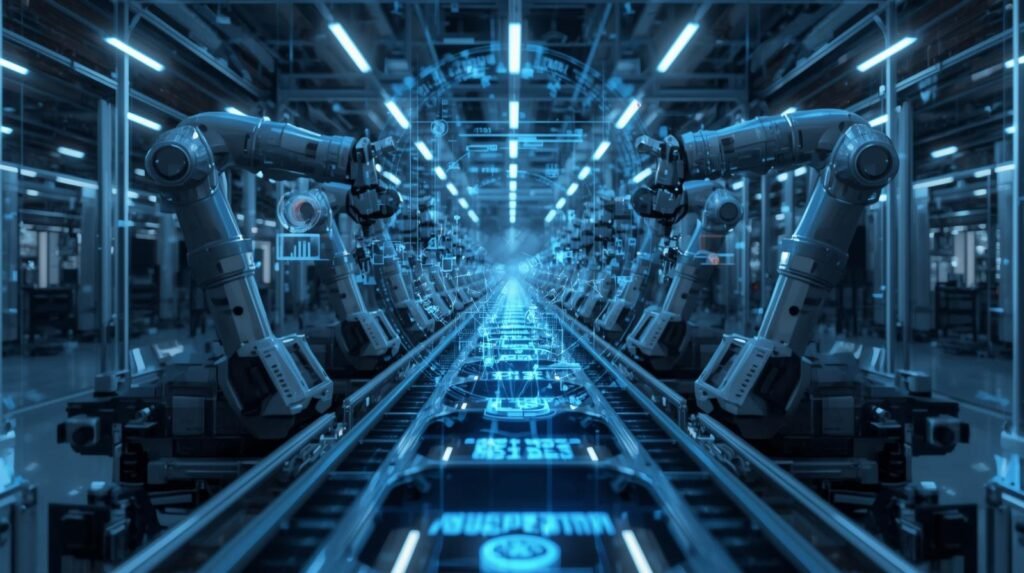
AI Makes Production Smoother by Finding Defects Early Every Time. AI improves manufacturing quality more smoothly by finding defects earlier rather than later. Instead of only detecting defects after the product has completed manufacturing, AI improves quality at each phase of production. Most defects start as small, almost undetectable variations in manufacturing processes. A dulling of a cutting tool, a slight variation in a fixture, a shift in temperature or humidity, or a new batch of materials behaving differently than expected can cause a defect to form.
Traditional ways to inspect for defects include manual inspections, periodic sampling, or reviewing products after they have been manufactured. These traditional methods of inspecting products may not detect early signs of a defect forming. As a result, by the time a defect becomes apparent, several other products may already be defective and scrapped, reworked, or delayed, or may pose additional risks to customers. AI detects these early, almost imperceptible differences and eliminates them from causing future problems.
#Revolutionary and Reliable Predictive Maintenance in Automation: What It Is and Why It Matters
AI improves manufacturing quality by continuously and reliably monitoring all aspects of production. AI models for computer vision use images captured by line cameras to validate part dimensions, alignment, surface finish, weld patterns, labeling, and part assembly. These models can detect scratches, dents, debris, missing components, misorientation, and aesthetic flaws as fast as they are produced. Since AI checks 100 percent of production units, the “gap” left by sampling (for intermittent defects that occur only in specific machine settings) is eliminated. Thus, AI improves manufacturing quality at scale, so fewer defective items reach the customer.
Another significant benefit of AI in this area is consistency. Human inspectors vary based on their level of fatigue, when they start work, the light levels they have available to them, and how they interpret standards. AI uses consistent criteria to evaluate all items it inspects. Therefore, AI helps plants apply the same standards for accepting products across multiple lines, facilities, and vendors. The repeated, objective evaluations demonstrate how AI improves manufacturing quality.
The most impactful function is that of linking inspection results to process data. As defect rates increase, the system correlates this with upstream data (spindle speeds, feed rates, torque signatures, vibrational patterns, oven temperature signatures, specific material lots). These correlations shorten the time required to complete a Root Cause Analysis (RCA) and enable Corrective Action before defect propagation; the manufacturer adjusts setpoints, recalibrates sensors, replaces worn-out tooling, or initiates maintenance activities.
In these instances, AI improves manufacturing quality not only by detecting defects but also by preventing future occurrences.
For AI-based inspection systems to be reliable, manufacturers pay attention to several fundamental requirements, including:
1. Stable lighting and camera placement.
2. Clear definitions of what constitutes acceptable variation.
3. Representative training data (for example, rare defect types).
4. Continuous monitoring to ensure performance does not degrade due to product evolution.
When all of these areas are properly addressed, AI improves manufacturing quality for each successive generation of products manufactured at each location. With each successive iteration of product development, the system becomes increasingly sophisticated and adapts to changes in materials and/or configuration; ultimately demonstrating how AI Improves Manufacturing Quality in dynamic manufacturing environments.
Once these requirements have been satisfied, AI transforms quality checking from a reactive gate to a proactive control system. The system will reduce waste, improve customer satisfaction, and maintain standards across the scale.
Ultimately, AI Improves Manufacturing Quality by shifting inspection from a final checkpoint to a smart, data-driven safeguard embedded in each phase of manufacturing.
Example
After demolding, a plastics company installs a new AI vision inspection station in addition to their current production line. Every single molded part is inspected by the computer model for sink marks, short shots, excess plastic (flash), and warped parts. Upon detection of defects, the computer model tracks all relevant process parameters from its linked machinery (melt temperature, injection pressure, etc., cooling time), and when there are increasing rates of excess plastic, the AI recommends adjusting down the ramp speed of the clamping force and indicates that the parting-line insert is wearing out.
The operator replaces the worn-out parting-line insert at the next scheduled stop. At this point, the system monitors that defect rates have returned to normal. Overall scrap decreases, customer returns decrease, and the facility now has traceable images for all lots.
What If a Computer Could Learn to See? Introducing AI-Powered Inspection
The major breakthrough in using Artificial Intelligence (AI) for quality inspections is enabling a machine to see and understand the inspection process. One of the ways AI Improves Manufacturing Quality is through intelligent visual inspection. Unlike simply automating the movement of objects from one location to another, this new form of intelligent visual inspection combines the capabilities of a high-resolution digital camera (the “eyes”) and sophisticated AI software (the “brain”). Together, the camera and AI software can provide a highly efficient means of quickly visually inspecting manufactured products.
Computer Vision is the ability of a machine to interpret the world based on images and video. While traditional sensors are limited to determining if an object exists, Computer Vision allows the system to determine if a product has a defect, such as a misplaced label on a soda bottle, a small scratch on a phone screen, or a seal that is not properly closed on a package – all types of defects that would be missed by a sensor. Because AI can instantaneously recognize these minor flaws, AI improves manufacturing quality with consistency and accuracy that manual inspection cannot.
Traditional sensors for quality assurance on an assembly line were simply “dumb.” They could only detect whether a cookie was in a tray (yes/no). Today’s AI-based inspection systems can evaluate cookies by asking more complex questions, such as “Is the cookie perfectly round?” “Is the cookie broken?” “Does the cookie contain the correct amount of chocolate chips?”
Quality Control is now much more effective because it can go beyond simple detection to more advanced intelligent judgment. The camera serves as the “eyes” for the inspection system, while the AI brain is where the true power exists.
This is not a computer program that uses a set of pre-programmed, rigid rules to determine when an item is acceptable. Rather, it is a dynamic, learning intelligence that defines “acceptable” through training. However, the question still remains: How do you train a machine to recognize a defect that it has never seen before?
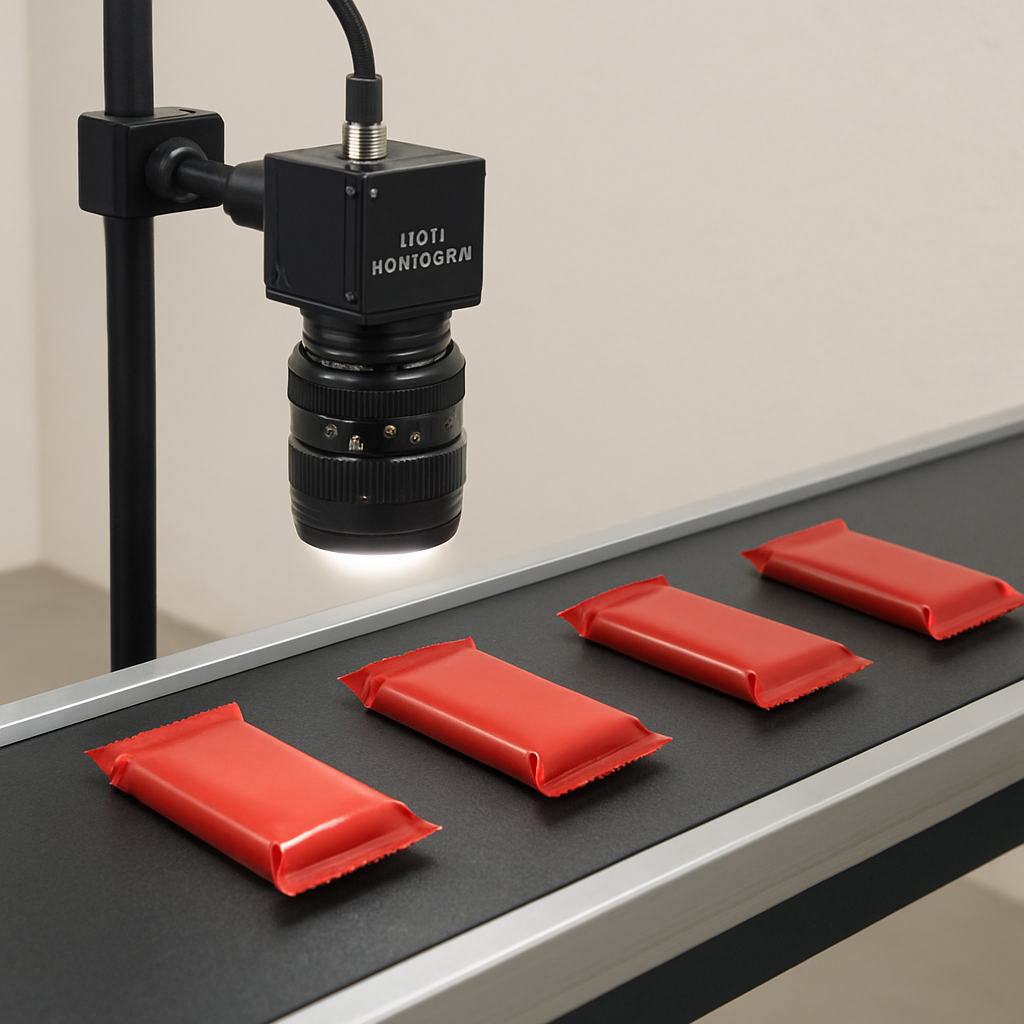
AI vs Human Inspection Accuracy
| Metric | Human Inspection | AI Inspection |
|---|---|---|
| Accuracy | 80-90% | 95-99% |
| Speed | Slower, fatigue-prone | Real-time, consistent |
| Error Rate | Higher over time | Very low |
| Scalability | Limited | Highly scalable |
| Consistency | Variable | Uniform |
Insight: AI doesn’t get tired – making it far more consistent for repetitive inspection tasks.
Source:
- Deloitte AI in Manufacturing
https://www2.deloitte.com - McKinsey Digital Manufacturing
https://www.mckinsey.com
How We Teach an AI to Spot a Flaw: A ‘Digital Flashcard’ System
AI improves manufacturing quality, much like how you teach people, with a huge bank of digital flashcards. Flashcard training is the critical step in converting a general-purpose AI into a highly expert system. There’s no need to write millions of lines of code to cover all the different ways a part could be defective. Rather, engineers will train the AI by providing it with examples (pictures) of good parts and bad parts. In addition to pictures of good parts, there are pictures of all of the things that can go wrong; a small scratch on a phone screen labeled “bad,” a perfectly straight soda can label labeled “good,” a crooked soda can label labeled “bad,” etc.
These pictures are called training data. Machine learning algorithms for quality control then sift through the training data and learn subtle pattern differences between good and bad. After sifting through all of the data, the AI learns the patterns. It develops its own knowledge, creating an AI model or a digital brain, which specializes in recognizing one thing. The AI model is the heart of the AI software used in product inspection, enabling fast, accurate decisions on the factory floor. Once deployed, AI improves manufacturing quality by consistently applying what it has learned, enabling factories to deliver more dependable products to their customers.
How AI Learns Defects
| Step | What Happens |
|---|---|
| Data Collection | Thoudands of product images gathered |
| Labeling | Defects marked (scratch, crack, etc.) |
| Training | AI model learns patterns |
| Testing | Model evaluated on new images |
| Deployment | Real-time inspection begins |
Example: An AI system trained on 10,000 images can detect microscopic defects invisible to the human eye.
Source:
- IBM AI Manufacturing
https://www.ibm.com - Google Cloud Vision AI
https://cloud.google.com
AI in Smart Manufacturing: AI enhances production accuracy through real-time data analysis
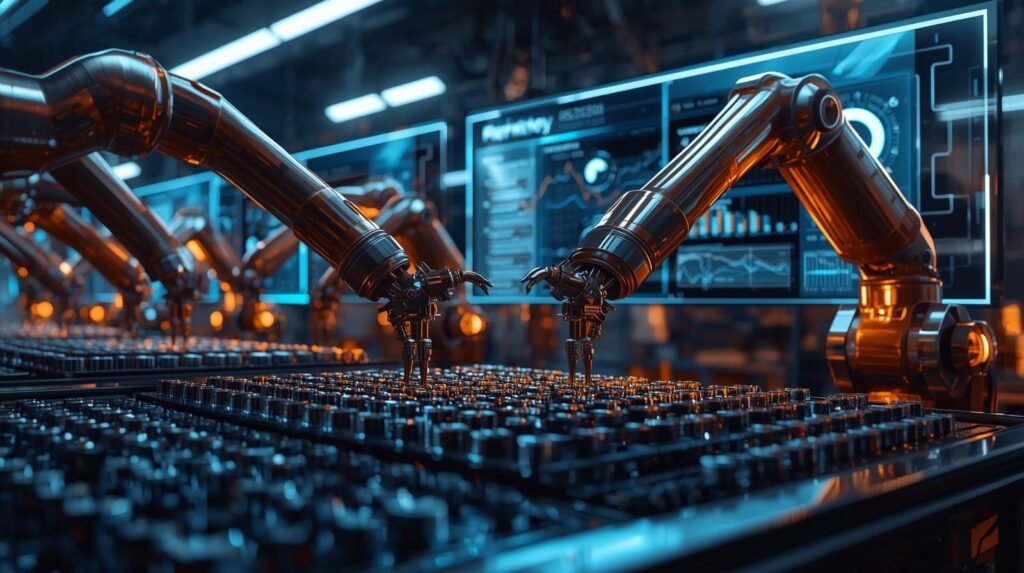
The accuracy of manufacturing processes is increasing in speed, consistency, and quality, with AI improves manufacturing quality through intelligent process decisions made in real time during normal operations. With AI’s capability for real-time feedback throughout each phase of manufacturing, it enables a new generation of smart manufacturing in today’s factories.
#Advanced & Transformative Robotic Process Automation Explained – Digital Robots for Computer Tasks
The incorporation of different types of data — machine data, sensor data, vision system data, and data from manufacturing enterprise systems (MES) and enterprise resource planning (ERP) platforms — enables Artificial Intelligence to make real-time decisions to improve a company’s production process.
AI in Smart Manufacturing: AI improves manufacturing quality by integrating data sources and immediately converting raw data into corrective actions.
An example of this is production teams will no longer need to wait until the end of a shift to determine what went wrong; with AI in place production teams are able to monitor production problems as they occur throughout the shift — such as tool wear, temperature variations, vibration changes, misfeeds, or minute changes in dimensions — so those production problems can be resolved prior to producing scrap.
Three examples of how Artificial Intelligence (AI) may be employed to improve manufacturing quality and efficiency, through creating consistent and high-quality products, are:
1.) AI identifies abnormality in production data. Machine learning algorithms allow AI to learn what normal operation looks like for each of your pieces of equipment and identify trends leading to issues, even when individual normal readings are not. Therefore, by proactively identifying potential manufacturing issues, AI can improve manufacturing process quality and reduce downtime and waste.
2.) AI helps support closed-loop process control. After AI identifies an issue in the manufacturing process, it provides recommendations for parameter changes and/or automatically adjusts the process setpoint limits. An example of this type of application would be the AI detecting an increasing trend in spindle torque or thickness. The AI would then provide the operator with recommendations for parameter and/or setpoint adjustments. Closed-loop process control is one of the capabilities of AI in Smart Manufacturing applications. Within safe operating conditions, the system continuously optimizes itself.
3.) AI enhances the ability of operators to make better decisions. The operator receives timely, clearly stated, and prioritized notification of the problem(s), along with probable cause(s) (i.e., when did the issue begin; which upstream processes are associated with the issue); therefore eliminating much of the “guess work” involved in troubleshooting, and allowing for faster corrective action. In these types of applications, AI improves Quality in the manufacturing process by enabling the operators to make more informed decisions.
The improvement in manufacturing quality achieved through the use of Artificial Intelligence (AI) is a direct result of its integration into inline inspection systems. Inline inspection systems use camera systems, laser scanning systems, acoustic sensing devices, or checkweighers. Through an inline inspection system, the AI continuously monitors manufactured units against a “learned” standard. If a unit does not meet the established standard, it will be identified as defective, and the operator will be notified.
In addition to notifying the operator of a defective unit, the AI will provide an explanation for the most likely cause(s) of the defect based on correlations developed between defects and processing conditions (e.g., a specific lot of material, a fixture misalignment, a worn nozzle). As the ability to continuously monitor manufactured units increases, so does AI’s ability in Smart manufacturing to produce products consistently at acceptable quality levels and speeds.
A feedback loop develops over time, in which the factory not only identifies and rejects defective parts but also identifies the causes of those defects and makes changes to eliminate the possibility of producing the same defective part again. A proactive approach to identifying and eliminating potential causes of defective parts demonstrates how AI improves Manufacturing Quality by moving quality control from a corrective action to a preventative optimization strategy.
Another way AI improves manufacturing quality is by enhancing scheduling efficiency and reducing waste. AI can be used to predict the likelihood of cycle-time variability and identify possible bottlenecks in real time, thus allowing the manufacturer to make adjustments to the product sequence in order to maintain stability in critical areas of the manufacturing process and reduce the number of rush setups that may occur during the manufacturing process, potentially resulting in errors. Dynamic adjustments to schedules are a key function of AI in Smart manufacturing, as scheduling decisions are made using current operating data.
In assembly operations, AI can assist operators through visual guidance and computer vision. Visual guidance informs operators whether all necessary components are present and properly positioned. Computer vision verifies that all components are properly assembled and that proper torque has been applied. As assembly verification becomes standardized throughout the organization, AI improves manufacturing quality and reinforces adherence to process standards across shifts and locations.
To achieve reliable results with AI, manufacturers should prioritize the quality of the data collected. This includes ensuring consistency among sensors, synchronizing timestamps, and clearly defining “good” versus “bad” results. Once these items are accomplished, AI in Smart manufacturing can act as a helpful “co-pilot,” offering minute-by-minute precision and assisting in producing large quantities of high-quality output.
Example
AI in real-time processes data from sensors on the line (vision of level, flowmeters, capper torque curve & speed of conveyor). As micro-foam increases, the AI determines that this condition exists due to warm incoming product and then adjusts the filler valve timing and/or the line pressure while maintaining safe limits.
Additionally, if the capper shows vibrations indicating that its torque will drift out of specification, the AI can make an immediate correction prior to rejection increases. Overall, by tightening fill accuracy, reducing underfills, decreasing rework, and keeping production steady during fluctuating temperatures and production demands.
Impact of AI on Manufacturing KPIs
| KPI | Improvement with AI |
|---|---|
| Defect Detection Rate | +30-50% |
| Production Efficiency | +20-40% |
| Downtime Reduction | -30% |
| Waste Reduction | -20% |
| Quality Consistency | Significant increase |
Key Insight: AI directly impacts both quality and cost savings.
Source:
- PwC Industry 4.0 Report
https://www.pwc.com - Capgemini Smart Factory Report
https://www.capgemini.com
Automation in Manufacturing: Automation streamlines workflows and improves product consistency
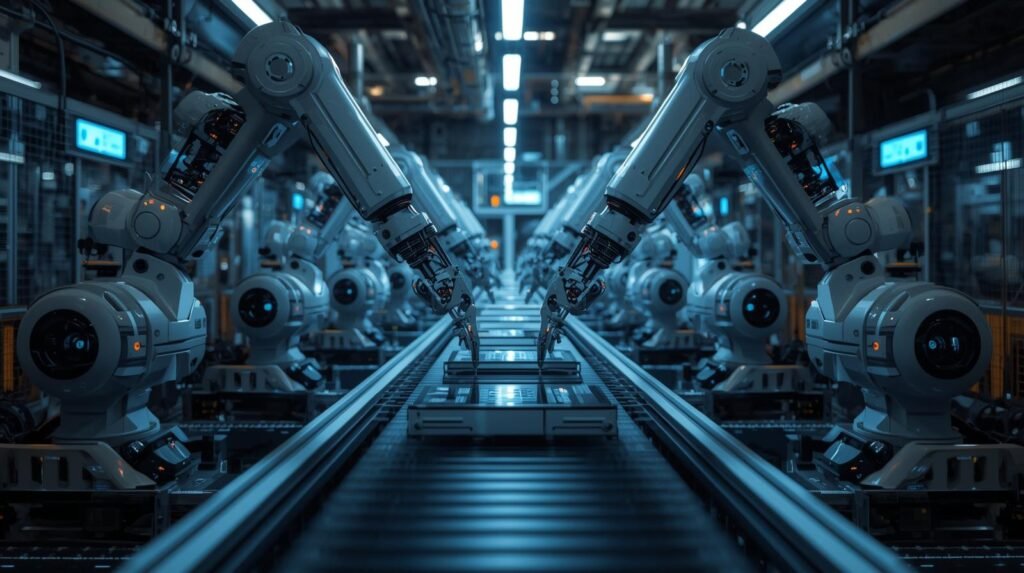
The use of automation in manufacturing enables consistent, rapid production. The production of goods through automation will be much more standardized because many variable tasks will be replaced by repetitive, measurable ones. Many examples of automation in manufacturing exist, including robotic arms, conveyor belts, programmable logic controllers (PLCs) controlling stations, automated fasteners, and pick-and-place machines.
These types of machines allow for continuous production without breaks in the production line due to handoffs, waiting on tools, or searching for parts. All of this contributes to manufacturers’ ability to adhere to their takt time, reduce bottlenecks, and produce product consistently regardless of the shift being worked.
Automated processes provide consistent products by eliminating variance. Automated dispensers are an example of how automated processes provide consistent products. Automated dispensers dispense beads of uniform size and at a uniform pressure. Servo presses are another example of how automated processes provide consistent products. Servo presses provide a consistent amount of force and travel distance.
CNC and coordinated motion systems also provide consistent products by maintaining tighter tolerances than non-automated processes. Error-proofing devices such as sensors, interlocks, and bar code checks are used to ensure correct component use, prevent missed steps, and verify proper orientation. Additionally, torque tools verify that the required fastening specification has been met and document the results for each unit, ensuring complete traceability.
Combining automation with AI in smart manufacturing makes the automated systems even more productive by continually monitoring production system performance to detect slight process drifts.
AI in smart manufacturing provides additional intelligence to traditional automation. AI systems do not just perform the programmed task; they also analyze patterns in torque curves, vibration signals, cycle times, and inspection results to identify early warning signs of deviation. Performance analysis enables the AI in smart manufacturing to identify emerging trends before defects occur. This enables proactive intervention by the teams. The combination of AI and standardized automation enables automation to improve over time, rather than performing the same task.
When working together, automation and Artificial Intelligence (AI), enhance both the stability and adaptability of manufacturing plants. To achieve the level of consistency necessary for repeated operations in Automation in Manufacturing, there must be analytical capabilities to support continued improvement through the use of AI in Smart Manufacturing. Therefore, when combined, automation and AI enable factory floors to produce at higher rates with improved precision and reliability, ultimately resulting in higher-quality products in greater quantities.
While providing greater consistency, the use of automated systems combined with artificial intelligence (AI) can improve productivity by increasing production speed. The integration of Automation in Manufacturing with advanced analytics will enable production lines to achieve both speed and stability. For example, vision systems can monitor each product during its manufacture and identify potential problems at an earlier stage than would be possible if the problem were allowed to become a major issue.
In addition to identifying these potential problems early, AI in Smart Manufacturing will continue to analyze inspection results to detect slight differences in product quality that might otherwise go undetected.
This information will be used to make automatic adjustments to the machine settings or quarantine items found defective so they do not proceed down the production line. As a result of this integration, Automation in manufacturing not only repeats tasks but also adapts intelligently to changes in product quality.
Additionally, using automation to collect data enables quick identification of defect sources by relating defect patterns to machine parameters, material lot numbers, or workstation locations. In this process, AI in Smart Manufacturing links quality outcomes to prior processing variables to recommend changes to either the programs controlling the machines or the maintenance schedules. Identifying these relationships early on, Automation in Manufacturing is able to prevent future occurrences of defects and decrease the likelihood of widespread quality control issues
Beyond ensuring quality consistency, Automation in Manufacturing increases the flow of work by reducing the time required to switch lines and improving material handling. With automated guided vehicles and smart warehouses delivering the correct component to the correct location at the correct time, manufacturers experience less downtime due to line shutdowns or incorrect parts being delivered to the wrong locations.
AI within Smart Manufacturing enables logistics systems to predict bottlenecks and dynamically route component deliveries to maintain production stability. The coordination of manufacturing processes helps ensure a smoother transition from one production run to another and helps maintain optimal production throughput.
Implementation success will depend on identifying production areas with excessive variability or potential safety risks, documenting current process flows, and establishing quality-critical parameters. To take advantage of the benefits of AI in Smart Manufacturing, organizations must establish a robust data foundation, ensure accurate calibration, and maintain consistent monitoring to ensure system performance. Automation in Manufacturing should be designed to support maintainability through design elements such as ease of service access, spare parts planning, and wear monitoring.
With intelligent systems in place, people are still important. Teams identify AI-raised exceptions in Smart Manufacturing and refine automation programming. People are responsible for maintaining equipment reliability. When manufacturers combine their skilled operators with well-designed Automation in Manufacturing, they develop a balance in which technology supports human decision-making and produces consistent, high-quality products in large quantities.
Smart Factory Technology: Smart factories connect machines for seamless, automated operations
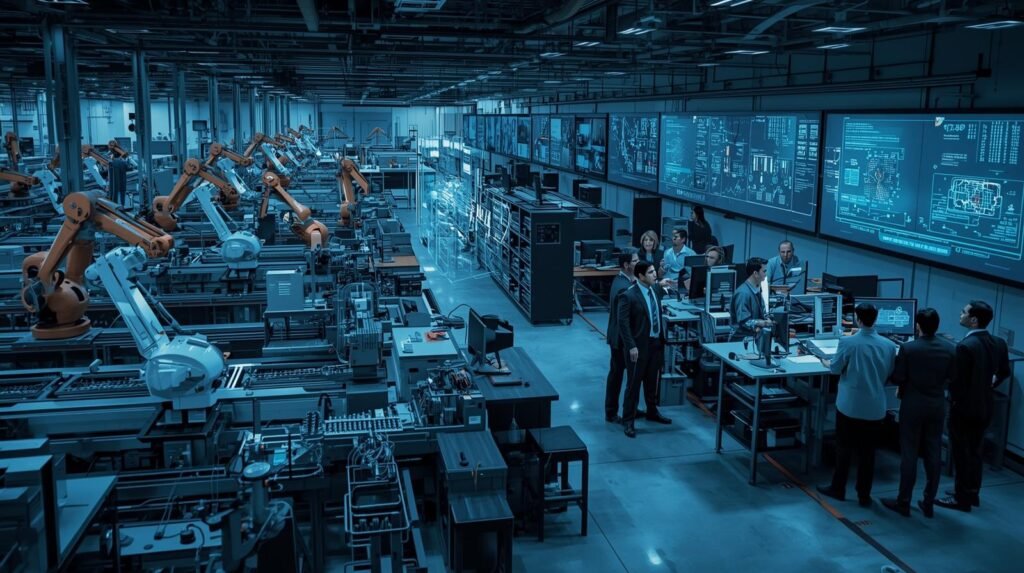
Smart Factor Technology brings together the workflow of both humans and machines. It enables continuous data exchange across all production assets within a facility. Production equipment will share data with each other and with operators as it continues to produce goods. Smart manufacturing is when all the equipment involved in production is networked so it can communicate with one another at every stage.
Machines will be able to share data, using Industrial Internet of Things (IIoT) sensors and industrial communication protocols. This includes data such as cycle times, temperature, vibration, energy usage, tool wear, and production quality. Using AI, Smart Factor Technology improves manufacturing quality. The AI will analyze real-time production data and identify trends or patterns that may signal issues before they affect production.
The Smart Factor Technology enables the automation of production workflows. This allows for real-time balance of production line flow. Idle time is minimized, the workload is automatically redistributed, and minor issues are contained and do not escalate into major problems. The AI continually evaluates process variables across all machines. Therefore, the AI improves manufacturing quality by enabling faster identification of root causes and proactive intervention to correct them. Instead of reacting to a defect after it occurs, manufacturers can now address a problem while it is still developing, enabling consistency across shifts and locations.
Real-time monitoring becomes possible when machines, robots, and inspection stations are connected to enterprise resource planning (ERP) systems via a manufacturing execution system (MES), enabling managers to track output, downtime, and scrap. Engineers can then compare current results with historical performance to identify deviations. Edge computing systems can act immediately — shut down a process or adjust parameters — before transferring data to the cloud for further analysis when safety or quality thresholds have been exceeded.
Through its layered decision-making architecture, AI improves Manufacturing Quality not only through inspection but also through intelligent process control and operational visibility.
Smart factor technology streamlines automation by using a standard data format across all devices and enabling end-to-end workflow orchestration. Product changeovers trigger updated recipes and digital work instructions that are automatically distributed to each station. Upon scanning with a barcode or RFID reader, the correct part and process parameters are confirmed instantly. Structured coordination ensures process consistency, improving manufacturing quality by reducing errors from manual data entry and incorrect configurations.
Automated work orders are generated by maintenance systems based on machine condition data, demonstrating how smart factor technology integrates predictive insights directly into operations. Material replenishment scheduling in intralogistic operations prevents starvation at assembly or packaging stations, maintaining flow and stability, while AI improves Manufacturing Quality through proactive adjustments.
As we move toward an increasingly high-quality product, driven by daily advancements in AI in manufacturing. The trend of utilizing connected factory data will continue to improve both quality and productivity. In addition to providing a means to identify trends early, smart factor technology uses systems to continuously monitor key performance indicators (KPIs), which alert operators to emerging issues, provide recommendations on adjusting set-points, and direct suspect products to the re-inspection area. This immediate response by AI to small deviations ensures that AI improves Manufacturing Quality.
Using digital twins also supports this approach by enabling “what if” simulations before making live changes in production. Digital twins help eliminate trial and error associated with testing changes on the live production line. The elimination of trial and error helps ensure that throughput remains stable and process reliability is maintained — another way AI improves Manufacturing Quality without impacting production stability.
The success of a smart factor Technology initiative depends on many factors, including interoperability, data governance, and cybersecurity. Smart Factor Technology relies on connecting existing equipment to new systems, establishing ownership of the data used, and maintaining network segmentation through role-based access controls and monitoring. Perhaps equally important as the technical aspects of a smart factory technology program is change management. Operators and technicians need to be properly trained and provided with user-friendly dashboards to have confidence in the system and use it effectively.
When done appropriately, connected machines and workflow automation result in a responsive factory. A responsive factory can maintain operational stability under increased pressure and deliver quality product at scale. As part of a cohesive ecosystem, AI improves Manufacturing Quality not only through inspection and analytics but also through coordinated, secure, and intelligent production operations.
Example
A manufacturing plant uses CNCs, tool cabinets, CMMs, and an MES (Manufacturing Execution System) to support automated processes. Once a work order is released to begin production, the MES automatically loads the appropriate CNC program version, confirms that all required tools are available from the smart cabinet, and assigns time for a CMM check of in-progress work.
If a trend on a CMM indicates a bore is out of tolerance, the system will suspend the release of the next set of batches until the issue is resolved, notify the cell staff, and document the occurrence in the digital traveler. The automatic triggering of material replenishment via RFID bins has eliminated manual intervention in supplying raw materials, reduced changeover times, and eliminated paperwork.
Industry 4.0 AI: Industry 4.0 AI integrates digital intelligence across manufacturing systems
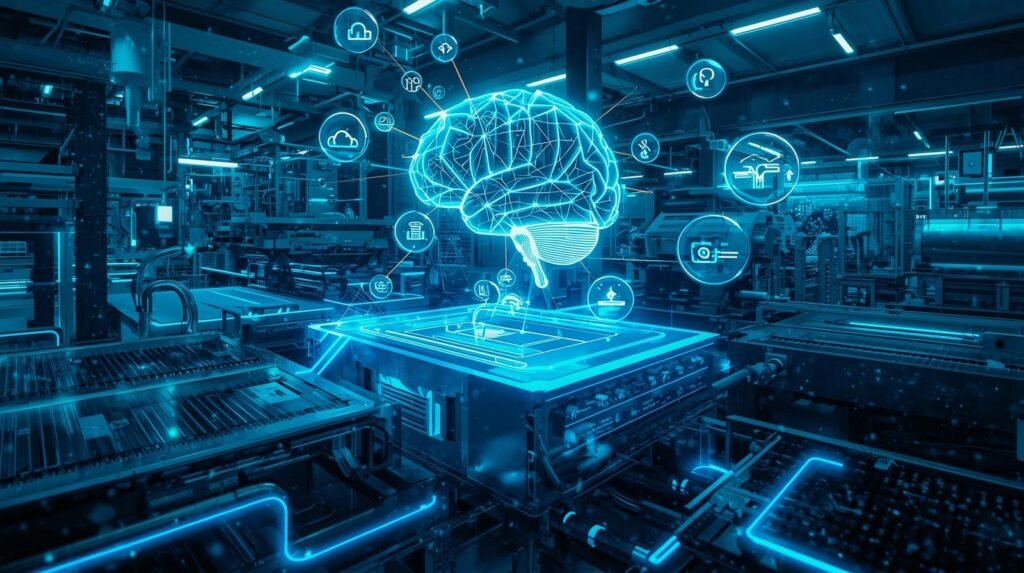
Industry 4.0 AI will enable manufacturers to create a cohesive relationship among all components of a manufacturing operation. Under the umbrella of Industry 4.0 AI, quality issues will no longer be isolated to one area of the operation; instead, the quality issue will be compared to all the related factors that contribute to the defect such as process parameters, the actions taken by the operators involved in the process, the condition of the tools used to perform the process, and the type of material being processed.
If scrap rates increase due to quality issues, Industry 4.0 AI will quickly identify the variables contributing to the increase, such as high temperatures on a specific piece of equipment, material changes from suppliers, and/or calibration errors on a measurement device. With this added layer of insight into how the various aspects of the manufacturing process affect one another, the team can respond more quickly and efficiently, enabling the use of AI to improve Manufacturing Quality by relying on factual, data-based information rather than pure speculation.
By correlating these elements, AI improves Manufacturing Quality not only by detecting defects but also by identifying why they occurred. By identifying the underlying causes of defects, AI improves Manufacturing Quality by enabling faster problem analysis and supporting departments in consistently improving their performance.
In addition to periodically reviewing data, Industry 4.0 AI will continually evaluate data trends and alert the team to potential risks before they become major problems. As a result, AI improves Manufacturing Quality by converting large amounts of complex, multi-sourced data into actionable advice for production teams.
Rather than relying on disconnected dashboards or manually analyzing large volumes of data to understand what’s happening in their operations, Industry 4.0 AI provides a single, real-time view of how all aspects of the operation are performing. This allows for understanding of current events, emerging trends, and necessary corrective action. Using its integrated, intelligent capabilities, Industry 4.0 AI improves manufacturing quality by enhancing operational stability and creating a smarter, more proactive manufacturing environment.
In addition to enabling more intelligent and resilient work practices, Industry 4.0 AI can anticipate potential bottlenecks, identify at-risk periods of downtime, and recommend schedule changes in response to variations between actual and planned production capacity. In an Industry 4.0 AI-enabled framework, continuous analysis of machine-generated data (e.g., vibration signal, temperature, power usage) identifies potential warning signs of impending failure prior to occurrence.
This predictive capability enables scheduled maintenance to occur when it fits the production plan, minimizing unplanned stoppages. By forecasting failures before they occur, Industry 4.0 AI improves manufacturing quality by enhancing operational stability and minimizing process interruptions.
Manufacturing with artificial intelligence (AI) improves product quality. The integration of AI into Industry 4.0 manufacturing systems provides real-time feedback on system quality and performance. By providing real-time information, AI improves Manufacturing Quality by improving process control and reducing variability throughout the manufacturing process.
The use of artificial intelligence in the quality control process enables manufacturers to produce more consistent products by identifying and correcting variations before they become major issues. AI-based inline inspection systems, along with those that provide real-time data on product anomalies, help prevent cascading defects. Cascading defects occur when a minor variation leads to a large number of defective products because the variation was not identified until it was too late. AI improves Manufacturing Quality by enabling manufacturers to contain defects and reinspect suspect products, while creating an automated paper trail to support traceability and regulatory compliance.
Inline inspection systems connected to Industry 4.0 AI ecosystems enable inspection data to be used as input for other manufacturing operations. This integration of inspection results with other operational data supports greater accountability and transparency among all parties involved in the manufacturing process.
Industry 4.0 AI ecosystems create continuous improvement cycles. All quality-related issues are recorded, reviewed, and added to the learning database, enabling the system to improve its ability to distinguish normal process variations from potential issues over time. With ongoing improvements to the system’s intelligence layer, AI enhances Manufacturing Quality through both long-term process refinement and predictive insights enabled by Industry 4.0.
Intelligent Manufacturing Systems: Intelligent systems optimize processes using continuous data insights
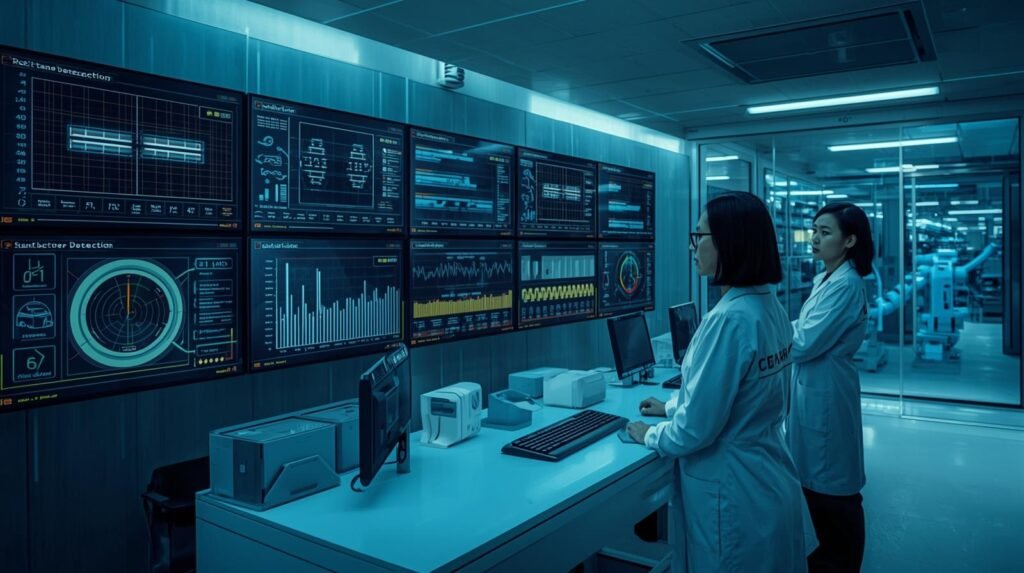
Manufacturing operations can now optimize production on an ongoing basis. Unlike traditional methods, which often wait for problems to develop and then react, manufacturers utilizing intelligent manufacturing systems (IMS) can make adjustments based on real-time performance data. This continuous optimization enables manufacturing operations to produce higher-quality products with less waste.
Intelligent manufacturing systems (IMS), provide manufacturing operations the capability to treat all aspects of the plant as part of one large system. The IMS does this by integrating signals from multiple sources, including machines, sensors, quality stations, and enterprise platforms such as MES and ERP. By using this coordinated approach, manufacturing quality improved through AI. The reason for this improvement in manufacturing quality is that all process adjustments are made with live operational data in mind.
The signals used in the production environment include: cycle times, temperature, pressure, vibration levels, tool offsets, defect images, and operator input. Using these signals, AI identifies patterns in the data. These patterns identify possible future problems. Within an intelligent manufacturing system, the data collected in the production environment is not simply saved but analyzed continuously to identify deviations and recommend corrective actions. If the pattern indicates potential instability, the AI improves manufacturing quality by sending alerts or automatic responses to correct the process and prevent defects.
A significant advantage of intelligent manufacturing systems is the continuous insight into the production environment. Each production cycle provides a great deal of information that can be used as guidance for adjusting production. For example, if there is evidence of drift, there could be many reasons for this. Drift can be caused by a machine being out of alignment, an increased scrap rate at a specific workstation, or an increase in cycle time due to component variation.
In addition to identifying the problem, the information is available quickly enough to take immediate action. Immediate actions include taking a sensor reading, replacing a worn tool, changing a setpoint, or resequencing production to alleviate a bottleneck. By acting quickly to stabilize operations, AI improves manufacturing quality.
Real-time monitoring, combined with dynamic adaptation, enables the creation of an intelligent manufacturing system that responds to changes in the manufacturing environment. The integration of this intelligence enables the maintenance of balance in production and the minimization of downtime while consistently producing high-quality products. AI improves Manufacturing Quality by directly integrating continuous learning and optimization into the factory’s daily routine.
The use of Intelligent Manufacturing Systems can enable manufacturers to have a quicker, safer way to continuously improve the efficiency of their production lines. Through the integration of real-time monitoring, adaptive control systems, and data-driven analytics, Intelligent Manufacturing Systems create a closed-loop process that supports continuous improvement. With each adjustment to the production line, the immediate performance evaluation of that adjustment is used as feedback to inform the model and generate new recommendations for future improvements.
The closed-loop nature of the system enables AI to improve Manufacturing Quality by eliminating or significantly reducing the reliance on trial-and-error methods in complex manufacturing processes. Some companies also develop a digital twin (a virtual replica) of the production system to test new ideas before implementation, to protect throughput and prevent unplanned quality issues.
Introducing Quality as a Primary Function of Intelligent Manufacturing Systems: The ability of intelligent manufacturing systems to provide real-time feedback on inspection results linked to process parameters offers insight into which process conditions most affect defect formation.
This correlation-based analysis is another way AI improves Manufacturing Quality by enhancing control of critical process parameters. For example, if weld porosity is correlated with both humidity and gas flow rates, the system will automatically notify the operator(s) to correct the corresponding parameters and verify that the corrected conditions have returned to their target range. Through these data-driven corrections, AI improves Manufacturing Quality by eliminating recurring defects rather than simply detecting them post-production.
The success of Intelligent Manufacturing Systems is contingent upon the ability to collect reliable data, define what constitutes “good” vs. “bad”, and create efficient workflows in the shop. Dashboards need to be user-friendly, alarms need to be actionable, and there needs to be a clear definition of who is responsible for responding, how quickly, and how suspect parts are addressed.
When all of the above-mentioned foundational elements are in place, AI will continually and predictively improve Manufacturing Quality. In this type of environment, Intelligent Manufacturing Systems can serve as catalysts for continuous improvement, thereby enhancing accuracy, reducing waste, and sustaining consistent throughput at scale.
Example
The intelligent systems in an SMT line combine information from various sources (AOI images, pick-and-place logs, stencil printer data, and reflow oven data) and identify an increase in the defect rate of a particular capacitor type due to tombstoning.
This is further attributed to a slight reduction in paste volume at a specific location on the stencil and an increase in reflow-soak time. Based on this analysis, the intelligent system identifies changes to the production process, including adjusting the stencil wipe interval and making a small adjustment to the oven profile.
Then it will monitor production results to determine whether the suggested changes have reduced the number of defective products. The engineers can rank the most likely causes of the problem based on evidence rather than simply looking at raw data. The intelligent system also continues to learn which modifications consistently prevent similar problems from recurring on subsequent boards.
Predictive Maintenance AI: AI forecasts equipment issues to prevent unexpected downtime.

Predictive Maintenance AI employs sensor data and machine learning to predict when an asset will fail, enabling proactive maintenance. The traditional schedule-based approach to maintenance is replaced by Predictive Maintenance AI, which takes a proactive, predictive approach to identifying trends based on real-time operating conditions — answering questions about your asset’s operating condition today. How has the condition of your asset trended over time?
Through the ability to anticipate potential equipment failures early, Predictive Maintenance AI, AI improves manufacturing quality — reducing the likelihood of a sudden equipment failure, that would potentially disrupt the production process and cause a deviation in product quality.
Predictive Maintenance AI continuously monitors and evaluates sensor and control systems signals — including vibration, temperature, acoustic noise, pressure, current draw, cycle counts, lubricant condition, and error codes. Over time, the Predictive Maintenance AI system learns what “normal” looks like for each individual asset in its actual operating environment.
As abnormal trends begin to appear (i.e., misalignment, imbalance, lubrication failure, or electrical irregularities) the Predictive Maintenance AI system identifies these issues prior to asset failure. Early identification and correction of these issues improve manufacturing quality by maintaining assets at optimal performance levels and reducing defects caused by production disruptions.
Predictive Maintenance AI provides a risk assessment score and estimates when to act, enabling manufacturing teams to plan repairs during scheduled shutdowns rather than at peak operating times. As Predictive Maintenance AI reduces unplanned shutdowns and maintains steady machine operation, it improves manufacturing quality by keeping operating parameters consistent across shifts.
It is obvious that there is also an operational value to this. The number of unplanned failures has decreased, overtime has been reduced, spare parts inventory planning has been simplified, and overall equipment effectiveness (OEE) has increased. Additionally, Predictive Maintenance AI reduces unnecessary preventive maintenance and prevents the premature replacement of components that are still working. Since there will be fewer component removals and installations, costs will decrease, and manufacturing-induced damage will be reduced. Long-term operational efficiency is also improved because Predictive Maintenance AI protects equipment reliability and prevents process instability.
AI improves Manufacturing quality goes beyond simply stopping catastrophic equipment failure. Sometimes subtle product defects show up before a machine fails entirely. Vibration from a worn-out bearing may cause variations in surface finish; if an actuator begins to drift, products will exhibit dimensional inconsistencies; clogged nozzles can affect the amount of material dispensed. By identifying these early warning signs, Predictive Maintenance AI enables plants to address problems before defects spread throughout a batch or shift. In those cases, Predictive Maintenance AI improves manufacturing quality by keeping process parameters under control until quality trends worsen.
Implementation of AI for quality begins by identifying the most critical equipment for which quality risks are high or for which downtime is costly. Teams evaluate if there are sufficient data sources and sensors to accurately predict equipment failures. Then, teams evaluate how they will use the alerts generated from Predictive Maintenance AI – whether to inspect, lubricate, recalibrate, replace parts, or continue to monitor more closely. Predictive Maintenance AI will only provide actionable guidance for maintenance personnel when it has been correctly configured to not only predict potential failures but also recommend actions to address them.
When Predictive Maintenance AI is properly implemented, it not only provides predictive failure analysis but also provides recommendations on how to address the predicted failures. The ability to provide recommendations for correcting failures enables manufacturing organizations to prevent instabilities at their root causes, thereby improving manufacturing quality and reducing the risk of downstream defects from previously unknown equipment failures.
Successful implementations of Predictive Maintenance AI require that predicted failures be integrated into maintenance workflow processes. Once predicted failures are integrated into maintenance workflows, the Predictive Maintenance AI system can automatically generate work orders based on the predicted failure and provide maintenance personnel with visual information on why the failure occurred (e.g., trend charts, threshold breaches, anomaly images). Additionally, once corrective action has been taken to address the failure, the Predictive Maintenance AI system can track its effectiveness.
Using this process, Predictive Maintenance AI improves Manufacturing Quality by providing maintenance personnel with a structured approach to identify and resolve issues quickly through data and continuous improvement. As Predictive Maintenance AI learns from each corrective action, the system becomes better equipped to determine the most effective way to address future failures.
When predictive maintenance is combined with operational data and quality data, the system achieves an even greater level of understanding. For example, when a system integrates equipment condition with scrap rates, rework levels, and inspection frequencies, Predictive Maintenance AI develops an even better understanding of how mechanical equipment affects end-product quality. With this expanded view, the system can develop a recommendation for maintenance actions that protect both uptime and quality.
Therefore, by using Predictive Maintenance AI to make maintenance decisions aligned with production performance, manufacturing organizations can improve Manufacturing Quality and maintain efficient operation without unnecessary interruptions.
Example
A paper mill uses predictive-maintenance artificial intelligence (AI) for critical dryer-roll bearings. The AI analyzes vibration data, ultrasonic data,, and motor current using an “edge” model which trains itself based upon the normal vibration signatures of each individual roll under various operating conditions and speed.
When a high-frequency vibration band is identified as increasing over time, the AI will generate a predicted timeline indicating when the risk of a bearing failure will become extreme (approximately 2 weeks).
Based on this information, maintenance can schedule the bearing replacement with the proper parts ordered through automation during a scheduled downtime for grade changes, avoiding an unexpected plant shutdown that could ruin all the paper currently being processed. Following the replacement, the model has confirmed that the vibration signature returned to normal and has updated its baseline.
Predictive Maintenance ROI Example
| Metric | Before AI | After AI |
|---|---|---|
| Machine Downtime | 15% | 5% |
| Maintenance Cost | High | Reduced 25% |
| Equipment Lifespan | Standard | Extended |
| Failure Prediction | Reactive | Proactive |
Example: A factory using AI reduced unexpected breakdowns by up to 70%
Source:
- Siemens Predictive Maintenance
https://www.siemens.com - McKinsey Maintenance Study
https://www.mckinsey.com
How Smart AI Creates Smarter, Greener Factories
Beyond correcting errors individually, the AI is an early warning sign of potential problems. By analyzing thousands of images per minute and identifying trends that indicate how future defects form, the AI can alert manufacturing staff to problems before they occur. The ability of the system to recognize a deviation in a machine, (thus, stopping production of poor product), is the power of Prescriptive Quality Analytics.
The use of advanced AI in quality management also allows engineers to determine the cause of a problem, rather than just its effect. For example, if the AI indicates that there is a small scratch on approximately every 100th can, it can go back through the data to pinpoint where this problem occurred. It is even better than that. The AI would tell the engineer, “It isn’t the cans that are causing the problem; it is the grippers on Machine #7 that need adjustment.”
Online AI improves manufacturing quality control systems, which have several benefits for both the factory and the environment:
- Reducing Waste: Faulty components are detected early in the production process, thereby reducing material and energy use.
- Increasing Uptime: Production will run continuously, with no downtime due to human fatigue.
- Improving Repair Efforts: The system provides the maintenance team with information on which machine requires repair, enabling them to resolve issues promptly.
The prospect of creating an entirely flawless, automated factory with a “perfect” vision of every aspect of the production line may seem realistic once the machinery reaches this level of intelligence; however, the practical use of such machines is far more complicated than imagined. There are many issues related to intelligent automation (such as the role of people in the workplace) that must be addressed before its widespread adoption in industry.
Environmental Impact of Smart AI
| Area | Impact of AI |
|---|---|
| Energy Use | Reduced through optimization |
| Material Waste | Lower due to defect detection |
| Carbon Emissions | Decreased |
| Resource Efficiency | Improved |
| Rework | Significantly reduced |
Key Insight: AI improves not just profits – but also sustainability.
Source:
- World Economic Forum (Smart Factories)
https://www.weforum.org - Accenture Sustainability in Manufacturing
https://www.accenture.com
Better Products for Everyone: What AI Quality Control Means for You
This very talented digital professional generates real value from what you buy. Humans are quite adept at discovering obvious flaws, but our capacity for inspection is limited by fatigue. As a result, this new AI was developed to provide perfect, unlimited inspection capability and high sensitivity for detecting micro-flaws (e.g., minuscule hairline fractures in a circuit board, microscopic air bubbles in car paint) that may not be easily detected by a human inspector.
Detecting micro-flaws provides many benefits. While a small blemish on a soda can is merely a nuisance, a similar flaw in an automotive airbag sensor can pose a serious safety hazard. Manufacturers can use AI to identify and fix defects before they cause problems, resulting in more durable and reliable products. Predictive quality analytics is one of the primary advantages of preventing failure before it occurs.
The ultimate goal of every production facility is to achieve zero-defect manufacturing through the utilization of artificial intelligence. Real-time quality control has been implemented. If an issue arises during production, the system immediately identifies it and alerts personnel before a significant quantity of defective product is manufactured.
By identifying every defect, a production facility eliminates waste of materials and energy used to produce defective products, which would otherwise be discarded or recycled, thereby increasing the efficiency of its operations. And the results do not stop here; they begin with greener, smarter production facilities and the innovation those facilities will generate.
As a result, production facilities not only produce higher-quality, lower-cost products but also enable cleaner, more efficient production processes.
Is This an AI Takeover? The Real-World Hurdles for Smart Inspection
It is easy to define what a self-correcting factory is, it is not simple to get to this point. The primary barrier to achieving this is getting enough information. AI learn by example. Engineers must obtain (and label) many photographs of products before an AI can begin to examine them. Obtaining photographs of products takes time, and the photographer has to be precise about which image represents a “perfectly manufactured product” versus “a small defect is at the location indicated”. The time and money spent initially to get to the first item the system examines are considerable.
Another major issue to overcome is cost. High-resolution cameras, advanced computer systems, and other equipment are expensive and necessary to run an AI-based quality control system. While AI does a great job of finding obvious, measurable defects (e.g., scratches on a cell phone), AI has little value in identifying defects where quality is subjective (e.g., how brown is too brown?).
Therefore, manufacturers using AI to perform quality control inspections on products with anticipated variations within acceptable limits will face one of their greatest challenges: training an AI to determine what constitutes acceptable product characteristics and what constitutes unacceptable defects.
Ultimately, AI will not replace human inspectors on the factory floor. Instead, AI will generate a requirement for a new kind of inspector. The individuals responsible for training the AI, monitoring its performance, and making decisions regarding complex issues the AI identifies will also manage the AI and develop quality strategies based on its output. Rather than performing repetitive inspection tasks, the human workforce will transition into the roles of System Manager and Quality Strategist. The human inspectors will provide direction to the AI to improve its performance. Success will be achieved in a partnership model, rather than a replacement model.
The Future of ‘Perfect’: Where Quality Control Goes From Here
Quality control is evolving beyond its original model of one person watching a product go through the production process, and an increasing number of companies are using Artificial Intelligence (AI) to improve their Quality Control. An AI platform, similar to how a college student uses digital flashcards, will allow the identification of possible defects with a uniqueness not found in previous methods of defect identification.
The ability to identify defects before they occur represents a paradigm shift in the use of artificial intelligence in quality control. The process previously involved recognizing defects only after they had occurred; however, the use of AI will allow manufacturers to implement a totally automated quality assurance process that continuously monitors each component of the production process (e.g., temperature, speed, machine vibration) to detect when an error is likely to occur and then to take action to eliminate it. The net result will be an AI-based zero-defect manufacturing process.
A further benefit of transitioning to an AI-based zero-defect manufacturing process will be increased job growth in the manufacturing sector. By using AI to perform routine inspection tasks, employees can focus on higher-level tasks such as directing, teaching, and establishing the complex environment required to effectively manage AI in quality management. Additionally, the shift away from routine, repetitive labor toward cooperative, strategic labor will also produce favorable outcomes across the entire workforce.
Humans and machines are building an unseen partnership to achieve the ultimate level of perfection through both quality management and product design. The result of this quiet revolution is that today’s products are being created in ways that make them better, smarter, and more sustainable than ever before. This represents a new era of manufacturing excellence.
My Critical Findings
Smart AI shifts quality from end-of-line detection to in-line prevention, inspecting every unit with vision and sensor analytics to catch defects before they propagate. The highest value comes from early drift detection—AI identifies subtle changes (tool wear, misalignment, thermal variation) that traditional sampling or manual checks often miss. Quality decisions become more consistent because AI applies uniform standards across shifts and sites, reducing subjectivity and fatigue-related errors.
A major finding is that AI-enabled quality improvement is most effective when connected to process and production data (MES/PLC/ERP). This linkage accelerates root cause analysis by correlating defect spikes with specific machine settings, stations, operators, material lots, or environmental conditions. Smart factory connectivity enables automated containment workflows—routing suspect parts to recheck, pausing lines, and generating traceable records for audits.
Predictive maintenance is a critical enabler: equipment health signals (vibration, temperature, power draw) often indicate impending issues that also degrade quality, so forecasting failures prevents both downtime and defect surges.
However, performance depends on fundamentals: stable sensing/lighting, representative training data, continuous monitoring for model drift, and strong cybersecurity/governance. The takeaway: AI delivers measurable quality gains when treated as an integrated control system rather than a standalone inspection tool.
Conclusion
Manufacturing quality inspections will evolve with AI and be executed earlier, more rapidly, and more uniformly than before. Quality inspections will no longer just depend on periodic sampling or end-of-line reviews. Using AI-based vision and sensor analysis, real-time verification of each part is achievable. Through this, subtle defects will be identified, and variations will not progress into large quantities of scrap. Additionally, results from quality inspections will be correlated to manufacturing data (tool conditions, machine settings, raw material lots), so that teams can go from identifying defects to eliminating their root causes.
When combined with other smart factory technologies (e.g., Intelligent Manufacturing Systems) and Industry 4.0 best practices, quality inspections will become part of the smart factory’s connected workflow. Products will have a history; anomalies will be isolated; and corrective actions will be initiated immediately as needed, with complete documentation to support audit and regulatory requirements. Predictive maintenance, another smart factory application, will also add to the protective layer for equipment health, helping to address issues that may lead to defects or unscheduled downtime.
It appears that manufacturers can use AI to enhance product consistency, decrease rework, and create a continuous improvement process that scales across all production lines and locations if they implement a solid data foundation, reliable sensors, and a secure workflow.
FAQs
1) What is “smart AI” in manufacturing quality checks?
AI is able to use machine learning algorithms and data from industrial sensors, along with image processing using cameras, to view the part being inspected to determine if there are any defects and if so, where, and also to monitor for changes in the manufacturing process that can be detected in real-time, usually on each and every product, not just samples.
2) How does AI catch defects earlier than traditional inspection?
AI continuously monitors production and alerts when any slight change is detected (shape, surface, alignment, torque, or dimension), enabling timely action to contain the issue before it progresses further downstream in the manufacturing process.
3) Will AI replace human quality inspectors?
Generally not. AI performs repetitive inspections at high production volumes and identifies exceptions, whereas humans conduct Root Cause Analysis, Handle Edge Cases, Address Supplier Issues, and drive continuous improvement.
4) What data and equipment are needed to get started?
Most projects begin with good images or sensor signals, consistent lighting and fixturing, a set of labeled examples of “Good” and “Defective”, and a connection to the customers’ current systems (PLC/MES) to enable traceability and actions.
5) How does predictive maintenance support better quality?
Predictive Maintenance through monitoring early signs of equipment failure (temperature, vibration, changes in power consumption) can help prevent machine drift over time, which typically results in defective products before the machine fails.

Garikapati Bullivenkaiah is a seasoned entrepreneur with a rich multidisciplinary academic foundation—including LL.B., LL.M., M.A., and M.B.A. degrees—that uniquely blend legal insight, managerial acumen, and sociocultural understanding. Driven by vision and integrity, he leads his own enterprise with a strategic mindset informed by rigorous legal training and advanced business education. His strong analytical skills, honed through legal and management disciplines, empower him to navigate complex challenges, mitigate risks, and foster growth in diverse sectors. Committed to delivering value, Garikapati’s entrepreneurial journey is characterized by innovative approaches, ethical leadership, and the ability to convert cross-domain knowledge into practical, client-focused solutions.