





































Artificial Intelligence (AI) is transforming all of our surroundings and how businesses operate. AI is also transforming how we work and how we live.


It can be very overwhelming when you begin with Artificial Intelligence; however, by taking small steps towards learning Artificial Intelligence, you can learn Artificial Intelligence.
This guide is intended to help individuals with little or no knowledge of artificial intelligence find an easy-to-follow method for understanding and mastering its concepts.
The first portion of this guide will explain the basics of artificial intelligence. The basics of artificial intelligence include Machine Learning (ML) and Neural Networks (NN). Machine Learning and Neural Networks are among the most important pieces of AI Technology.
I’ll be covering the fundamental requirements for an individual to start their AI journey in Part II of this guide. The three most common skill categories are: Mathematics, Programming, and Data Analysis.
Although hands-on experience is valuable when studying AI, we will gain it by completing our own projects or applying the knowledge we gain to solve real-world problems.
Additionally, we will provide information on staying up to date with the latest advancements in AI and trends in the rapidly changing AI landscape.
By the end of this section, you will have a solid base of understanding of AI, allowing you to pursue further studies in AI as well as potential career options.
Global Artificial Intelligence Statistics (2024-2030)
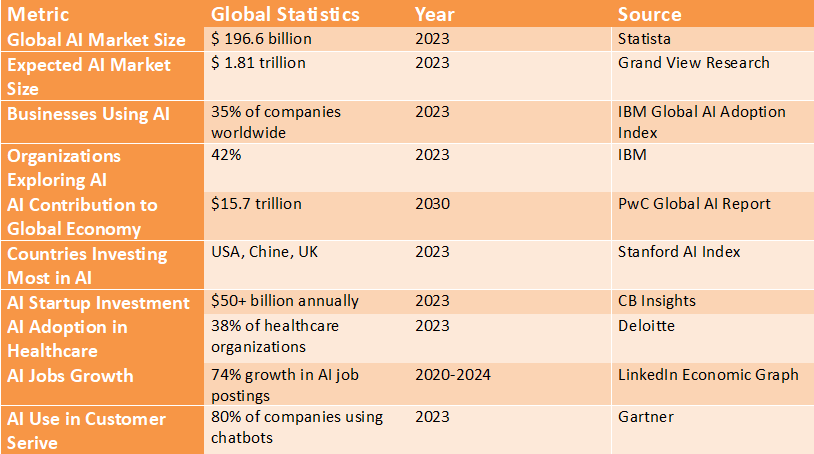
The rate at which companies and sectors across the globe are adopting artificial intelligence has clearly demonstrated that a growing number of businesses are using AI technologies as a means of automating operations, analyzing data and making decisions. By 2030, artificial intelligence is expected to add approximately $15.7 trillion to the world’s total economic output according to PwC, thus potentially being the most impactful technology to have been developed in recent history.
Beginner AI Projects

What Is Artificial Intelligence? Understanding the Basics
“Artificial Intelligence (AI), a subset of computer science, aims to develop ‘smart’ machines — computers that are able to make their own decisions without human intervention. The primary goal of AI is to create systems that can complete tasks using logic, be able to learn, problem-solve, and improve performance over time.
While the primary focus of AI is improving performance and solving difficult problems, it differs from robotics and mechanical devices that perform tasks by mimicking human actions. Currently, AI has become a significant factor in numerous sectors such as healthcare and banking.”
#The Beginner’s Guide to Artificial Intelligence
To gain a greater understanding of how AI functions, it is essential to understand that there are three primary objectives of Artificial Intelligence (AI):
- Automation of Repetitive Tasks: Machines will perform repetitive tasks without experiencing fatigue.
- Enhancement of Problem-Solving Ability: AI will assist in making sense of large quantities of information.
- Development of Adaptive Systems: AI systems may adapt and continue to improve with each experience.
Algorithms are the methods by which AI’s objectives are achieved. Algorithms are essentially the set of “instructions” that computers use to process information, generating decision-making and/or predictive capabilities. With technological advancements occurring rapidly, the importance of understanding these basic components of AI has increased significantly.

Types of AI: Narrow, General, and Superintelligent
The three types of AI are defined based on how well they can complete a task. There are three classifications for AI: Narrow AI, General AI, and Superintelligent AI.
Narrow AI (also known as Weak AI) is designed to accomplish only one thing at a time. Examples of narrow AI include virtual assistants such as Siri and systems that recommend movies or music (for example, Netflix’s movie recommender). Narrow AI can be very good at doing that one thing and will never be able to do anything else (e.g., no virtual assistant has ever been able to book a flight), and it will not be able to learn anything new about accomplishing different tasks.
General AI is the ultimate objective for future AI development. The aim of general AI is for machines to perform all the intellectual functions that humans can. Currently, the idea of general AI remains theoretical, with no evidence of its creation yet. Developing general AI requires creating machines capable of processing information, learning, and adapting to new tasks without needing human intervention.
The concept of super intelligence refers to systems that surpass human capacity in every way. Like general AI, superintelligence is often conceptualized as an optimistic or futuristic concept, but it also raises many ethical and existential questions.
Both concepts are important to understand, as they help us determine what we currently know about AI and where it may eventually end up.

Key Concepts in AI: Machine Learning, Deep Learning, and Neural Networks
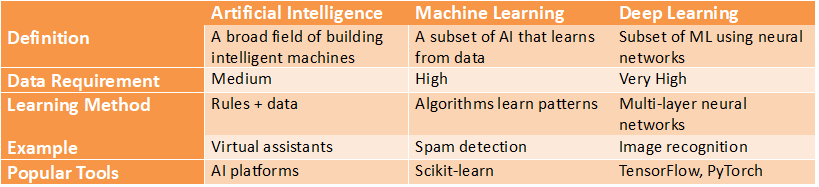
Artificial Intelligence is primarily a result of machine learning (AI). Machine learning is the process by which computers are trained to reach conclusions using large amounts of data. In this way, a machine learning model uses data to develop new knowledge and improves its ability to make decisions over time as it receives more data, rather than having to be programmed prior to use.
Machine learning has several subcategories of deep learning (DL), and deep learning is based on neural networks, which have many layers and can find and interpret complex patterns. The applications developed and used through deep learning can also recognize images and understand natural language, as well as numerous other complex forms of pattern recognition.
An artificial system modeling the human brain, a neural network consists of “nodes” or “neurons,” that are interconnected. With these connections, when a network’s nodes are interrelated, the network can both learn and make decisions by modifying its node weights.
Training a Neural Network is accomplished through several methods. Those include:
1. Unsupervised Learning: identifying patterns in data with no labels.
2. Supervised Learning: learning using labeled data.
3. Reinforcement Learning: learning as you try different actions and see what works.
You may have to learn at least one type of learning in order to use more advanced types of Artificial Intelligence (AI). This topic provides an introduction to various learning techniques; it also shows the challenges of implementing and using AI while highlighting the potential for growth and development in AI.

by Mehdi Mirzaie (https://unsplash.com/@mirzaie)
Prerequisites: What You Need Before Starting Your AI Journey
To begin using AI, there are several initial requirements that must be met. A number of these requirements require advanced mathematical knowledge. Understanding how AI algorithms function can be aided by a basic grasp of Linear Algebra, Calculus, and Probability.
Along with establishing a strong foundation in mathematics, programming is also a critical requirement when working with AI. This was covered previously, but as mentioned above, Python is one of the most commonly used languages for developing AI, due to its ease of use and extensive libraries.
When working with AI, it is beneficial to establish the ability to analyze and interpret large amounts of data (data analysis). The process of identifying meaningful information within large datasets will help you train your AI model and evaluate whether it is functioning properly.
#5 Powerful Machine Learning Advancements You Should Know
To succeed in AI projects, it would be beneficial to know some of the most popular forms of software. Common AI project tools consist of Jupyter Notebooks, Git, and command-line interfaces.
Below are the main requirements needed to get started with an AI career:
- Mathematics: The need to know linear algebra, calculus, statistics, and probability.
- Programming: Knowing Python as a programming language.
- Data Analysis: Being able to read and understand data.
- Software Tools: Knowing the many different tools that aid in creating AI projects.
By knowing the basics of these four subjects, you can begin your AI journey. These are the basic subjects that allow you to create and solve AI problems. Learning about these subjects at the beginning of your AI career will give you a good base to build from and make learning even easier.
Step 1: Master the Fundamentals of Mathematics and Statistics
A solid foundation in mathematics is essential for creating and working with Artificial Intelligence (AI). Understanding the mathematical underpinnings of AI enables developers to gain insight into complex AI Models and their training algorithms. Calculus and Linear Algebra are two of the main areas of Math that all users of AI should be familiar with.
Using Calculus, you can find the Minimum of a Function; Optimizing, and this is one of the Main Problems with Training Machine Learning Models. Derivatives enable you to enhance the Predictive Power of your Model.
Linear Algebra is another Fundamental Concept in AI. Matrices and Vectors are the backbone of many machine learning applications. These same components are at the root of Many Machine Learning Applications.
You cannot use the Tools of Analysis that Allow You to Understand Your Data and Level of Uncertainty Without Basic Statistical Knowledge and Probability. By being able to Analyze Different Types of Distributions, Mean, and Variance, You Will be Able to Fine-Tune Your Artificial Intelligence (AI) Models.
Please look at the below to narrow down your subject of focus:
- Calculus: Derivatives and Integrals
- Linear Algebra: Vectors, Matrices, and Eigenvalues
- Statistics: Variance, Statistical Testing, and Probability Distribution
- Probability: Random Variable and Bayesian Concept
When you master all the above topics, you’ll have improved enough on your analytical ability to develop and improve your AI models. Keep working to improve your knowledge and apply it.

Step 2: Learn Programming for AI (Python and Beyond)
While the programming skills you have are crucial in order to develop an AI model, they provide you with the programming language that will allow you to develop your AI model and analyze your data. Of all programming languages, Python has become the most commonly used language among developers of AI systems.
The reason for this widespread acceptance of Python is both its simplicity and the number of libraries available for it (NumPy, pandas, TensorFlow), which make the development and implementation of AI models easier than ever before.
Although Python is generally the first language developers choose to write AI applications in, many other programming languages may be suitable for creating AI applications as well. For instance, while R is widely used for statistical analysis, Java and C++ are commonly used for either high-speed operation in a specific environment or when high performance is required.

To get started in programming in AI, first you need to understand these basics:
- Python: Learn enough about the language to know the common syntax, data types, and available libraries so you can get some experience with writing simple programs.
- R: Understand what R does well (statistics) and learn those skills.
- Java/C++: While C++/Java are fast, if you’re just starting out, they probably won’t be as relevant to most people using AI.
The easiest way to get a feel for programming and the process of building on your knowledge is to write simple programs in Python. After you are comfortable with Python, you can then look into other programming languages to help meet your interests and/or needs for programming and enhance your AI skills. Programming will also allow you to develop more sophisticated and efficient solutions.

by Safar Safarov (https://unsplash.com/@safarslife)
Step 3: Build a Strong Foundation in Data Analysis
Data Analysis is a vital element of Artificial Intelligence (AI) and is an important piece of developing the best possible AI Systems. Therefore, the ability to analyze data and discover new insights is an important skill for making the best decisions about your future AI Project.
First, you need to learn how to gather data, then you will be able to determine how to get it into a usable state by cleaning and preparing it as fast and efficiently as possible. This will provide you with the opportunity to handle large amounts of data and create an accurate AI Model.
Secondly, learning how to use data visualization techniques is also important. With data visualization techniques, you can view your data in different ways to identify trends or patterns that may not have been apparent before. In addition, numerous data visualization tools are available today, including Matplotlib and Seaborn in Python.
There are three major aspects to focus on when performing data analysis:
- Data Cleaning: Gain hands-on experience in cleaning and handling missing or incorrect data.
- Statistical Analysis: Develop your skills for analyzing data distributions and trends.
- Data Visualization: Learn how to use graphs (plots, charts, etc.) to get insights from the data.
Get hands-on experience with real datasets as soon as possible. It is likely that the experience will help to develop your data analysis skills and give you the confidence to take on much larger projects.
Step 4: Explore Core AI Algorithms and Techniques
An AI is made up of the combination of all its algorithms. An algorithm is simply a list of rules in order that will guide you to arrive at a solution to a problem or decision you need to make.
Understanding your algorithms is also important when building a solid AI model. Begin by using the simplest algorithms available, i.e., linear regression and decision trees. These two are considered foundational algorithms; once you have worked with these, you will be able to build upon them to use more advanced algorithms as you progress in your AI development. The reason both can serve as good introductory algorithms is that they are simple to use and to understand for those new to AI.
Once you have progressed through the various levels of AI development, then it is time to explore the more complex AI problem-solving techniques, including k-nearest neighbor and support vector machine.
“Here are the three major beginner-friendly algorithms:
- Linear Regression: used to see how one variable relates to another variable (and/or multiple variables).
- Decision Trees: help understand a decision-making process and the possible outcomes of that process.
- K-Nearest Neighbors: decides what class a data point should be in by looking at the classes of its nearest neighbors.
Using these three will give you a good base to build upon for your models.”

by The New York Public Library (https://unsplash.com/@nypl)
With libraries such as Scikit-learn, you are able to use these algorithms in real-world experiments to gain practical experience and increase your knowledge of the above and other artificial intelligence (AI) algorithms. Also, using a library like Scikit-learn lets you test different parameter combinations for an algorithm, thereby improving your ability to choose the right algorithm for a specific purpose.
Step 5: Get Hands-On with AI Tools and Frameworks
There are also several AI tools and frameworks available to help developers with some of the complexities of building AI models and to generally help increase overall development efficiency, and to make it easier for even beginning developers to create an AI model at an advanced level.
Some of the most well-known and widely used AI frameworks include TensorFlow and PyTorch; both have large libraries and active communities.
Therefore, these frameworks should be included in your learning plan as they are among the most widely used by the industries where you will work.
Here are some of the tools that you may want to utilize in your learning experience:
- TensorFlow – Offers an incredibly large and powerful ecosystem for developing models, from start to finish.
- Keras – Keras provides a simple-to-use front-end for interacting with the TensorFlow Ecosystem.
- PyTorch: Many researchers and prototype developers like it for its high level of flexibility.

by Growtika (https://unsplash.com/@growtika)
A great way to get hands-on practice with a variety of development frameworks is to start with small projects that have a specific end goal (e.g., building an image model). In addition to providing you with practical experience using a specific development framework, completing a small project helps you apply what you are learning in a real-world environment.

Step 6: Work on Real-World AI Projects
AI is innovative because it allows the student to apply the AI concepts/techniques they are learning in school (theory), to real-world applications that can aid them in their job/project.
Real-world project applications allow the student to gain information/knowledge that a textbook cannot teach.
Start small and build up to larger projects. The larger the project, the more confident you will become at working through problems and thinking critically.
Here are some ideas for projects:
- Develop an image classification project to identify items in photos using neural networks.
- Create a basic chatbot for a chatbot development project.
- Create a sentiment trend analysis project by analyzing social media posts using sentiment analysis.

by Milad Fakurian (https://unsplash.com/@fakurian)
Each project you finish will improve your ability to use AI. It would be great to include your finished projects in your portfolio. When employers or potential collaborators view your experience working with AI and see what you can do, it shows them how committed you are to using AI and that you can apply AI in real-world applications.
Step 7: Join AI Communities and Participate in Competitions
Being a part of an AI Community is a wonderful way to gain support with learning AI. Many AI Communities have various methods to connect with one another (online discussions, online forums, etc.), along with many resources to assist you in improving your AI abilities.
As a result of your participation in these competitions, you get a chance to test your skills on different tasks. These competitions also require you to be creative and responsive. Many of the competitions also provide a glimpse into how the real-world applications of artificial intelligence (AI) will work.
Some platforms where you may want to consider participating in AI and data science competitions include:
- Kaggle: Competitions and collaboration with peers on data science/AI competitions.
- Reddit: News about AI and/or discussions about AI from various AI subreddits that you can participate in.
- Meetups: Local organizations that offer AI-related meetups and events for people in your area.
Participating in the above activities will allow you to go beyond just reading a textbook and become an active part of your own learning by engaging with other people who are involved in AI-related projects. In addition to enhancing your own knowledge, you will also enhance your resume.
Step 8: Stay Updated with AI Research and Trends
Research on Artificial Intelligence (AI) is evolving rapidly. To understand it, you need to be aware of what is happening presently. Research on AI continues to evolve with new developments and innovative uses that can only be learned by being aware of what is currently developing in AI research.
Following and subscribing to newsletters from AI Researchers will help you identify the most recent and up-to-date research findings and trends as they develop. Subscribing to newsletters also provides insight into where the field of AI research may be headed and the potential applications of AI.
#Object Detection vs Image Classification – The Ultimate Easy Guide
“Using the following information sources is one way for you to maintain your knowledge base of AI:
- ArXiv: Many new AI research papers are published daily and can be accessed as preprints on ArXiv.
- AI Weekly: A weekly newsletter with summaries of recent AI-related news & research.
- LinkedIn: Find and connect with (follow) individuals who are considered experts/leaders in the field of AI.
By utilizing the above resources, you should be able to continue to keep your knowledge base up to date.”
Step 9: Build Your AI Portfolio and Showcase Your Skills
A portfolio of various AI-related work is key to entering the field. It will show an employer a candidate’s skill set and an example of how the candidate has applied their AI knowledge in real-world experience. Most employers use a candidate’s portfolio to determine how they can leverage the candidate’s AI knowledge to benefit the company.
An effective portfolio should include a variety of AI-related projects. The projects should represent a broad array of different AI-related activities, such as data cleaning and manipulation, developing and training high-level models. Each project should include information about the work completed and, more importantly, the candidate’s role and contributions to the project.
Here are a few things to consider when developing your portfolio of work:
- Demonstrate data analysis skills by using datasets.
- Show how you have applied knowledge of different algorithms through projects that use artificial intelligence.
- Share and read any publications you have written about artificial intelligence (you may also be able to add blog posts).
Make your portfolio available online for others to see on an open platform such as GitHub or your personal website. This will provide visibility and connectivity with professionals in your field. It is obviously easy to see how creating a well-crafted portfolio could benefit your job opportunities.

by pure julia (https://unsplash.com/@purejulia)
Step 10: Choose Your AI Specialization and Career Path
Artificial intelligence (AI) includes several areas of study with various potential career paths. As such, it is useful to identify the areas of AI study you wish to pursue, which will be influenced by both your interests and your skills, to ultimately increase the likelihood of achieving your desired level of success.
The three primary areas of AI study include:
- Machine learning
- Natural language processing
- Computer vision
Each area of AI study has unique uses and requirements. Understanding the difference between these areas of study prior to pursuing an education or job in AI, will allow you to make informed decisions about what area of study you should pursue.
Some possible job areas for a person pursuing an education in Artificial Intelligence include:
- Machine Learning Engineer – Developing new algorithms or machine learning techniques.
- Data Scientist – Analyzing and interpreting vast amounts of data using various statistical and programming methodologies.
- Product Manager for AI Products – Overseeing the development and delivery of products that incorporate artificial intelligence.
The process of selecting an area of specialization in Artificial Intelligence requires consideration of two main factors: the level of demand in the marketplace for the specialty, and the rate of growth. Consider the number of organizations in an industry that use AI. Healthcare and Finance are two industries that have rapidly expanded their use of AI.

Best Resources for AI Beginners: Courses, Books, and More
There are many options for people who want to increase their knowledge of Artificial Intelligence. First, you should try to determine your optimal source(s) for developing your AI knowledge based upon how you learn (text, video, audio, etc.).
Many institutions with high-quality AI courses can be accessed online, and the course material is structured. For example, many leading academic institutions have partnered with websites such as Coursera and edX to provide their students with a high-quality foundation in how AI functions.
If you are interested in obtaining a solid understanding of the theory of Artificial Intelligence, you may want to read some of the most widely known and highly regarded AI literature books. For example, one book titled “Artificial Intelligence: A Modern Approach” has been in publication for many years and provides extensive explanations of each of the major concepts of AI.
The following is a list of the Top AI Tools/Resources I’ve selected to assist with your learning journey in AI to become proficient at AI:
- Classes/Courses: Online Courses (Udacity, Coursera & edX)
- Books: Deep Learning (Ian Goodfellow), AI: A Very Short Introduction (Margaret Boden)
- Web Sites: Towards Data Science, Analytics Vidhya
These resources provide many options for learning about AI and will provide you with a wealth of knowledge in achieving your goal of being a successful AI Expert.
AI Learning Methods


Overcoming Common Challenges in AI Learning
Many people are excited about learning AI, but also frustrated. Most students will encounter several significant obstacles in their path to learning about AI. Therefore, to be successful in learning about AI, you should recognize potential obstacles and develop a strategy to address those obstacles early in the process.
The other significant obstacle is the volume of knowledge required to apply AI. For example, simply acquiring knowledge of programming and statistics related to data processing is only one area among others that must be learned to successfully complete an AI project. The best way to overcome such obstacles is to be consistent and patient in acquiring skills.
Many individuals face the complexity of AI. This may initially overwhelm a student. The first step to understanding AI is to break it down into smaller, simpler-to-understand parts.
Challenges when dealing with AI include:
- What You Want To Get Out Of Learning: Stay focused on your goals as you learn.
- Help Is Available: Use online forums and groups where other AI users may be able to offer advice and help with using AI.
- The Best Way to Learn AI: Start by building simple AI projects to develop your skills.
By approaching AI learning in an organized way, most AI challenges will create opportunities. Ultimately, persistence will enable the challenges to lead to your eventual success.
Ethics in AI: Responsible and Fair Development
Ethics in Artificial Intelligence (AI), as AI continues to grow and become a larger part of our lives, ethics will continue to be an important focus area for developers to ensure that their AI systems are both fair and ethical; the goal of developing Ethical AI is to protect the welfare of society and minimize potential harms.
As developers create AI models, they must acknowledge, identify, and mitigate potential biases in those models. Biases may arise from either the biased nature of the original data used to train the model or from the inherent limitations of the algorithms. To help avoid these types of bias, it is essential for developers to collect a diverse, balanced set of data.
Another critical consideration for ethical AI development is privacy. The amount of user-specific information that AI systems gather and analyze is so vast that there are many different ways to protect this private user data.
To ensure that AI systems can serve users ethically, some important factors to consider during development are:
- Transparency: How do you explain how AI works?
- Accountability: Who will hold developers responsible for the actions of their AI systems?
Inclusion: Who are the diverse voices that should be involved in AI system development?

There are many goals for Ethical AI, but one of the most important is to develop an Ethical AI that will enable everyone to use it. The primary goal of Ethical AI is to increase people’s trust in, and reliance on, AI technology. Ethical AI should be included in every AI development project.
The Future of AI: Trends and Opportunities
There are vast possibilities with emerging technologies (AI)—and no signs of slowing down. We see this growth trend continuing to evolve rapidly in various sectors of the economy.
As we continue to see Artificial Intelligence expand across all facets of industry, many existing systems will be modified to integrate it. Several of the first areas to experience the impact of AI have been the healthcare, finance, and transportation sectors, as AI has enabled both automation and analytics.
Generative AI and quantum computing are expected to create even greater opportunities for AI; however, they also pose potential risks.
We should continue to follow some key trends:
- Healthcare and AI: Develop personalized medicine and an automated diagnosis system.
- Autonomous Vehicles: Improve safety and efficiency.
AI and Quantum Computing: Make use of the full capacity of the computing power.

The potential for AI growth continues to emerge and become more apparent. Understanding AI trends will help you get ahead of the curve on the next generation of innovations that can help resolve many of the world’s largest problems.

Key Takeaways and Next Steps in Your AI Learning Path
I hope you’ve enjoyed the ride thus far and that you’re beginning to understand how to use Artificial Intelligence in a structured method. As well as providing foundational knowledge of AI concepts and hands-on ideas for projects related to real-world applications, each step has helped build knowledge and skills.
AI will continue to grow and develop at an amazing pace; therefore, it is necessary to constantly seek additional resources on new trends and developments in AI. This will enable you to keep your knowledge current and be better prepared for the rapid changes that occur in the job market.
A summary of the topics that were addressed is as follows:
- The concepts of Artificial Intelligence (machine learning, deep learning, neural networks).
- Fundamental skills for AI: math, coding, and analytical skills for data.
- Hands-on: using frameworks to work on real-world projects.
- Learning Resources: courses, books, and communities for AI.
AI Ethics and Trends: developing best practices in ethical development of AI and possible areas of opportunity in the future.

Take initiative and explore your interests in AI by continuing on your path of learning, practice, and networking with other AI professionals. Your motivation to continue studying and learning about AI will lead to a variety of career opportunities for you as well.















Comments 1