


















Executive Briefing
Identity and Access Management determines who can act, not merely who can log in. It connects people, workloads, resources and permissions across the enterprise. Its effectiveness depends on whether access is appropriate, changes when responsibilities change and disappears when it is no longer authorized.
The hardest problems sit behind the dashboard. A platform may enforce strong authentication while leaving local administrator accounts, inherited permissions or long-lived API keys untouched. Successful deployment requires reliable identity records, clear entitlement ownership and verification inside target applications.
Buy capabilities against specific failure paths. Workforce access, customer registration, privileged administration, governance and workload authentication serve different purposes. A suite can connect those functions, but it does not remove the need to design each one.
Executive decision rule: Test onboarding, access changes, termination, account recovery and an identity-provider outage before approving enterprise rollout.
Identity and Access Management: Define the Control Model
Separate Identity Populations
Different identities need different controls. Employees, customers, administrators and applications should not inherit one policy merely because a platform can store them in the same directory. Their registration, assurance, privacy and recovery requirements differ.
| Identity population | Main requirement | Failure to test |
| Workforce | Appropriate access throughout employment or engagement | Terminated users retain local accounts or sessions |
| Partners and guests | Sponsored, bounded access across organizations | Access survives the project or sponsor |
| Customers | Reliable product access, recovery and abuse controls | Fraud prevention blocks legitimate users or recovery enables takeover |
| Privileged users | Controlled administration and limited standing access | Broad permanent privileges bypass ordinary safeguards |
| Workloads and agents | Machine-appropriate credentials and explicit permissions | Unowned secrets or delegated access persist indefinitely |
Privileged access is a capability as well as a population. Employees, contractors and workloads can all hold powerful permissions. Inventory administrative paths across every identity type.
Distinguish Proofing, Authentication and Authorization
These processes answer different questions. Identity proofing establishes confidence in an identity claim during enrollment where required. Authentication establishes confidence in control of an enrolled authenticator; authorization decides whether a requested action is permitted.
Strong authentication does not correct excessive permissions. A legitimate user with an unnecessary administrator role remains a security problem. The same distinction applies when a correctly authenticated workload receives access to too many resources.
Use current technical guidance. NIST released SP 800-63 Revision 4 in July 2025, covering identity proofing, authentication and federation. It provides a stronger basis for design than inherited password rules whose purpose nobody can explain. pages.nist.gov
Treat Zero Trust as an Architecture
Network location should not establish trust by itself. NIST SP 800-207 describes a resource-focused approach that avoids implicit trust based solely on network location or asset ownership. Identity is an important input, alongside resource, device and policy context. CSRC
Zero Trust Security Architecture requires enforcement beyond login. Applications, gateways and cloud services must apply appropriate permissions. A central identity provider cannot compensate for an application that ignores authorization decisions.
Architecture: Connect Sources, Policies and Target Systems

Authority should be defined by attribute and population. HR may establish employee status, a partner registry may establish sponsorship and a workload inventory may establish service ownership. One source need not govern every identity or every attribute.
| Component | Responsibility | Evidence to retain |
| Authoritative sources | Establish approved identity and lifecycle facts | Source events, identifiers and ownership |
| Directory | Store identities, groups and relevant attributes | Changes, correlation and configuration |
| Identity provider | Authenticate users and support federation and sessions | Authentication and policy events |
| Provisioning services | Create, update, suspend and remove target access | Requests, results and reconciliation |
| Authorization services | Evaluate permissions and relevant context | Policy versions and decisions |
| Enforcement points | Apply decisions at the resource | Access results and denied actions |
| Governance | Manage requests, approvals, reviews and conflicts | Decisions, removals and exceptions |
| Privileged controls | Govern elevation, credentials and sensitive sessions | Approval, duration and administrative activity |
| Monitoring | Detect misuse, failures and drift | Alerts, investigations and remediation |
Establish Stable Identity Correlation
Email is useful for communication, but unreliable as a permanent identity key. Names change, addresses are reused and acquisitions introduce collisions. A mistaken match can grant access to the wrong person faster than a manual process would.
Use stable identifiers with controlled exceptions. Define how records are linked, how ambiguous matches are reviewed and what happens during rehire or transfer. Preserve correlation decisions so investigators can reconstruct them.
Keep Entitlements Visible Outside the Directory
Federation does not make every permission central. Applications may retain local roles, shared accounts and administrator paths after SSO is enabled. Cloud-native permissions can also exceed what central group membership suggests.
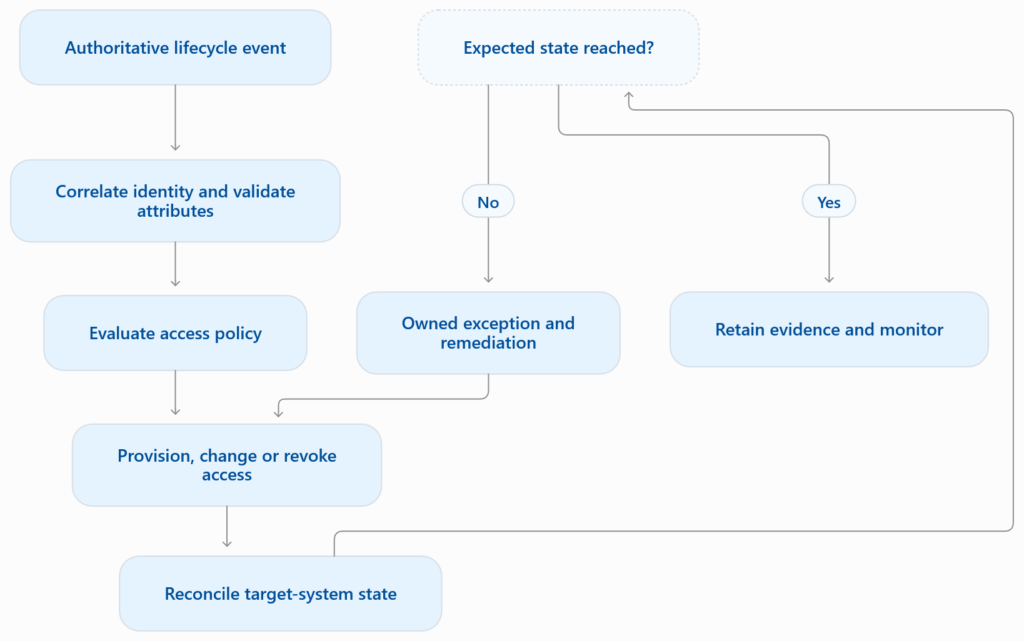
Reconcile intended and actual access. Compare approved assignments with target-system state, including nested groups and inherited roles. A connector’s success message is not sufficient proof of effective revocation.
Lifecycle Automation: Verify the Final State

Design Joiner, Mover and Leaver Workflows Separately
Onboarding needs validated inputs. Confirm the identity, engagement status, start conditions and approved role before provisioning. Quarantine ambiguous records rather than creating access and investigating afterward.
Transfers are not just additions. A mover workflow should remove obsolete permissions as well as grant new ones. Otherwise, employees accumulate access from every previous responsibility.
Termination requires a coordinated sequence. Address directory access, applications, active sessions, refresh tokens, devices, certificates, API keys and privileged assignments according to the environment. Some credentials must be rotated rather than simply deleted.
Handle Rehires and Guests Deliberately
A returning person may not need their old access. Re-establish current authorization and ownership instead of automatically restoring every historical entitlement. Preserve records needed for accountability without confusing old permissions with new approval.
External access needs an end condition. Assign a sponsor, purpose and expiry or review trigger. Partner identity signals can help, but the resource owner still needs a process for withdrawing access.
Engineer for Partial Failure
Lifecycle workflows cross unreliable boundaries. APIs time out, connectors lose authorization and applications apply changes asynchronously. Use bounded retries, idempotent operations where supported and reconciliation against the intended result.
Define secure failure behavior. Failed termination should create urgent, owned escalation and alternative containment. Failed onboarding should not silently bypass approval to meet a service target.
Protocols: Choose and Validate the Correct Mechanism
| Standard | Main function | Typical application | Implementation risk |
| SAML 2.0 | Federated authentication assertions | Enterprise browser SSO | Incorrect signature, audience, recipient or certificate handling |
| OpenID Connect | Authentication and identity claims | Modern web and mobile applications | Incorrect issuer, audience, signature, state or nonce handling |
| OAuth 2.0 | Delegated authorization | API access | Token misuse, insecure redirects or excessive scopes |
| SCIM 2.0 | Cross-domain identity provisioning | Account and group lifecycle | Partial deprovisioning or mismatched target state |
| WebAuthn | Scoped public-key authentication | Passkeys and security keys | Weak enrollment, recovery or relying-party validation |
OAuth is not an authentication protocol by itself. OpenID Connect adds an identity layer over OAuth 2.0. Applications must validate the appropriate tokens and claims rather than treating any access token as proof of the user’s identity. openid.net
Follow current OAuth security practice. RFC 9700, published in January 2025, updates the threat model and deprecates insecure patterns. Apply appropriate authorization-code and PKCE protections, strict redirect handling and secure token management for the client and flow involved. rfc-editor.org
SCIM standardizes provisioning, not the complete business process. Its HTTP-based protocol supports cross-domain identity management. Approval, entitlement meaning, connector coverage and operational verification remain deployment responsibilities. rfc-editor.org
Integration acceptance rule: Demonstrate the denied action in the target application after revocation. Do not stop at an upstream “disabled” status.
Passwordless Authentication Deployment and Recovery
Verify What Makes the Method Resistant to Phishing
Passwordless is a description, not an assurance level. Evaluate the protocol, authenticator, origin binding, enrollment and fallback. Removing a password does not automatically produce phishing resistance.
WebAuthn provides scoped public-key credentials. Correct relying-party validation and authenticator operation can protect against credential phishing and replay. W3C published WebAuthn Level 3 as a Recommendation on 25 August 2026. Level 3
Local biometrics and server-side biometric processing are different. A fingerprint or face check may unlock an authenticator without sending the biometric template to the application. Assess the actual architecture before making privacy or assurance claims.
Plan the Authenticator Lifecycle
| Stage | Questions to resolve |
| Enrollment | How is registration authorized and an attacker prevented from adding a factor? |
| Daily use | Which devices, browsers and applications are supported? |
| Additional authenticator | How is it approved, recorded and protected? |
| Device loss | How is access restored and the missing credential addressed? |
| Recovery | What evidence is required, and who can override the process? |
| Departure | What happens to credentials, sessions and organization-managed devices? |
Synced and device-bound credentials need different analysis. Consider assurance needs, platform dependencies, recovery and credential synchronization. Choose the method according to the resource and transaction rather than deploying one pattern universally.
Test the Weakest Recovery Route
Attackers can bypass a strong primary method through support. Help-desk resets, fallback factors, session theft and recovery-account compromise all deserve testing. Training support staff is necessary, but the workflow should also limit unauthorized overrides.
Avoid universal prevention percentages. Outcome depends on factor type, enrollment, session protection, policy coverage and recovery. NIST’s authentication guidance distinguishes assurance requirements rather than treating every second factor as equivalent. pages.nist.gov
Permissions, Governance and Privileged Access
Make Authorization Policies Understandable
Role-based control works when roles retain meaning. Stable job functions can support repeatable assignments. Hundreds of exceptions embedded in one-off roles create a maintenance problem.
Attribute-based decisions depend on trustworthy attributes. Department, device posture, resource classification and other inputs need owners and freshness rules. Missing or contradictory context should trigger an explicitly designed outcome.
Relationship-based models require the same discipline. Ownership, membership and hierarchy can support collaboration, but inherited relationships need explainable decisions and tests. Version policies and verify both allowed and denied actions.
Make Access Reviews Actionable
Reviewers need business context. Explain what a permission permits, why it exists, when it was used and what removal could affect. A long list of opaque group names encourages blanket approval.
Prioritize consequential access. Privileged permissions, sensitive information and incompatible duty combinations deserve deeper review. Low-risk birthright access can follow a different review approach.
Use Privileged Access Management Solutions for Administrative Paths
Reduce standing privilege where feasible. Approved, time-bound elevation can limit exposure, provided emergency and operational requirements are addressed. Define what happens when the approval or elevation service is unavailable.
Vaulting is only one capability. Session brokering, credential rotation, command restrictions and monitoring may be relevant. Session recording also creates sensitive records, storage costs and access obligations.
Break-glass access needs independent viability. It must work during the failure it is intended to address. Protect credentials, alert on use, test access and review each invocation.
Workload Identities and Agent Delegation
Replace Unowned Secrets With Governed Credentials
Applications cannot follow workforce MFA workflows. Use machine-appropriate mechanisms such as managed identities, workload federation, certificates or short-lived tokens. Limit permissions, intended audience and lifetime.
Credential elimination requires dependency testing. A key that appears unused may support a monthly process or recovery procedure. Establish ownership and validate replacement before revoking it.
Keep the Human, Agent and Tool Distinct
An agent should not inherit unlimited authority from its sponsor. Record the initiating principal, agent identity, requested action and downstream authorization. Restrict delegation to the task and resource required.
Prompt injection is an authorization problem when tools can act. Retrieved content should not be able to expand privileges or approve its own action. Enforce policy at the tool or resource boundary, with additional approval for consequential operations.
Protect policy inputs from poisoning. Altered entitlement descriptions or source documents can mislead an AI-assisted reviewer. Preserve provenance, restrict changes and require accountable approval before recommendations change access.
Control Retries and Inference Costs
A repeated request can become a repeated action. An inference timeout may lead to another model call even though the first completed. Separate decision generation from execution, use action identifiers and prevent duplicate grants or transactions.
Budget for supervision. Model consumption, review, investigation and integration maintenance belong in the operating model. An agent’s output count is not evidence of useful automation.
Identity and Access Management Tools: Compare Deployment Fit

Enterprise Identity Management Software should be evaluated by layer. Workforce IAM, customer IAM, identity governance, PAM, device management and cloud-entitlement management overlap without becoming interchangeable. Define the missing capability before choosing a suite.
| Platform | Deployment context to evaluate | Supplier-described portfolio | Commercial and technical checks |
| Microsoft Entra | Workforce and cloud access, particularly in Microsoft environments | Identity, conditional access, governance and related products | Prerequisite licenses, tenant design, workload coverage and non-Microsoft integration |
| Okta Workforce Identity | Heterogeneous application environments | SSO, MFA, lifecycle, governance and privileged-access options | Package boundaries, connector behavior, recovery and add-ons |
| Ping Identity | Complex workforce, customer and hybrid requirements | Federation, identity orchestration and access capabilities | Architecture, deployment model, specialist support and scoped pricing |
| JumpCloud | Directory, device and access convergence | Cloud directory, SSO, MFA and device-management packages | Governance depth, privileged scenarios, integration coverage and operating scale |
These are supplier descriptions, not independent rankings or proof of suitability. Microsoft, Okta and JumpCloud publish pricing or package information; Ping provides workforce and customer package information alongside sales-led options. Obtain a current bill of materials for the actual scope. Microsoft Security
Calculate Total Cost of Ownership
Licenses are one part of the commitment. Include implementation, connector engineering, migration, authenticators, support, training, administration and retirement of old systems. Model recurring years separately from initial deployment.
Pricing meters can reverse the comparison. Workforce users, monthly active customers, privileged accounts, machine identities, connections and governance modules may be priced differently. Confirm definitions and growth assumptions in writing.
Open source still needs operations. Infrastructure, upgrades, patching, support and recovery require funding. Managed services shift work while leaving organizational responsibilities intact.
Twelve Procurement Gates
| Gate | Acceptance question |
| Population | Does the design cover the required human and workload identities? |
| Protocols | Do the difficult applications support the proposed integration? |
| Lifecycle | Can source events produce verified target-state changes? |
| Authentication | Do enrollment, daily use and recovery meet the risk requirement? |
| Authorization | Are local, inherited and contextual permissions controlled? |
| Governance | Can reviewers understand and act on access decisions? |
| Privilege | Are elevation, secrets and emergency routes governed? |
| Telemetry | Can relevant events be exported and investigated promptly? |
| Resilience | Can responders operate during an identity-provider outage? |
| Privacy | Are monitoring, retention and biometric practices justified? |
| Economics | Are all meters, services, renewals and transition costs visible? |
| Portability | Can identities, configuration and evidence be migrated usefully? |
Proof-of-concept rule: Include a legacy application, privileged access, a workload identity and a failure scenario. Easy SaaS integrations alone do not establish enterprise fit.
Deployment Risks and Performance Measures
Legacy Applications and Cloud Permissions
SSO completion can hide local bypasses. Test administrator accounts, fallback login, session expiry and deprovisioning. Gateways and vaulting can help legacy applications while adding their own availability dependencies.
Federated cloud access still needs entitlement review. Cloud-native roles and policies can remain excessive. Cloud infrastructure entitlement management can assist discovery, but removals need workload and recovery context.
Outages, Guests and Customer Access
Centralization creates concentration risk. An identity outage can block communications, incident tooling and production recovery simultaneously. Test DNS, certificates, time synchronization, network dependencies and emergency administration.
Customer platforms face product-scale constraints. Registration abuse, traffic spikes, accessibility, consent and recovery require different design from employee access. Fraud controls should be tested for legitimate-user exclusion as well as attacker detection.
Measure Verified Outcomes
| Measure | Definition | Interpretation caution |
| Termination completion | Leavers with verified removal across defined paths | State which systems and credentials are covered |
| Revocation latency | Time from authoritative event to effective denial | Include queue and target-application delays |
| Strong-authentication coverage | Protected targeted identities and access paths | Averages can conceal exposed administrators |
| Reconciliation accuracy | Agreement between intended and actual target state | Investigate duplicates and unexplained mismatches |
| Standing privilege | Persistent high-impact access | Define privilege consistently across platforms |
| Review quality | Justified approvals and verified removals | Removal volume alone is not success |
| Recovery assurance | In-scope routes tested against defined scenarios | Passing one route does not validate all fallbacks |
| Workload credential exposure | Age, scope, ownership and revocability | Age alone does not describe credential risk |
Coverage needs an honest denominator. Report known gaps and independently reconcile discoveries. A high success percentage across half the applications can mislead leadership.
Deployment Roadmap and Implementation Checklist
Use phases as readiness gates, not fixed promises. Legacy complexity, migration risk, staffing and assurance requirements determine timing. Preserve rollback and communication plans throughout.
| Phase | Main work | Evidence before expansion |
| Discover and stabilize | Inventory stores, privileges, credentials and recovery; define authority | Owned scope, stable identifiers and usable logs |
| Federate and strengthen | Integrate suitable applications and improve authentication | Tested enrollment, recovery and denied-access behavior |
| Automate lifecycle | Connect source events, provisioning and reconciliation | Joiner, mover, leaver and rehire results |
| Govern access | Improve reviews, elevation and workload credentials | Verified removals, exceptions and response measures |
| Operate and improve | Monitor drift, incidents, outages and cost | Periodic review and funded remediation |
Implementation review should confirm the following:
- Accountable executives, resource owners and policy owners are named.
- Identity populations, sources and stable keys are documented.
- Lifecycle events include contractors, guests, movers and rehires.
- Target-state reconciliation and exception handling operate.
- High-risk authentication, enrollment and recovery are tested.
- Local, inherited and non-human access remain visible.
- Emergency and privileged paths are monitored.
- Logs support investigation without unnecessary sensitive retention.
- Outage and rollback procedures have been exercised.
- Metrics expose residual access, failures and overdue decisions.
Economics: Separate Savings, Capacity and Risk Reduction
Establish the Baseline Before Automation
A defensible case starts with observed work. Measure provisioning delays, reset effort, review time, failed connectors and unused licenses. Record the systems and populations included.
Phantom savings usually omit exceptions. Automated provisioning can reduce routine effort while adding reconciliation, investigation and maintenance. Count net time after those activities.
Calculate Benefits Without Mixing Categories
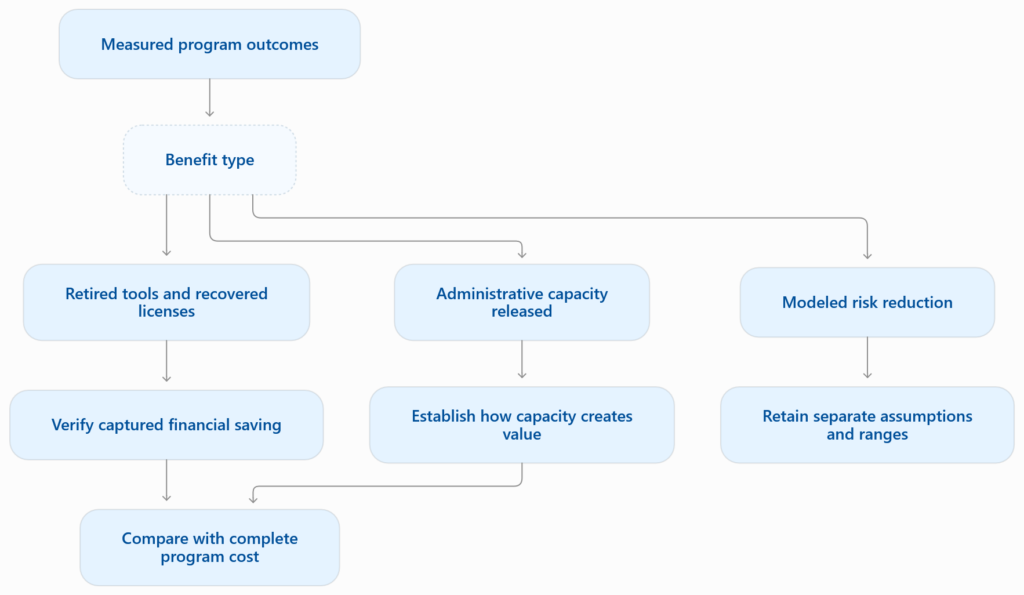
An inactive account does not prove license savings. Confirm that the license is removed and the billing commitment changes. Annual minimums or prepaid contracts may delay realization.
Risk reduction is modeled, not guaranteed. Document incident assumptions separately from captured financial benefits. Avoid adding speculative losses avoided to cash savings without explaining uncertainty.
Use consistent periods. Include migration and implementation in first-year cost, then calculate recurring operation separately. Do not count the same administration hours under reset, provisioning and access-review savings.
Report Exposure Rather Than Login Volume
Executives need unresolved decisions. Show terminated users with residual access, unowned credentials, standing privilege, failed reconciliation and untested recovery. Attach owners and remediation dates.
Consolidation has a trade-off. Fewer platforms may simplify administration while increasing outage concentration and exit costs. Include both effects in the business case.
Standards, Privacy and Regulatory Boundaries
Apply Technical Guidance Proportionately
Standards support design; they do not establish universal compliance. NIST digital-identity guidance informs assurance, SP 800-207 informs architecture and RFC 9700 informs OAuth deployment. Select the relevant requirements and preserve configuration evidence.
Maturity is not certification. CISA’s Zero Trust Maturity Model and NIST CSF can help organize improvement. They do not prove that every access path is secure or replace sector-specific obligations.
Distinguish Biometric Verification From Identification
The use case changes the legal analysis. EU AI Act materials distinguish one-to-one biometric verification from certain remote-identification and other biometric uses. Sole-purpose verification is excluded from the relevant Annex III remote-identification category; that does not remove privacy or other applicable duties. AI Act Service Desk
Monitoring also deserves review. Device, location and behavioral signals can affect privacy, accessibility and workforce expectations. Determine lawful processing, retention, transparency and any required impact assessment from the actual jurisdiction and activity.
Keep Exceptions Accountable

Security controls can deny legitimate access. False positives, unavailable devices and broken integrations require safe support paths. Exceptions should identify the owner, reason, compensating measures and review trigger.
Recovery must not become an invisible bypass. Review factor resets, privilege changes and emergency use alongside ordinary authentication. The easiest route into an account is part of its real security posture.
Closing Takeaway
Identity and Access Management succeeds when access is verified throughout its lifecycle. Strong login controls matter, but so do identity correlation, local permissions, workload credentials, recovery and effective revocation.
Choose tools through difficult operational tests. Start with critical access paths, define acceptance criteria and require evidence from target systems. The strongest platform decision is one the organization can operate, investigate and recover—not simply purchase.
Appendix A: Primary Sources and Reference Links
| Source | Use in this article |
| NIST SP 800-63 Revision 4 | Identity proofing, authentication and federation guidance |
| NIST Authentication Guidance | Authenticator and assurance considerations |
| NIST SP 800-207 | Zero trust architecture |
| NIST Cybersecurity Framework | Risk-management structure |
| W3C WebAuthn Level 3 | Public-key authentication and current Recommendation status |
| OpenID Connect Core | Authentication layer and identity claims |
| IETF RFC 9700 | OAuth security best current practice |
| IETF RFC 7644 | SCIM provisioning protocol |
| CISA Zero Trust Maturity Model | Maturity-planning reference |
| GDPR | Separate privacy applicability reference |
| EU AI Act Annex III | Biometric verification and identification distinction |
| Microsoft Entra pricing | Supplier portfolio and purchasing information |
| Okta pricing | Supplier portfolio and purchasing information |
| Ping Identity pricing | Workforce and customer packages |
| JumpCloud pricing | Supplier package information |
Appendix B: Editorial & Fact-Checking Disclosure
Research scope. Primary standards, government and supplier materials were checked for this revision on 29 October 2026. Standards-based guidance is distinguished from legal obligations and supplier descriptions.
Technical analysis. Architecture, procurement gates, metrics and rollout phases are analytical recommendations. Protocol support does not establish correct implementation; acceptance requires testing of the actual configuration and integrations.
Commercial limits. No hands-on comparative product testing is claimed. Costs depend on scope, meters, packaging, implementation and operations; neither savings nor security outcomes are guaranteed.
Publisher metadata. The disclosure below, including its statement about paid placement, is retained as supplied rather than independently verified. Author qualifications and the historical review date are also supplied metadata.
Editorial and Commercial Disclosure
AI-assisted tools were used to support research organization, drafting and language refinement. NezzHub retains editorial responsibility for the published article. Vendor inclusion does not constitute endorsement.
No vendor paid for placement. Vendor-owned pages support only attributed product and pricing descriptions, not independent security or performance conclusions.
The paper does not guarantee regulatory compliance, breach prevention, audit results, authentication availability, cost savings or vendor performance. Standards, laws, prices and capabilities can change.
Author and Editorial Review
Author: Garikapati Bullivenkaiah
Technology research writer with LL.B., LL.M., M.A., and MBA qualifications. He writes about emerging technologies and their business, governance and legal implications. His multidisciplinary academic background informs his analysis of technology adoption, intellectual property, and organizational risk. His articles explain technical concepts and practical considerations for business owners, IT managers and technology decision-makers. LinkedIn Profile
Reviewed by: Chitikineni Ramadevi — Editor
Chitikineni Ramadevi holds an M.Sc. in Computers from Andhra University and has over 10 years of research experience in technology-related subjects. She reviews NezzHub articles for clarity, factual accuracy, source support and practical relevance.
Published by: NezzHub
Research approach: This article draws on primary sources, technical documentation and relevant industry research. References are provided within the article or its sources section.
Published: 05-24-2026
Last reviewed: 10-29-2026
Corrections: To report a factual error or outdated information, please contact NezzHub.